Infographic of: Structure Follows Strategy
Management: Classical and Behavioural Foundations
Structure Follows Strategy
Alfred DuPont Chandler Jr. (1962)
When a company changes how it grows and competes, it must reorganize to manage the new work effectively.
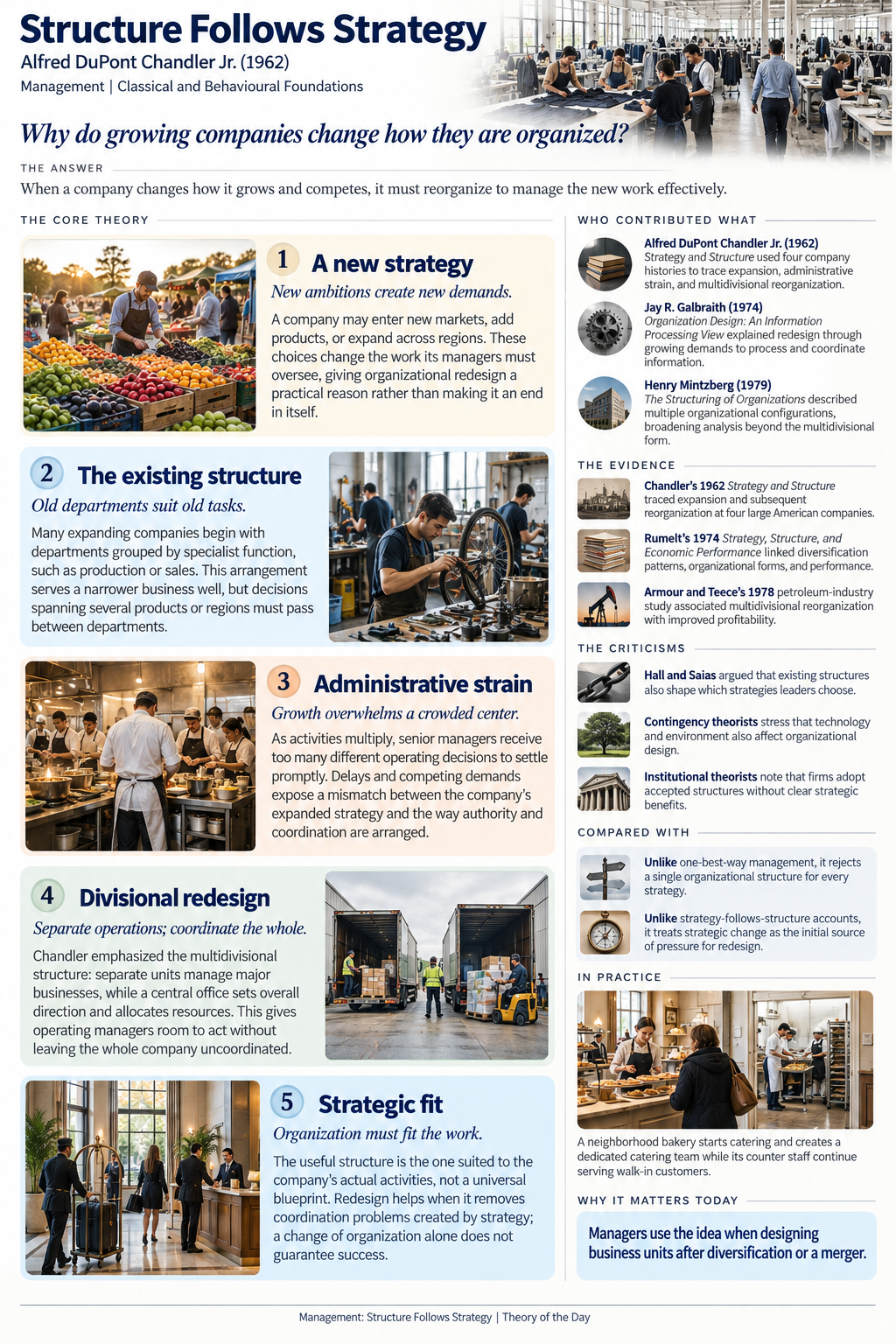
Structure Follows Strategy emerged from Alfred D. Chandler Jr.’s study of large American businesses in the first half of the twentieth century. Published in his 1962 book Strategy and Structure, the argument addressed a historical puzzle: why had some growing companies replaced centralized, function-based management with separate operating divisions? Chandler examined how companies expanded into new products and markets, and how their established ways of organizing became difficult to manage. His account was a historical explanation, not a rule that every company should adopt the same design.
The central claim is that major changes in strategy create new administrative demands, which eventually call for changes in structure. In a function-based organization, departments such as production and sales each handle a specialist task. That arrangement can become cumbersome when the company must run several distinct businesses or serve widely separated markets. Decisions accumulate at the top, and coordinating departments becomes harder. In the multidivisional response Chandler emphasized, division managers take responsibility for their businesses, while a central office oversees the company as a whole and allocates resources among divisions.
Chandler developed the original account by reconstructing decisions and reorganizations in four companies. Later scholars broadened the question rather than simply repeating his conclusion. In 1974, Jay R. Galbraith explained organizational design in terms of information processing: as work becomes more uncertain and interdependent, organizations need greater capacity to exchange and act on information. In 1979, Henry Mintzberg described several organizational configurations and their coordinating methods. His wider framework made clear that the multidivisional form is one possible arrangement, not the endpoint of every company’s growth.
Chandler’s principal evidence was comparative business history, especially DuPont, General Motors, Standard Oil of New Jersey, and Sears, Roebuck. Across these cases, he traced strategic expansion, mounting administrative problems, and subsequent changes in managerial arrangements. Richard Rumelt’s 1974 study examined relationships among diversification, structure, and economic performance in large companies. A 1978 petroleum-industry study by Henry O. Armour and Oliver E. Williamson’s collaborator David J. Teece associated adoption of multidivisional structure with improved profitability. These studies offer support for the importance of organizational fit, but they do not establish that one sequence occurs everywhere.
The direction of causation is the main point of dispute. David J. Hall and Maurice A. Saias argued in 1980 that structure also shapes strategy: existing reporting lines, expertise, and authority affect which opportunities leaders notice or pursue. Other contingency research shows that technology and the external environment matter alongside strategy. Institutional scholars add that organizations can adopt familiar structures because those structures appear legitimate, not because they solve a particular operating problem. Later thinking therefore tends to treat strategy and structure as mutually influential, with outcomes depending on context.
The theory remains useful because it asks managers to connect ambitions to the practical allocation of work and authority. A company entering several markets needs to ask who makes operating decisions, who coordinates across units, and how resources are assigned. Those questions arise in diversification, mergers, and the design of business units. Chandler’s lasting lesson is not that divisions are always best; it is that pursuing a new strategy while leaving persistent organizational bottlenecks untouched has consequences.
The argument in four steps
- Companies expand into new products or markets to pursue growth.
- Their existing departments face more varied decisions and coordination demands.
- Overloaded managers cannot direct every operation effectively from the center.
- Therefore, sustained strategic expansion requires a structure that divides operating responsibility and coordinates the whole.
How it works
- Leaders commit resources to additional products, markets, or locations, increasing the variety of daily decisions.
- Decision queues and strained coordination reveal where the existing arrangement obstructs the expanded business.
- Managers redistribute authority and establish links between units; the quality of that fit affects subsequent performance.
Who contributed what
- Alfred DuPont Chandler Jr. (1962): Strategy and Structure used four company histories to trace expansion, administrative strain, and multidivisional reorganization.
- Jay R. Galbraith (1974): Organization Design: An Information Processing View explained redesign through growing demands to process and coordinate information.
- Henry Mintzberg (1979): The Structuring of Organizations described multiple organizational configurations, broadening analysis beyond the multidivisional form.
Compared with rival views
- Unlike one-best-way management, it rejects a single organizational structure for every strategy.
- Unlike strategy-follows-structure accounts, it treats strategic change as the initial source of pressure for redesign.
Further reading
- Alfred D. Chandler Jr., Strategy and Structure: Chapters in the History of the Industrial Enterprise (1962)
- Henry Mintzberg, The Structuring of Organizations (1979)
- David J. Hall and Maurice A. Saias, Strategy Follows Structure! (1980)