Infographic of: The Forgetting Curve and Spaced Repetition
Education: Memory, Study and How Learning Sticks
The Forgetting Curve and Spaced Repetition
Hermann Ebbinghaus (1885)
Memory weakens after learning, but revisiting material across separate sessions improves long-term retention.
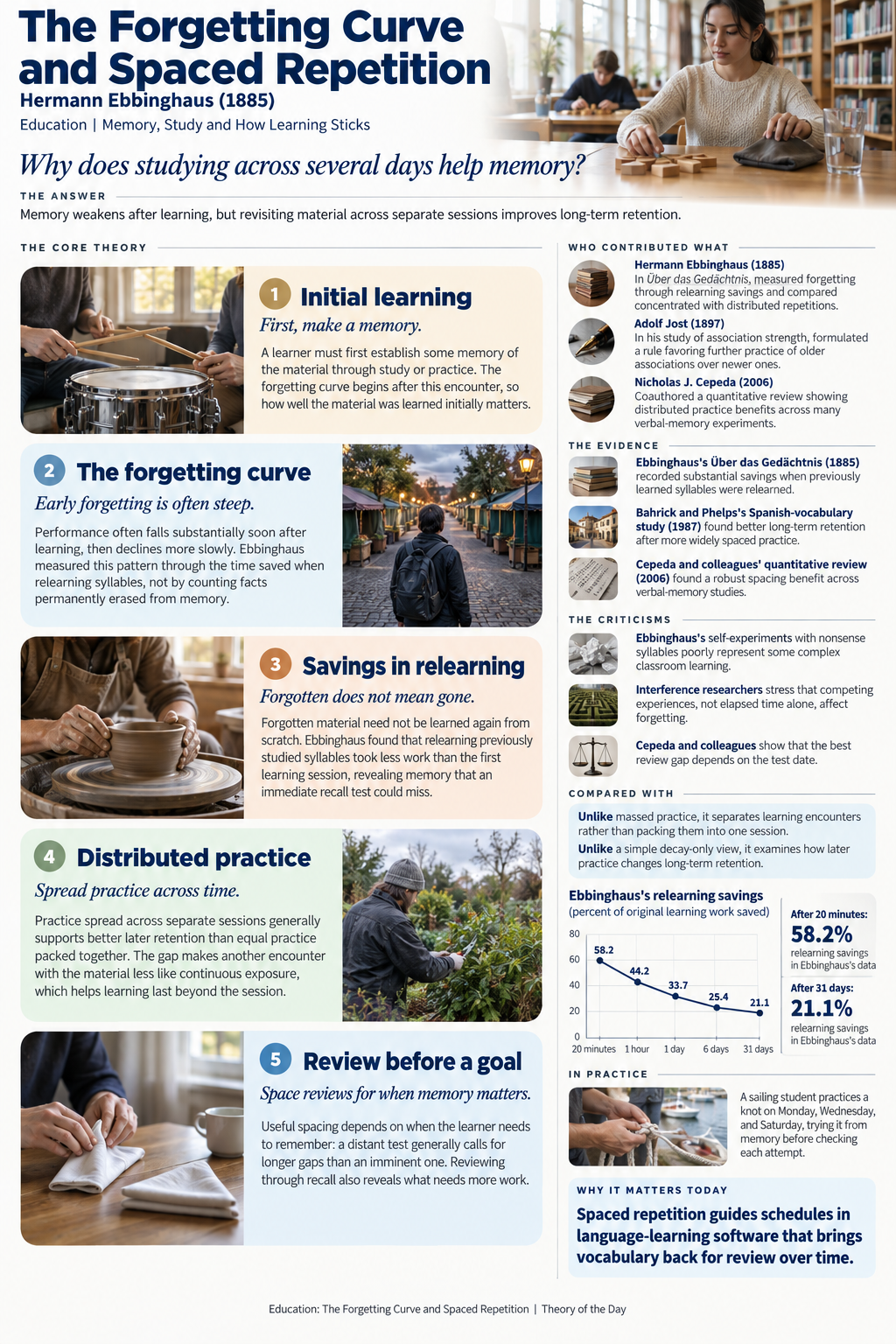
In 1885, German psychologist Hermann Ebbinghaus published an experimental study of memory that included what became known as the forgetting curve. He wanted to measure learning and forgetting rather than rely on impressions of what people remembered. Acting as his own participant, he learned lists of largely meaningless syllables and returned to them after various delays. He timed how much work relearning required compared with learning them the first time. He also investigated whether repetitions spread over time differed from repetitions crowded together.
His results suggested that memory performance often drops sharply soon after learning and then declines more slowly. Crucially, the curve measured savings in relearning, not the percentage of facts a person still knows: material he could not readily produce could nevertheless take less time to relearn. Spaced repetition builds on a related finding. When encounters with material are separated, later practice renews learning after some forgetting has occurred. For lasting memory, this generally works better than spending the same practice time in one uninterrupted bout.
Ebbinghaus supplied the early measurements and a comparison of distributed and concentrated repetition. In 1897, Adolf Jost investigated how the age of an association affects further practice and formulated a rule favoring the strengthening of older associations under particular conditions. Much later, Nicholas J. Cepeda and colleagues drew together a large body of experimental work. Their 2006 quantitative review established that the benefit of distributed practice extends well beyond Ebbinghaus's self-experiments; subsequent work examined how the best interval changes with the intended retention period.
The historical forgetting data are memorable: in Ebbinghaus's measurements, relearning after 20 minutes saved 58.2 percent of the original work, while relearning after 31 days still saved 21.1 percent. These are results from his particular materials and method, not universal percentages of knowledge retained. Other studies tested practical implications. Harry P. Bahrick and Elizabeth Phelps reported in 1987 that more widely spaced practice improved long-term retention of Spanish vocabulary. Cepeda and colleagues' 2006 review found a reliable spacing advantage across many verbal-memory experiments.
There are important limits. Ebbinghaus studied himself with syllables designed to minimize familiar meaning, so his precise curve cannot simply be applied to a history course, a skilled procedure, or every learner. Forgetting is not explained by time passing alone: competing experiences and conditions at retrieval also matter. Nor is there one ideal review schedule. Studies of spacing find that a useful gap depends partly on when knowledge must be recalled. Retrieving an answer during review is beneficial too, but retrieval practice and spacing are related, distinct ideas.
Today, teachers and learners use spaced review to plan several encounters with important material instead of relying on a single intensive session. A student might first learn a concept, try to recall it a few days later, and revisit it again before a later assessment. Language-learning software applies the same broad principle when scheduling vocabulary reviews. The enduring lesson is not a fixed curve or a magic interval: how practice is distributed across time affects what learners retain when they need it.
The argument in four steps
- After a single learning session, access to newly learned material declines with time.
- A later encounter requires the learner to recover or relearn what has weakened.
- Repeating that encounter on separate days distributes practice across time.
- So spaced practice produces better long-term retention than the same practice crowded into one session.
How it works
- A learner studies something well enough to recognize or recall it soon afterward.
- Between sessions, access becomes less reliable; the next attempt demands renewed work rather than uninterrupted repetition.
- The interval before review, the quality of recall, and the eventual test date shape how well learning lasts.
Who contributed what
- Hermann Ebbinghaus (1885): In Über das Gedächtnis, measured forgetting through relearning savings and compared concentrated with distributed repetitions.
- Adolf Jost (1897): In his study of association strength, formulated a rule favoring further practice of older associations over newer ones.
- Nicholas J. Cepeda (2006): Coauthored a quantitative review showing distributed practice benefits across many verbal-memory experiments.
Compared with rival views
- Unlike massed practice, it separates learning encounters rather than packing them into one session.
- Unlike a simple decay-only view, it examines how later practice changes long-term retention.
Further reading
- Hermann Ebbinghaus, Über das Gedächtnis: Untersuchungen zur experimentellen Psychologie (1885)
- Nicholas J. Cepeda et al., Distributed Practice in Verbal Recall Tasks: A Review and Quantitative Synthesis (2006)
- John Dunlosky et al., Improving Students’ Learning With Effective Learning Techniques: Promising Directions From Cognitive and Educational Psychology (2013)