Infographic of: How to Win Friends and Influence People
Positivity: Classic Positive Thinking
How to Win Friends and Influence People
Dale Carnegie (1936)
Genuine interest, attentive listening, and respectful persuasion build goodwill and help people cooperate.
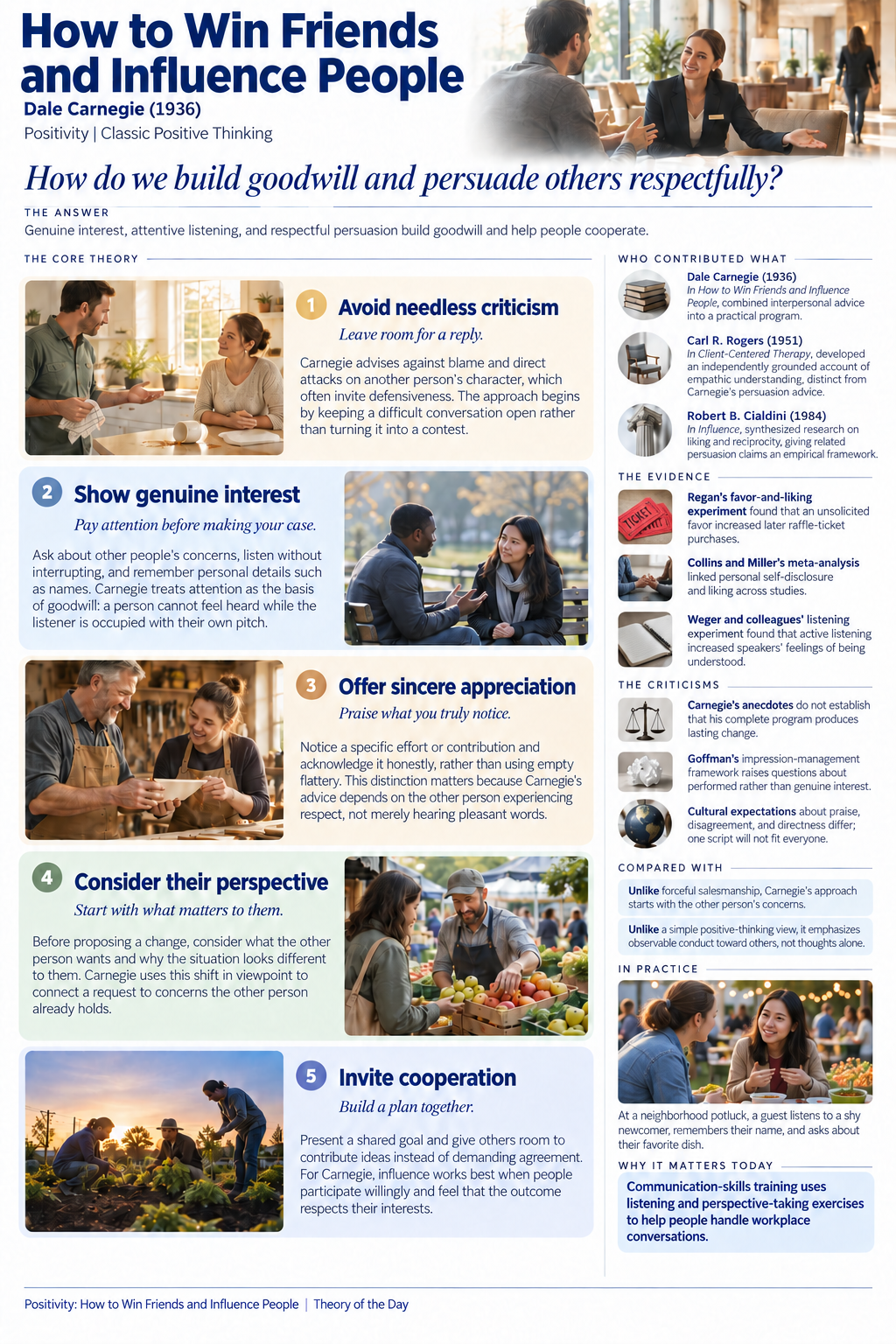
Dale Carnegie published How to Win Friends and Influence People in 1936, drawing on his experience teaching public speaking and dealing with people. It appeared in a growing American market for adult education and practical self-improvement. Carnegie was addressing an everyday problem: how to make a favorable impression, work through disagreements, and persuade without provoking resistance. The book is a popular guide, not a scientific theory developed through controlled research. Its many stories illustrate advice that readers could try in ordinary social and professional encounters.
Carnegie's starting point is that people want to be treated as significant and respond badly to needless criticism. He recommends showing genuine interest, listening carefully, remembering names, and giving honest appreciation rather than flattery. To persuade, he advises considering what the other person wants, acknowledging mistakes, and inviting cooperation instead of demanding submission. In his account, these practices reduce defensiveness and build goodwill. That goodwill makes it easier to discuss a request or disagreement in terms the other person finds meaningful.
Carnegie alone developed the book's program. Later scholars did not jointly create it, but their work helps place particular parts of it in context. In Client-Centered Therapy (1951), psychologist Carl R. Rogers developed a separate account of empathic understanding in therapeutic relationships; it gives listening a more systematic role than Carnegie's practical advice does. In Influence (1984), psychologist Robert B. Cialdini brought together research on persuasion, including liking and reciprocity. His research-based account examines some processes resembling those Carnegie discussed, without validating every recommendation in Carnegie's book.
Research supports some narrower claims. Dennis Regan's 1971 experiment found that receiving an unsolicited favor increased people's later purchases of raffle tickets, illustrating reciprocity rather than testing Carnegie's whole method. Nancy Collins and Lynn Miller's 1994 review found an association between personal self-disclosure and liking. Harry Weger and colleagues reported in 2014 that active listening helped speakers feel understood in an initial interaction. These studies concern particular behaviors or responses; none shows that following all of Carnegie's advice reliably wins friends or changes minds.
The book's evidence is largely anecdotal, and its memorable successes tell little about occasions when the same approach fails. Sociologist Erving Goffman's work on self-presentation also suggests a tension: a display of interest can be strategically performed, even when it appears sincere. What counts as considerate praise, tact, or appropriate disagreement varies across relationships and cultures. Listening well does not erase conflicts of interest, power differences, or a justified reason to refuse a request. Later research therefore sharpens and qualifies individual recommendations rather than confirming the package as a universal formula.
The book still matters because it offers a usable vocabulary for small choices that shape conversations: pause before criticizing, ask a question, attend to the answer, and acknowledge a real contribution. Such habits appear in communication-skills training and discussions of workplace relationships. Carnegie's enduring contribution is to make respectful attention central to practical persuasion. The sound way to teach the book is as influential advice with some research-supported elements, not as a proven method for securing friendship or agreement.
The argument in four steps
- People respond poorly when they feel criticized, ignored, or pushed.
- Interest and attentive listening help people feel recognized and understood.
- Sincere appreciation and attention to their concerns make disagreement less threatening.
- So respectful exchanges build goodwill and support cooperative persuasion.
How it works
- Someone begins by listening for the other person's concerns before making a request.
- Criticism or insincere praise interrupts trust; honest attention and specific appreciation keep the exchange open.
- The response depends on whether the proposal addresses concerns the other person recognizes as their own.
Who contributed what
- Dale Carnegie (1936): In How to Win Friends and Influence People, combined interpersonal advice into a practical program.
- Carl R. Rogers (1951): In Client-Centered Therapy, developed an independently grounded account of empathic understanding, distinct from Carnegie's persuasion advice.
- Robert B. Cialdini (1984): In Influence, synthesized research on liking and reciprocity, giving related persuasion claims an empirical framework.
Compared with rival views
- Unlike forceful salesmanship, Carnegie's approach starts with the other person's concerns.
- Unlike a simple positive-thinking view, it emphasizes observable conduct toward others, not thoughts alone.
Further reading
- Dale Carnegie, How to Win Friends and Influence People (1936)
- Erving Goffman, The Presentation of Self in Everyday Life (1959)
- Robert B. Cialdini, Influence: The Psychology of Persuasion (1984)