Infographic of: Entitlement Theory of Justice (Libertarianism)
Politics: Political Philosophy
Entitlement Theory of Justice (Libertarianism)
Robert Nozick (1974)
People are entitled to holdings they acquired justly or received through voluntary transfer, subject to correcting past wrongs.
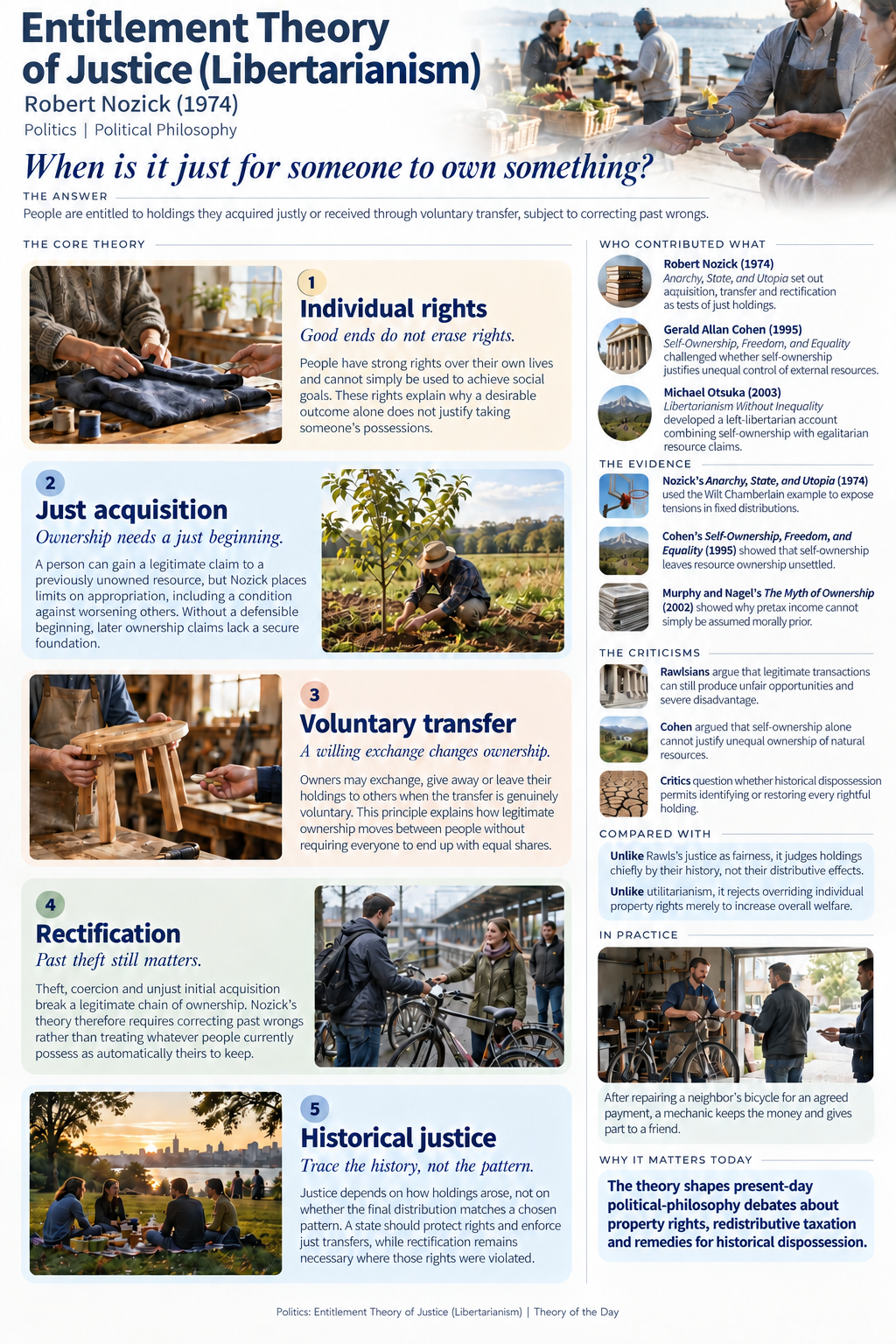
Robert Nozick set out entitlement theory in his 1974 book Anarchy, State, and Utopia. Writing amid debates about equality, welfare and the proper reach of government, he offered an alternative to theories that assess justice by the shape of a society's final distribution. His most prominent interlocutor was John Rawls, whose 1971 account gave institutions a role in improving the position of the least advantaged. Nozick asked instead whether each person's particular holdings had come into their hands by legitimate means.
The theory has three principles: justice in acquisition, justice in transfer and rectification of injustice. Acquiring a previously unowned resource must satisfy appropriate conditions; Nozick adapted a Lockean proviso against making others worse off through appropriation. Once someone holds something legitimately, they may exchange it, give it away or leave it to another person. Theft and coercion do not create legitimate title, and earlier wrongs call for correction. Justice is therefore historical: knowing that two people have unequal wealth does not, by itself, tell us whether either has been wronged.
Nozick connected this account of property to strong individual rights and a defense of a minimal state concerned chiefly with protection and enforcement. His famous hypothetical involving a basketball player, Wilt Chamberlain, asks readers to imagine people willingly paying to watch him play. Even if everyone begins with a favored distribution, their payments upset it; preserving that pattern would require interfering with choices. Later philosophers developed the debate in different directions. Gerald Allan Cohen questioned whether rights over oneself establish rights over unequal shares of the external world. Michael Otsuka developed a left-libertarian view that combines self-ownership with more egalitarian claims to natural resources.
Entitlement theory is a work of moral and political philosophy, not an empirically confirmed law of behavior. The Chamberlain case tests the implications of voluntary exchange; it does not establish that actual fortunes have just histories. Cohen's Self-Ownership, Freedom, and Equality examined the gap between owning oneself and owning resources. Liam Murphy and Thomas Nagel's The Myth of Ownership challenged the assumption that pretax income is a morally fixed possession independent of the tax system. Such works offer arguments and counterarguments rather than experimental measurements of justice.
Critics contend that formally voluntary exchanges can occur against backgrounds of unequal power and opportunity. Rawlsian critics ask whether a society should accept severe disadvantage simply because each immediate transaction followed the rules. Others point to conquest, slavery, land seizure and exclusion: tracing legitimate title through such histories is difficult, and rectification could require extensive redistribution. Nozick acknowledged rectification as a necessary part of the theory but did not provide a complete method for resolving these historical claims. His acquisition proviso and account of taxation also remain heavily disputed.
The theory still matters because it asks a question that aggregate measures of inequality cannot answer: who has a justified claim to what, and why? It frames current arguments over property rights, taxation and compensation for historical dispossession. Its force lies in insisting that individual rights and the history of ownership matter; its difficulty lies in establishing just starting points and dealing fairly with the enduring effects of unjust ones.
The argument in four steps
- Individuals have rights that others, including governments, must respect.
- Appropriating an unowned resource creates a claim only under acceptable conditions.
- Voluntary transfers pass legitimate claims between people; theft and coercion do not.
- Therefore, holdings arising through just acquisition and transfer are just, provided past injustices are corrected.
How it works
- First, trace a present holding back through earlier owners to its initial acquisition.
- Then examine whether consent was genuine and whether appropriation harmed others or earlier owners suffered injustice.
- Finally, correct defective claims and leave legitimate holdings under their owners' control.
Who contributed what
- Robert Nozick (1974): Anarchy, State, and Utopia set out acquisition, transfer and rectification as tests of just holdings.
- Gerald Allan Cohen (1995): Self-Ownership, Freedom, and Equality challenged whether self-ownership justifies unequal control of external resources.
- Michael Otsuka (2003): Libertarianism Without Inequality developed a left-libertarian account combining self-ownership with egalitarian resource claims.
Compared with rival views
- Unlike Rawls's justice as fairness, it judges holdings chiefly by their history, not their distributive effects.
- Unlike utilitarianism, it rejects overriding individual property rights merely to increase overall welfare.
Further reading
- Robert Nozick, Anarchy, State, and Utopia (1974)
- G. A. Cohen, Self-Ownership, Freedom, and Equality (1995)
- Michael Otsuka, Libertarianism Without Inequality (2003)