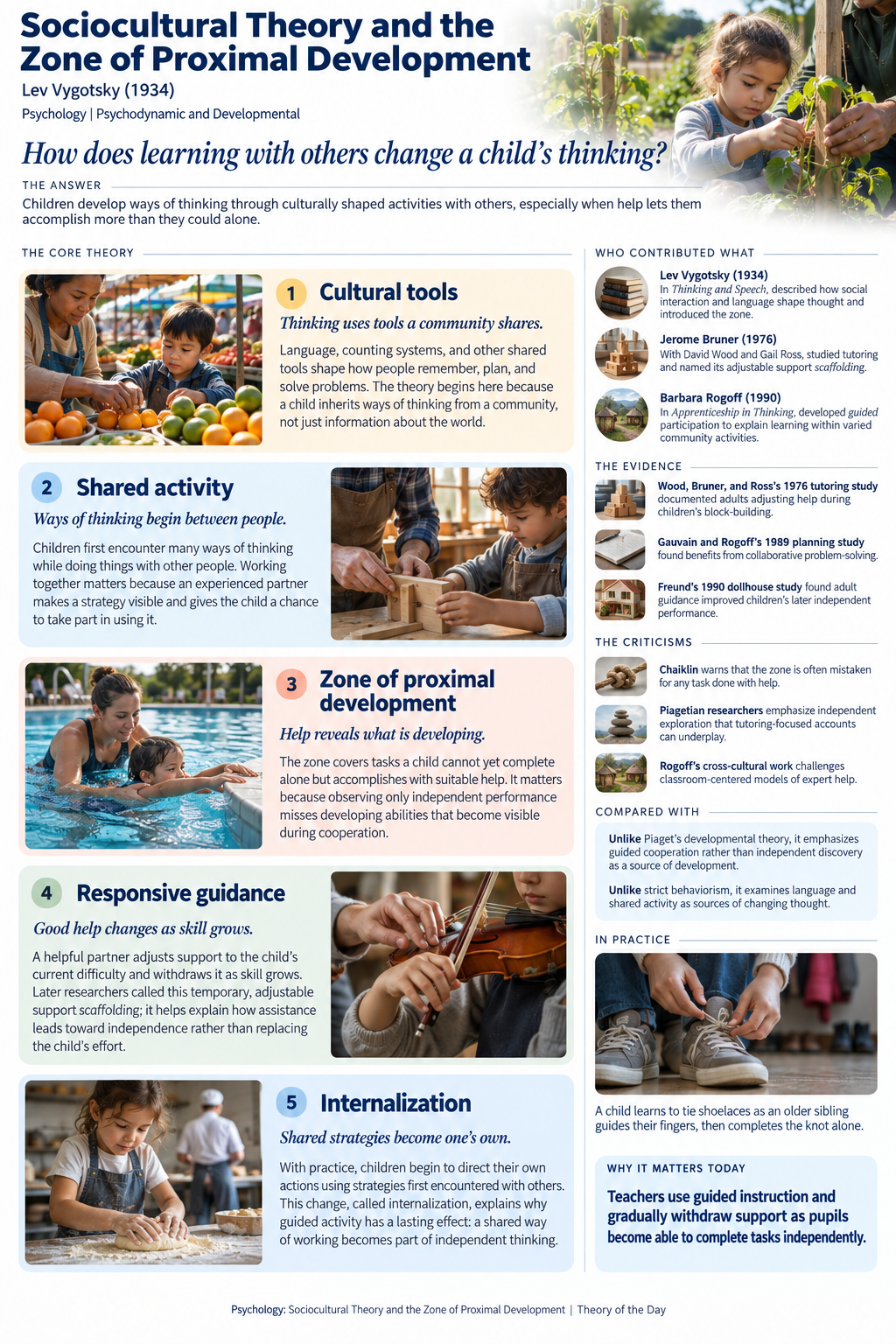
Infographic of: Sociocultural Theory and the Zone of Proximal Development
Psychology: Psychodynamic and Developmental
Sociocultural Theory and the Zone of Proximal Development
Lev Vygotsky (1934)
Children develop ways of thinking through culturally shaped activities with others, especially when help lets them accomplish more than they could alone.
Lev Vygotsky developed his account of learning and development in the Soviet Union in the early twentieth century. He wanted to explain how children acquire distinctively human ways of thinking, including deliberate attention, planning, and reasoning. Rather than treating development as a process unfolding chiefly inside the individual, he examined how children participate in activities organized by other people. His account of the zone of proximal development appeared in Thinking and Speech, published in 1934, the year of his death. What is now called sociocultural theory draws on this work and other writings by Vygotsky.
For Vygotsky, children learn to use cultural tools: shared resources such as language and counting systems that help people organize thought and action. Children encounter these tools in activities with more experienced partners. The zone of proximal development describes the difference between what a child accomplishes independently and what the child accomplishes with suitable guidance or collaboration. It is not a fixed measure of intelligence. It directs attention to abilities still developing, which an independent test can miss. As children participate and practice, ways of working first shared with others become available for independent use, a process Vygotsky called internalization.
Vygotsky supplied the central account of socially mediated development and the zone. Later scholars extended it in different directions. In a 1976 study of tutoring, David Wood, Jerome Bruner, and Gail Ross described how adults adjusted assistance while children attempted a construction task. They called such temporary support scaffolding; the term was not Vygotsky's. Barbara Rogoff's 1990 account of guided participation broadened attention beyond one adult teaching one child. She examined how children learn through taking part in the everyday activities of their communities, with forms of guidance that vary across settings.
Research illustrates parts of this account rather than proving every claim of the theory. Wood, Bruner, and Ross observed tutors changing their help as children worked on a block-building problem. Mary Gauvain and Barbara Rogoff's 1989 research connected collaborative problem-solving with children's planning skills. Lisa Freund's 1990 dollhouse study found that children who received adult guidance performed better on a later independent task than children left to discover a solution without that guidance. Together, such studies support the importance of interaction and appropriately adjusted assistance, while leaving open questions about how broadly their findings apply.
The theory also has limits. A child who succeeds with help will not necessarily succeed later without it: the kind of help, the task, and opportunities to practice all matter. Seth Chaiklin has argued that the zone is often oversimplified as any task completed with assistance, rather than understood within Vygotsky's account of developing abilities. Piagetian perspectives place greater weight on what children discover through their own activity. Cross-cultural research, including Rogoff's, also shows that learning need not resemble formal adult-led tutoring; children may learn by observing and joining community work.
The lasting value of the theory is its shift in what educators and psychologists look for. A child's unaided answer shows current independent performance, but working together can reveal how the child approaches a challenge with support. In teaching, this encourages instructors to offer help that fits the difficulty and to withdraw it as pupils gain control. More broadly, it asks researchers to study thinking in the relationships and cultural activities through which it develops, without assuming that one style of instruction suits every child or community.
The argument in four steps
- Every community uses language and other shared tools to organize activities and solve problems.
- Children encounter these tools while taking part in activities with more experienced people.
- Guidance lets children perform tasks beyond what they accomplish independently.
- Therefore, participating in guided activity transforms how children think and what they do alone.
How it works
- A child joins a familiar activity and notices how an experienced partner uses words, gestures, or tools.
- The partner offers just enough help for a task beyond the child's independent reach, adjusting when the child struggles.
- Repeated participation and fading support determine whether the child uses the strategy independently.
Who contributed what
- Lev Vygotsky (1934): In Thinking and Speech, described how social interaction and language shape thought and introduced the zone.
- Jerome Bruner (1976): With David Wood and Gail Ross, studied tutoring and named its adjustable support scaffolding.
- Barbara Rogoff (1990): In Apprenticeship in Thinking, developed guided participation to explain learning within varied community activities.
Compared with rival views
- Unlike Piaget's developmental theory, it emphasizes guided cooperation rather than independent discovery as a source of development.
- Unlike strict behaviorism, it examines language and shared activity as sources of changing thought.
Further reading
- Lev Vygotsky, Thinking and Speech (1934)
- James V. Wertsch, Vygotsky and the Social Formation of Mind (1985)
- Barbara Rogoff, Apprenticeship in Thinking: Cognitive Development in Social Context (1990)