Infographic of: Structuralism and Binary Oppositions
Anthropology: Foundations and Schools of Thought
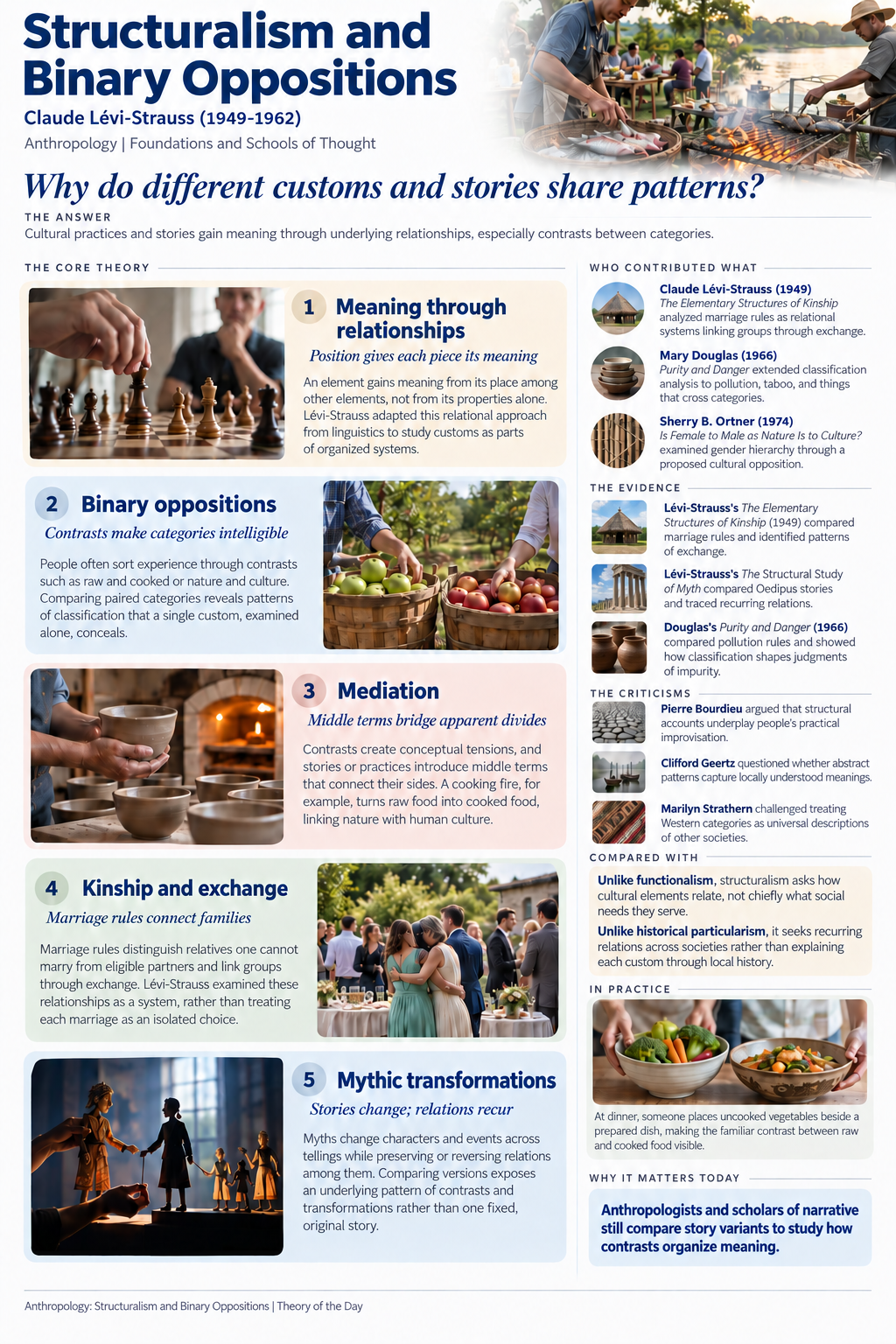
Structuralism and Binary Oppositions
Claude Lévi-Strauss (1949-1962)
Cultural practices and stories gain meaning through underlying relationships, especially contrasts between categories.
Structuralism in anthropology is associated above all with Claude Lévi-Strauss. Working in the mid-twentieth century, he drew on structural linguistics, which studies how elements gain significance through their relations to other elements. He asked whether kinship rules, classifications, and myths could be studied in a similar way. His 1949 book The Elementary Structures of Kinship was an early statement of this approach; later work developed it for other parts of cultural life. Rather than explaining a custom only by its history or practical function, he looked for the relations that made it intelligible.
A binary opposition is a contrast between categories, such as raw and cooked. In Lévi-Strauss's account, a category does not carry its full meaning in isolation: its place in a system of differences matters. Such systems also include middle terms, substitutions, and reversals. Cooking, for instance, connects raw food with food altered by human activity. An anthropologist therefore compares related practices or different versions of a story to see which relationships persist as particular details change. The proposed structure is an interpretation of those relationships, not a claim that everyone consciously follows a hidden rulebook.
Lévi-Strauss applied this approach to marriage rules, arguing that rules about eligible partners could be understood through relations between groups, including exchange. In his 1955 essay The Structural Study of Myth, he compared versions of the Oedipus story by examining relationships among events rather than seeking one original telling. Mary Douglas extended attention to classification in Purity and Danger (1966), especially to dirt, pollution, and things that do not fit established categories. Sherry B. Ortner's 1974 essay used the proposed nature–culture opposition to examine gender hierarchy, helping open a feminist debate rather than settling it.
The classic materials are comparative interpretations, not laboratory tests. Lévi-Strauss assembled kinship rules from ethnographic accounts and used their differences to identify forms of exchange. His analysis of Oedipus stories showed how a myth could be read through recurring and reversed relationships across tellings. Douglas compared beliefs and practices surrounding purity to show why a substance or action might be objectionable in one context but not another. These works demonstrate the reach of relational analysis, but their examples alone do not prove that every society shares the same categories or mental structures.
Critics have challenged both the method and its breadth. Pierre Bourdieu argued that a focus on rules and structures can miss how people improvise in practice. Clifford Geertz favored close attention to meanings understood in particular settings over highly abstract comparisons. Feminist and later anthropological work questioned whether oppositions such as nature and culture, or male and female, can be treated as universal or consistently paired. Structural analyses also risk overlooking historical change and inequalities when they reduce complicated practices to a neat set of contrasts. Later scholars often retained comparison and classification while making more room for context, agency, and contested meanings.
The approach still matters because it offers a disciplined question: what changes, and what stays relationally similar, when people tell a story differently or sort the world into categories? Researchers studying myths, narratives, food, or kinship can use that question without accepting every universal claim Lévi-Strauss made. Its most durable lesson is that an apparently self-contained symbol or custom may be easier to understand when examined alongside what it contrasts with, connects to, or transforms.
The argument in four steps
- Human beings classify experience through relationships, not just isolated properties.
- Many classifications arrange categories in contrasts, such as raw and cooked.
- Marriage rules and myths connect and rearrange these categories through exchanges, reversals, and middle terms.
- So recurring relations organize meaning across otherwise different customs and stories.
How it works
- People recognize a figure as a relative, stranger, or spouse through its position among others.
- Rules and stories shift those positions through exchanges, substitutions, and reversals.
- The resulting pattern of permitted and forbidden relations shapes how an act or story is understood.
Who contributed what
- Claude Lévi-Strauss (1949): The Elementary Structures of Kinship analyzed marriage rules as relational systems linking groups through exchange.
- Mary Douglas (1966): Purity and Danger extended classification analysis to pollution, taboo, and things that cross categories.
- Sherry B. Ortner (1974): Is Female to Male as Nature Is to Culture? examined gender hierarchy through a proposed cultural opposition.
Compared with rival views
- Unlike functionalism, structuralism asks how cultural elements relate, not chiefly what social needs they serve.
- Unlike historical particularism, it seeks recurring relations across societies rather than explaining each custom through local history.
Further reading
- Claude Lévi-Strauss, Structural Anthropology (1958)
- Edmund Leach, Lévi-Strauss (1970)
- Sherry B. Ortner, Is Female to Male as Nature Is to Culture? (1974)