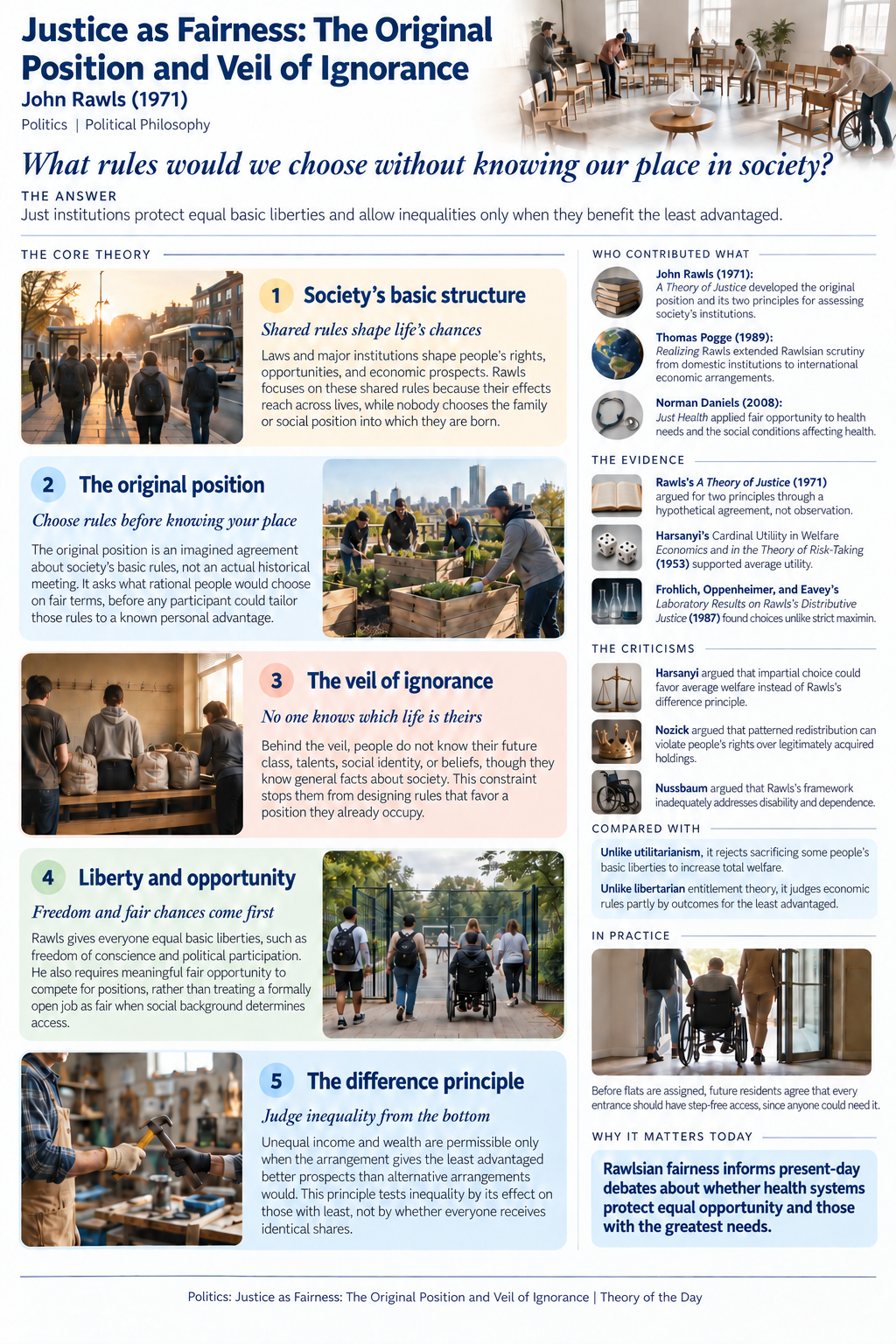
Infographic of: Justice as Fairness: The Original Position and Veil of Ignorance
Politics: Political Philosophy
Justice as Fairness: The Original Position and Veil of Ignorance
John Rawls (1971)
Just institutions protect equal basic liberties and allow inequalities only when they benefit the least advantaged.
John Rawls developed justice as fairness amid twentieth-century debates about democracy, inequality, and utilitarianism. His fullest initial statement appeared in A Theory of Justice in 1971. Rawls asked how society's major institutions should distribute rights, opportunities, and economic advantages. He objected to judging those institutions solely by the total happiness they produce: a larger total need not make it fair to deny some people liberty or leave them with very poor prospects. His project was a way to identify fair principles for a society whose members disagree about the good life.
Rawls's central device is the original position, an imagined choice of principles for society's basic structure. Its participants stand behind a veil of ignorance: they do not know their class, talents, social identity, or conception of the good, although they know general facts about human societies. They therefore cannot write rules to favor their known position. Rawls argued that they would choose equal basic liberties for all, fair equality of opportunity, and the difference principle. The last permits social and economic inequalities only when they give the least advantaged better prospects than alternative arrangements would. Basic liberties have priority over economic gains.
Rawls developed this account; the original position is his philosophical thought experiment, not a survey of actual voters. Later scholars carried its concerns into new fields. In Realizing Rawls (1989), Thomas Pogge examined whether principles of institutional justice should also apply to international economic arrangements, challenging a narrowly domestic focus. In Just Health (2008), Norman Daniels connected Rawls's fair equality of opportunity to health needs and the social conditions that affect them. These applications build on Rawls rather than supplying additional founders of the original position.
The theory's principal support is philosophical argument, not a famous quantitative finding. Rawls's 1971 book tests whether the proposed principles follow from a deliberately fair choice situation. Its assumptions remain open to challenge: John Harsanyi's 1953 argument about decisions under equal chances supports maximizing average utility under different assumptions about choice. Laboratory research also probes, but cannot settle, the question. In a 1987 study, Norman Frohlich, Joe Oppenheimer, and Cheryl Eavey found that groups making distributive choices did not generally choose Rawls's strict priority for the worst-off.
Critics dispute both the choice device and its conclusions. Harsanyi questioned why uncertainty should lead people to give the least advantaged the priority Rawls proposed. Robert Nozick argued that redistribution aimed at a preferred pattern can conflict with rights over legitimately acquired property. Martha Nussbaum later argued that contract-based accounts centered on cooperating parties inadequately address people with disabilities and other relationships of dependence. Rawls revised and clarified aspects of his wider account in later work, including Political Liberalism (1993), while retaining the original position as a way to represent fairness.
Justice as fairness still matters because it turns a familiar concern—would this rule be fair if I occupied another position?—into a demanding test of public institutions. It asks not merely whether opportunities are formally open, but whether people from different backgrounds have a fair chance to use them. It also directs attention to how inequalities affect those with least. Contemporary debates over health care, education, taxation, and global economic rules draw on these questions, even when participants reject Rawls's answers. The veil of ignorance remains a tool for examining whose interests a proposed rule protects.
The argument in four steps
- Society's institutions shape opportunities, but no one earns the circumstances of their birth.
- Fair rules must be chosen without knowing one's future position, talents, or social advantages.
- Under that restriction, rational parties secure equal basic liberties and fair access to positions.
- So just institutions permit economic inequalities only when they best improve the least advantaged's prospects.
How it works
- Participants compare possible rules for liberties, jobs, income, and wealth without knowing their own eventual circumstances.
- Their need for resources shapes the choice, while ignorance of personal circumstances blocks bargaining for special advantages.
- They assess arrangements by protected liberties, fair access to positions, and the prospects of the least advantaged.
Who contributed what
- John Rawls (1971): A Theory of Justice developed the original position and its two principles for assessing society's institutions.
- Thomas Pogge (1989): Realizing Rawls extended Rawlsian scrutiny from domestic institutions to international economic arrangements.
- Norman Daniels (2008): Just Health applied fair opportunity to health needs and the social conditions affecting health.
Compared with rival views
- Unlike utilitarianism, it rejects sacrificing some people's basic liberties to increase total welfare.
- Unlike libertarian entitlement theory, it judges economic rules partly by outcomes for the least advantaged.
Further reading
- John Rawls, A Theory of Justice (1971)
- Robert Nozick, Anarchy, State, and Utopia (1974)
- Samuel Freeman, Rawls (2007)