Infographic of: The Science of Getting Rich
Positivity: Classic Positive Thinking
The Science of Getting Rich
Wallace D. Wattles (1910)
Clear belief, gratitude, and purposeful action align a person with a creative force that brings wealth.
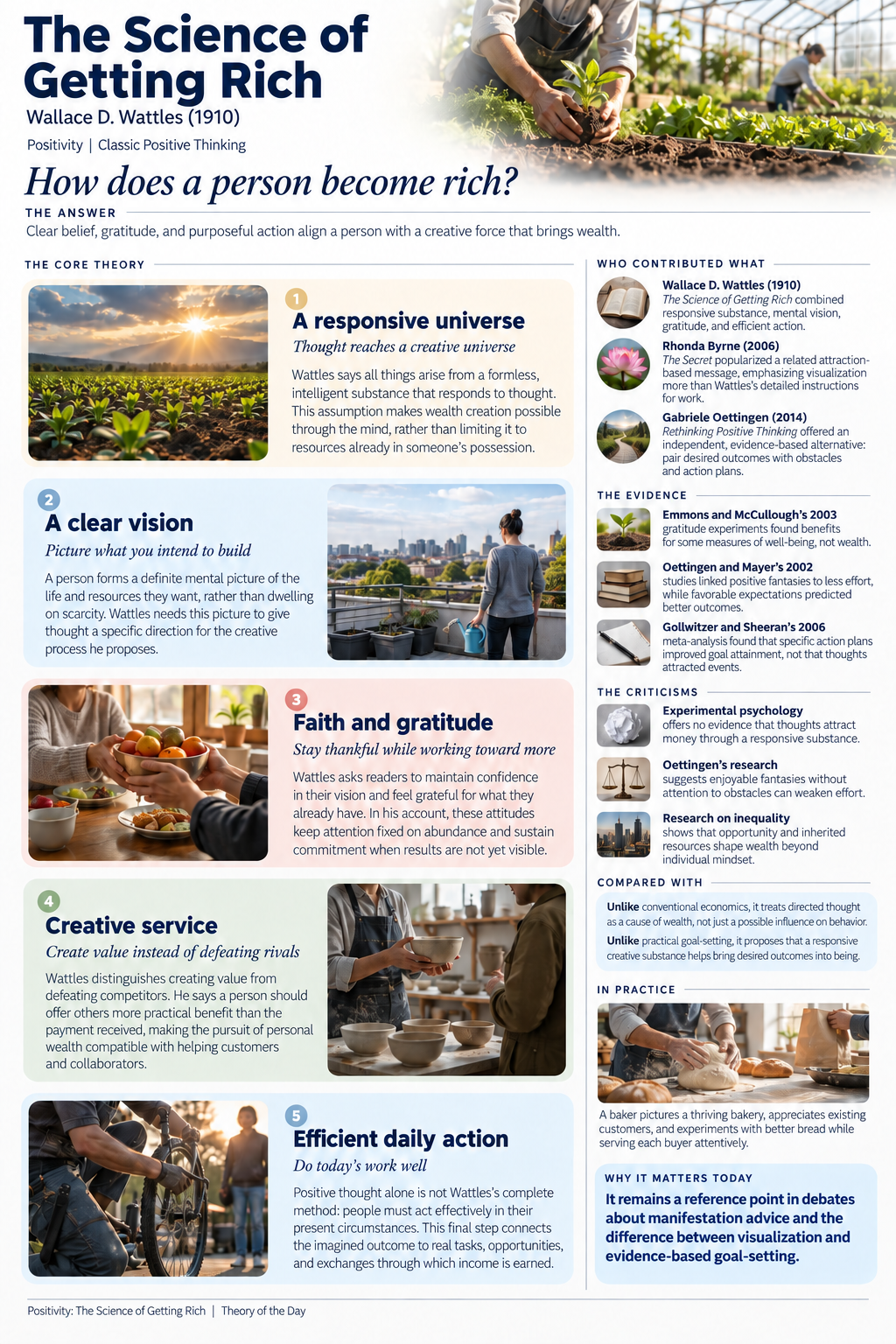
Wallace D. Wattles published The Science of Getting Rich in 1910, amid the American New Thought movement’s interest in the power of mind and belief. He wrote for readers seeking a practical route out of limited means. Despite its title, the book was not an experimental study of how wealth is acquired. It offered a spiritual and practical method, presenting riches as something a person could pursue without taking prosperity away from others.
Wattles’s starting claim is that a formless, intelligent substance underlies everything and responds to thought. A person should form a clear picture of what they want, hold it with faith, and feel gratitude before the desired result appears. Wattles called this thinking and acting in a “certain way.” Crucially, his method also requires effective work in one’s current circumstances. He urges readers to create value for others rather than concentrate on beating competitors. In his account, focused thought initiates a creative process, while daily action provides its practical route to wealth.
Wattles developed and published the original account himself. Decades later, Rhonda Byrne said his book helped inspire The Secret, published in 2006. Byrne’s widely read presentation brought related ideas about attracting desired outcomes to a new audience, though it placed greater emphasis on visualization than Wattles’s instructions for efficient work and service. Psychologist Gabriele Oettingen did not extend Wattles’s metaphysical theory. Her 2014 book Rethinking Positive Thinking instead offered a research-based alternative: imagine a desired future, identify the obstacles in the present, and make plans for overcoming them.
Research supports parts of the ordinary behavior described by Wattles, but not his proposed creative substance. In experiments published in 2003, Robert Emmons and Michael McCullough found that gratitude exercises improved some measures of well-being. Research by Oettingen and Doris Mayer in 2002 distinguished favorable expectations, which were associated with greater effort and success, from pleasant fantasies, which could be associated with less effort. Peter Gollwitzer and Paschal Sheeran’s 2006 review found that specifying when and how to act improves goal attainment. None of these findings shows that thoughts attract money or change external events without a causal route through behavior.
The principal scientific objection is therefore to Wattles’s asserted mechanism, not to every recommendation in the book. No established evidence shows that an intelligent universal substance responds to someone’s financial wishes. Positive thinking can also backfire when imagining success replaces preparation. More broadly, research on social inequality makes it difficult to explain wealth primarily through mindset: family resources, access to education, discrimination, and economic conditions matter. Modern psychological approaches retain useful practices such as gratitude and planning while testing their effects without relying on Wattles’s supernatural premise.
The book still matters because its blend of hope, visualization, and action helps explain the appeal of present-day manifestation advice. It also offers a useful distinction for readers: gratitude may improve well-being, and clear plans may help people act, but neither finding establishes a law by which believing in riches produces them. Taking Wattles seriously means understanding both his promise of creative abundance and the limits of the evidence for it.
The core theory
1. A responsive universe
Wattles says all things arise from a formless, intelligent substance that responds to thought. This assumption makes wealth creation possible through the mind, rather than limiting it to resources already in someone’s possession.
2. A clear vision
A person forms a definite mental picture of the life and resources they want, rather than dwelling on scarcity. Wattles needs this picture to give thought a specific direction for the creative process he proposes.
3. Faith and gratitude
Wattles asks readers to maintain confidence in their vision and feel grateful for what they already have. In his account, these attitudes keep attention fixed on abundance and sustain commitment when results are not yet visible.
4. Creative service
Wattles distinguishes creating value from defeating competitors. He says a person should offer others more practical benefit than the payment received, making the pursuit of personal wealth compatible with helping customers and collaborators.
5. Efficient daily action
Positive thought alone is not Wattles’s complete method: people must act effectively in their present circumstances. This final step connects the imagined outcome to real tasks, opportunities, and exchanges through which income is earned.
The argument in four steps
- An intelligent, formless substance fills the universe and responds to thought.
- A clear vision, held with faith and gratitude, impresses a desire on that substance.
- A person acts efficiently on present opportunities and gives others more value than they receive.
- Therefore, thinking and acting in this certain way brings that person riches.
How it works
- First, the person chooses a definite vision and repeatedly directs attention toward it with confidence and gratitude.
- They then work where they are, using present opportunities and offering value rather than fixating on competitors.
- In Wattles’s account, sustained thought and effective action determine whether the envisioned wealth arrives.
Who contributed what
- Wallace D. Wattles (1910): The Science of Getting Rich combined responsive substance, mental vision, gratitude, and efficient action.
- Rhonda Byrne (2006): The Secret popularized a related attraction-based message, emphasizing visualization more than Wattles’s detailed instructions for work.
- Gabriele Oettingen (2014): Rethinking Positive Thinking offered an independent, evidence-based alternative: pair desired outcomes with obstacles and action plans.
Compared with rival views
- Unlike conventional economics, it treats directed thought as a cause of wealth, not just a possible influence on behavior.
- Unlike practical goal-setting, it proposes that a responsive creative substance helps bring desired outcomes into being.
Further reading
- Wallace D. Wattles, The Science of Getting Rich (1910)
- Rhonda Byrne, The Secret (2006)
- Gabriele Oettingen, Rethinking Positive Thinking: Inside the New Science of Motivation (2014)