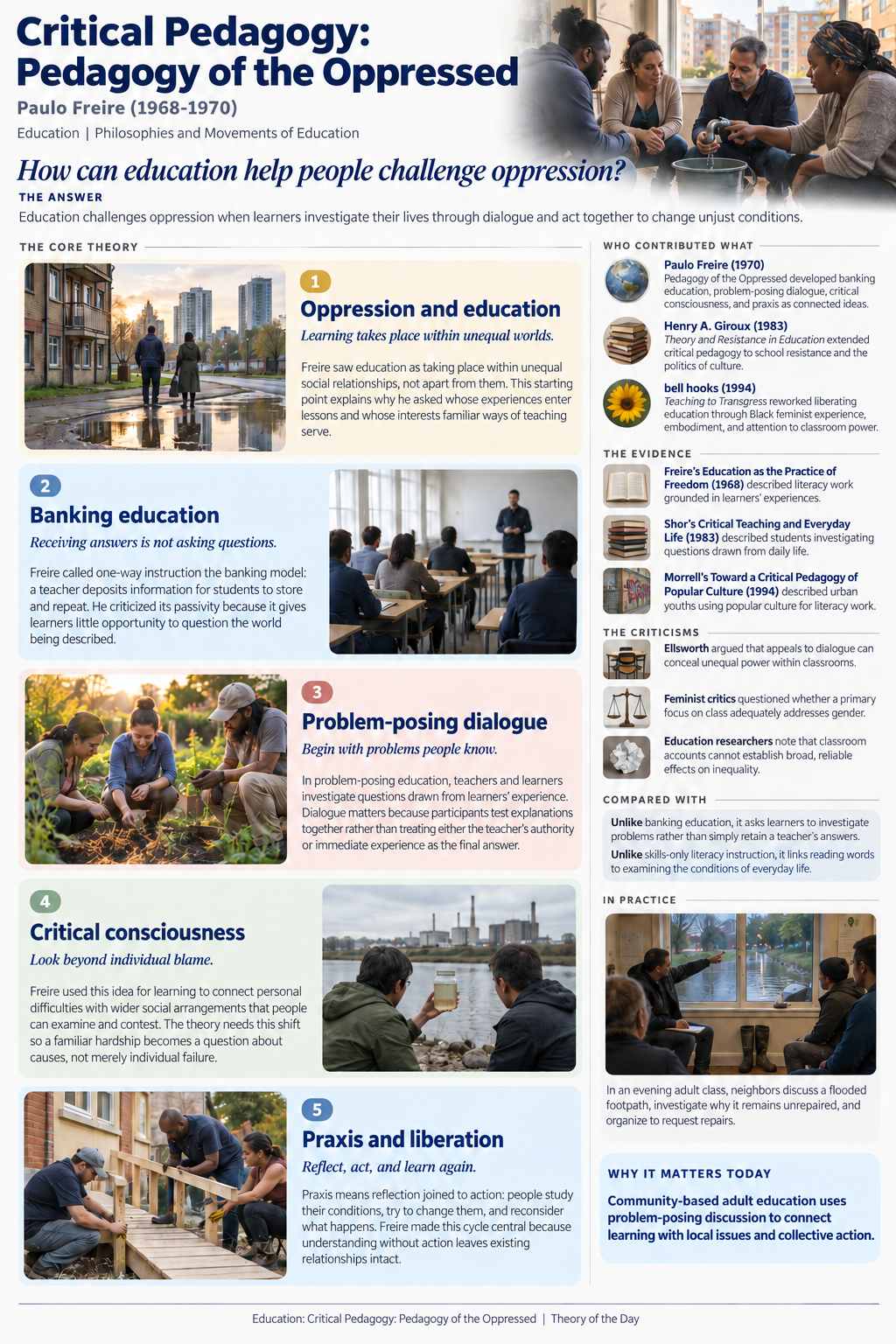
Infographic of: Critical Pedagogy: Pedagogy of the Oppressed
Education: Philosophies and Movements of Education
Critical Pedagogy: Pedagogy of the Oppressed
Paulo Freire (1968-1970)
Education challenges oppression when learners investigate their lives through dialogue and act together to change unjust conditions.
Paulo Freire developed the ideas associated with Pedagogy of the Oppressed through adult literacy work in Brazil and reflection on poverty, political exclusion, and authoritarian rule. He wrote the book in 1968, during exile after Brazil’s 1964 military coup; its English edition appeared in 1970. Freire wanted to understand why teaching people to read was not enough if education also taught them to accept unequal conditions as natural. His answer made education a question of power as well as knowledge.
Freire criticized what he called the banking model of education, in which teachers treat students as containers for information. In his alternative, problem-posing education, teachers and learners investigate situations that matter in learners’ lives. Dialogue helps participants move beyond describing a difficulty to asking what social relationships produce it. Freire called the development of this questioning awareness critical consciousness. Its purpose was praxis: reflection joined to action, followed by further reflection. He did not mean that teachers possess no expertise, but that their authority should support inquiry rather than silence it.
Freire supplied the theory’s central concepts and its connection between literacy, dialogue, and liberation. Later scholars developed critical pedagogy in other settings. In Theory and Resistance in Education (1983), Henry A. Giroux examined schools as places where dominant ideas are reproduced but also resisted; he gave greater attention to culture and institutions. In Teaching to Transgress (1994), bell hooks drew on Black feminist experience to explore race, gender, the body, and the teacher’s own position in an engaged classroom. These contributions extended rather than simply repeated Freire’s account.
The literature offers illustrations of the approach, but less decisive evidence for its largest claims. Freire’s Education as the Practice of Freedom (1967) described literacy teaching connected to adults’ experiences. Ira Shor’s Critical Teaching and Everyday Life (1980) gave an account of classroom inquiry based on familiar social questions. Ernest Morrell’s Toward a Critical Pedagogy of Popular Culture (2002) described work that used urban youths’ cultural interests to support literacy. Such accounts show how educators have put the approach into practice; they do not establish that it reliably reduces oppression across settings.
Critics have challenged both the theory’s assumptions and its classroom practice. Elizabeth Ellsworth argued that calls for empowering dialogue can hide differences in authority and leave some students less able to speak than others. Feminist scholars have pressed critical pedagogy to address gender and race alongside class. Others note that open discussion does not replace the need for careful teaching of subject knowledge, or solve the difficulty of evaluating long-term social change. Later work has responded by examining identity, teacher power, and the limits of particular educational settings more closely.
The theory still matters because it asks educators to consider who sets questions, whose knowledge is taken seriously, and what learning is for. In community-based adult education, a group might study a local flooding problem while developing reading, discussion, and organizing skills. Freire’s enduring contribution is not a guarantee that dialogue produces liberation. It is a framework for connecting learning about the world with collective efforts to change it.
The core theory
1. Oppression and education
Freire saw education as taking place within unequal social relationships, not apart from them. This starting point explains why he asked whose experiences enter lessons and whose interests familiar ways of teaching serve.
2. Banking education
Freire called one-way instruction the banking model: a teacher deposits information for students to store and repeat. He criticized its passivity because it gives learners little opportunity to question the world being described.
3. Problem-posing dialogue
In problem-posing education, teachers and learners investigate questions drawn from learners’ experience. Dialogue matters because participants test explanations together rather than treating either the teacher’s authority or immediate experience as the final answer.
4. Critical consciousness
Freire used this idea for learning to connect personal difficulties with wider social arrangements that people can examine and contest. The theory needs this shift so a familiar hardship becomes a question about causes, not merely individual failure.
5. Praxis and liberation
Praxis means reflection joined to action: people study their conditions, try to change them, and reconsider what happens. Freire made this cycle central because understanding without action leaves existing relationships intact.
The argument in four steps
- Social hierarchies shape whose knowledge counts in education.
- One-way teaching treats learners as receivers and leaves those hierarchies unquestioned.
- Dialogue about lived problems helps learners recognize the social forces shaping their circumstances.
- Therefore, learning joined to collective action challenges oppression rather than reproducing it.
How it works
- Learners bring a problem from daily life into a shared inquiry with the teacher.
- Questions and dialogue connect immediate experience to possible social causes; teacher domination or unexamined assumptions obstruct that inquiry.
- Participants act on what they learn, then judge their understanding against what their action reveals.
Who contributed what
- Paulo Freire (1970): Pedagogy of the Oppressed developed banking education, problem-posing dialogue, critical consciousness, and praxis as connected ideas.
- Henry A. Giroux (1983): Theory and Resistance in Education extended critical pedagogy to school resistance and the politics of culture.
- bell hooks (1994): Teaching to Transgress reworked liberating education through Black feminist experience, embodiment, and attention to classroom power.
Compared with rival views
- Unlike banking education, it asks learners to investigate problems rather than simply retain a teacher’s answers.
- Unlike skills-only literacy instruction, it links reading words to examining the conditions of everyday life.
Further reading
- Paulo Freire, Pedagogy of the Oppressed (1970)
- Henry A. Giroux, Theory and Resistance in Education (1983)
- bell hooks, Teaching to Transgress (1994)