Infographic of: The Protestant Ethic and the Spirit of Capitalism
Sociology: Classical Foundations
The Protestant Ethic and the Spirit of Capitalism
Max Weber (1904–1905)
Certain Protestant beliefs encouraged disciplined work and restrained spending, helping a distinctively capitalist way of life take hold.
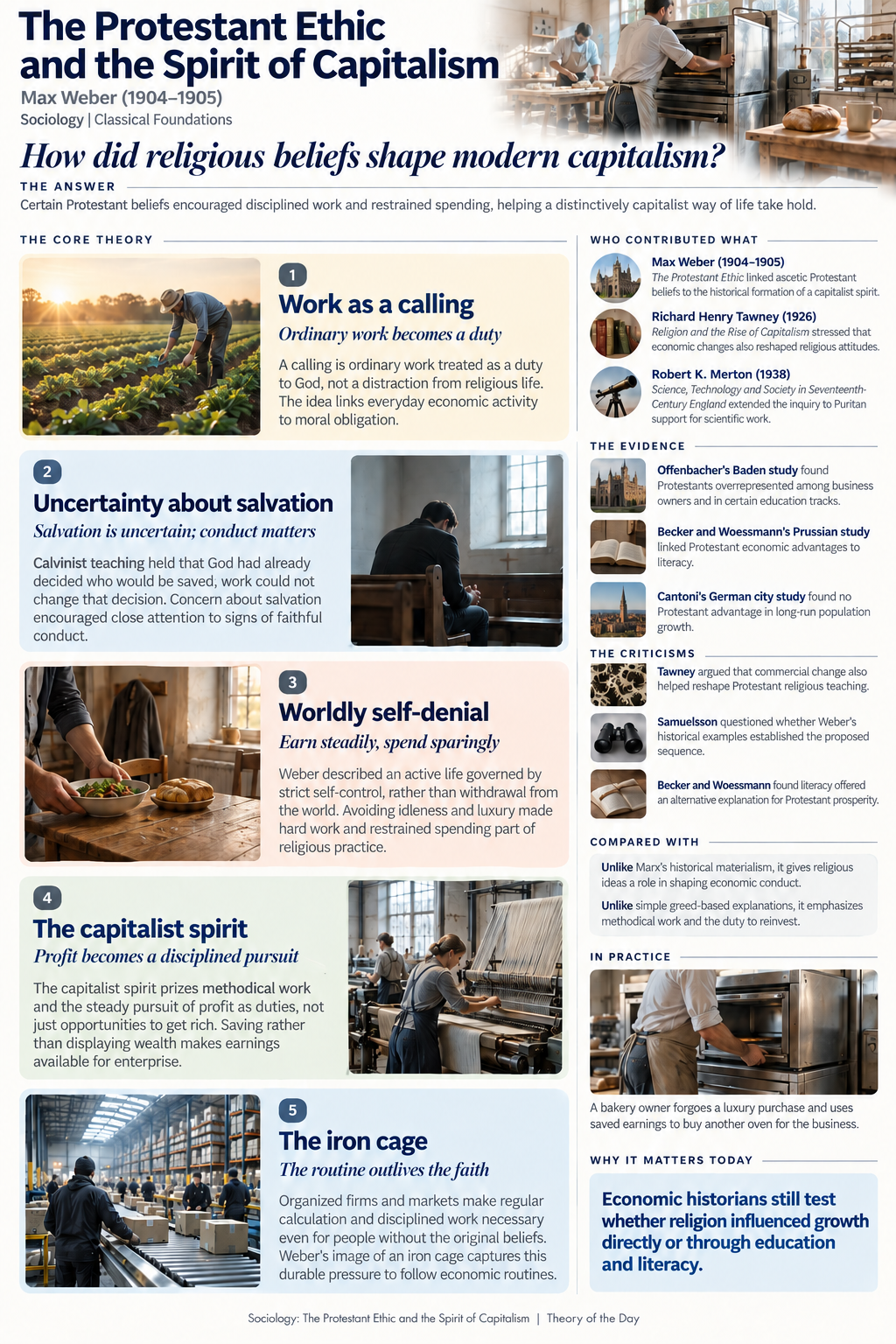
Max Weber published The Protestant Ethic and the Spirit of Capitalism as two essays in 1904 and 1905, when sociologists were asking how modern Western capitalism had developed. Capitalism and the pursuit of wealth existed long before the Protestant Reformation, so Weber was not claiming that Protestants invented either one. He wanted to explain the emergence of a particular way of approaching work: the steady, rational pursuit of profit as a responsibility rather than an occasional opportunity.
Weber focused especially on forms of Protestantism that encouraged believers to live with strict discipline while remaining active in ordinary occupations. Calvinist teaching held that God had already decided who would be saved; hard work could not change that decision. Weber proposed that uncertainty about salvation encouraged believers to scrutinize their lives for signs of faithful conduct. Treating one's occupation as a calling made sustained effort meaningful, while avoiding luxury limited personal consumption. Together, these habits favored saving and reinvestment. Once established, organized capitalist enterprises could demand similar discipline without requiring the beliefs that had helped foster it.
Weber supplied the central argument and examined religious teachings alongside historical patterns of economic activity. Richard Henry Tawney later argued, in Religion and the Rise of Capitalism, that the relationship also ran the other way: changing commerce influenced religious thought. Robert K. Merton extended a related question beyond business in his 1938 study of seventeenth-century England, asking how Puritan values supported practical scientific work. Merton's extension concerns science, not a second origin for Weber's theory, and its historical interpretation has also been debated.
Weber drew partly on Martin Offenbacher's 1901 study of Baden, which reported Protestant overrepresentation among business owners and in some educational tracks. Such patterns made the question worth investigating but could not, by themselves, show that belief caused prosperity. Later research tested possible mechanisms more directly. Sascha O. Becker and Ludger Woessmann's 2009 study of Prussia found that education and literacy could account for Protestant economic advantages. Davide Cantoni's 2015 study found no long-run Protestant advantage in population growth among German cities, challenging a broad growth claim.
Critics have questioned both Weber's chronology and how far his selected religious writings reflected believers' behavior. Tawney emphasized commercial developments that preceded or accompanied changes in religious teaching; Kurt Samuelsson challenged Weber's use of historical evidence. Literacy offers another possible route from Protestantism to economic outcomes, because encouragement to read scripture could increase schooling without relying on disciplined saving. These objections do not show that religious ideas never shaped economic conduct. They do limit any claim that one religious ethic explains capitalism everywhere.
The theory remains important because it asks how beliefs and institutions affect one another over time. Weber's point was not simply that industrious people become rich. It was that a moral understanding of work could help establish habits that later appear to be ordinary economic necessities. Economic historians continue to investigate that possibility by comparing places with different religious histories and testing alternatives such as schooling. In sociology, the work also remains a model of explaining a large historical change without reducing it to either ideas or material conditions alone.
The argument in four steps
- Calvinists believed God had already decided who would be saved.
- Uncertainty about salvation encouraged believers to work diligently in a calling and examine their conduct.
- Religious self-restraint discouraged luxury, leaving earnings available for saving and reinvestment.
- Therefore, religious discipline helped establish a capitalist way of life that outlasted its religious origins.
How it works
- Religious teaching brings a sense of duty into trades and decisions about how to use each day.
- Personal conscience reinforces steady effort, while the appeal of comfort and status pulls against restraint.
- As organized enterprises reward predictable work, these habits persist beyond the communities that fostered them.
Who contributed what
- Max Weber (1904–1905): The Protestant Ethic linked ascetic Protestant beliefs to the historical formation of a capitalist spirit.
- Richard Henry Tawney (1926): Religion and the Rise of Capitalism stressed that economic changes also reshaped religious attitudes.
- Robert K. Merton (1938): Science, Technology and Society in Seventeenth-Century England extended the inquiry to Puritan support for scientific work.
Compared with rival views
- Unlike Marx's historical materialism, it gives religious ideas a role in shaping economic conduct.
- Unlike simple greed-based explanations, it emphasizes methodical work and the duty to reinvest.
Further reading
- Max Weber, The Protestant Ethic and the Spirit of Capitalism (1904–1905)
- R. H. Tawney, Religion and the Rise of Capitalism (1926)
- Sascha O. Becker and Ludger Woessmann, Was Weber Wrong? A Human Capital Theory of Protestant Economic History (2009)