Infographic of: Contingency Theory of Organizations
Management: Organization Theory
Contingency Theory of Organizations
Paul R. Lawrence, Jay W. Lorsch (1967)
An organization works best when its structure fits the demands of its environment and tasks.
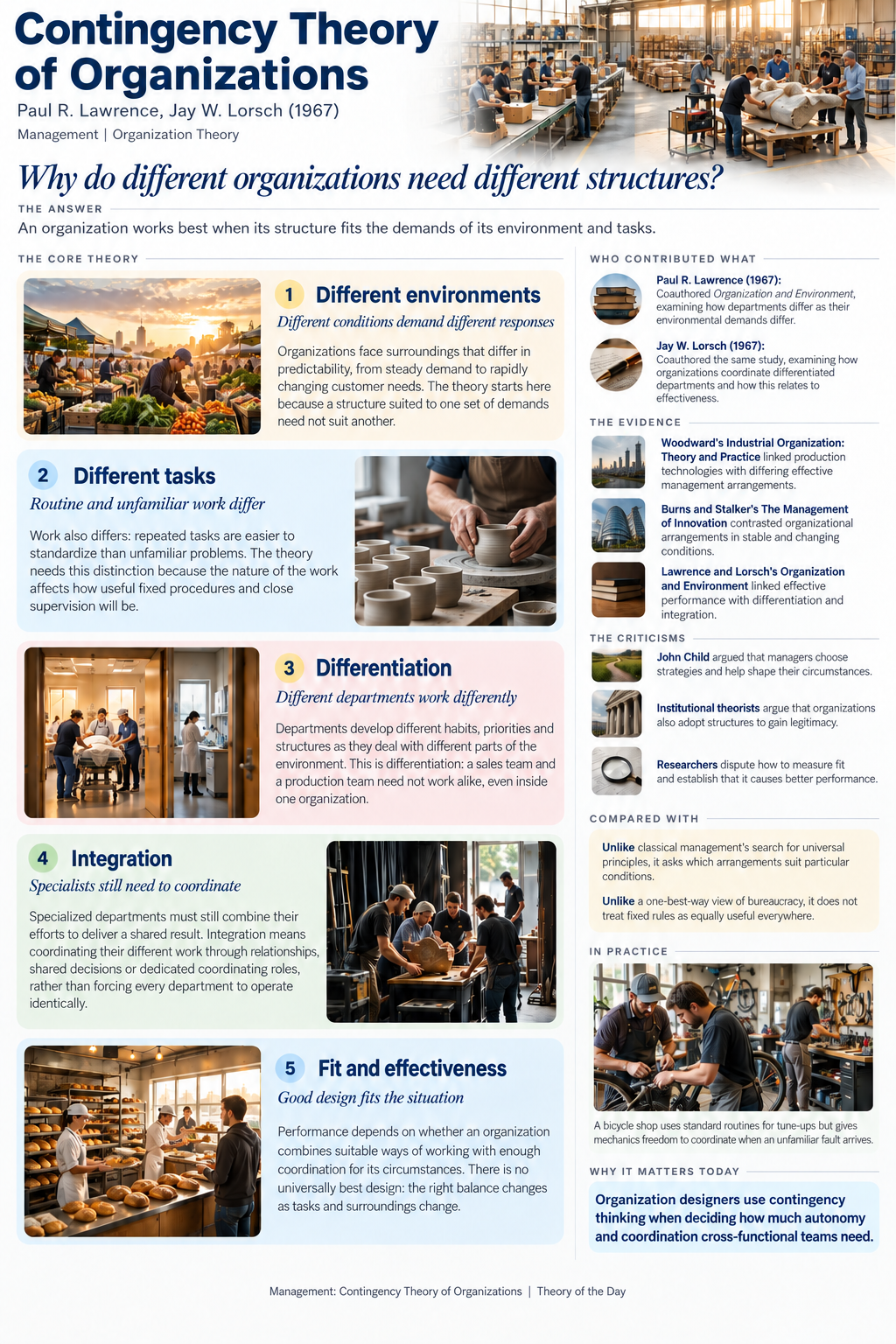
Contingency Theory of Organizations emerged from mid-twentieth-century research questioning whether one ideal way to organize could work everywhere. Earlier management approaches often emphasized general principles such as clear authority and standardized procedures. Yet researchers observed important differences among organizations. Joan Woodward investigated how production technology related to management arrangements, while Tom Burns and G. M. Stalker studied organizations working under more or less changing conditions. In 1967, Paul R. Lawrence and Jay W. Lorsch developed a particularly influential account of how organizations should respond to their environments.
The central claim is that organizational effectiveness depends on fit: arrangements that help in one setting may hinder work in another. Predictable work is easier to coordinate through established roles and procedures. Uncertain work places greater demands on communication and adaptation. An organization can face several kinds of uncertainty at once because its departments deal with different people and problems. Its design must therefore address both the needs of individual departments and the need for them to work together.
Lawrence and Lorsch called the development of distinct departmental practices differentiation. For example, production staff may concentrate on schedules and efficiency while sales staff respond quickly to shifting customer requests. They called the coordination of those departments integration. Their work treated the two as connected requirements: allowing teams to develop suitable ways of working creates a need to bring their efforts together. The concepts came from their joint research; they should not be treated as separate inventions by one author apiece.
Classic studies provided the empirical basis for these ideas. Woodward's Industrial Organization: Theory and Practice, published in 1965, reported that effective arrangements differed across forms of industrial production. Burns and Stalker's The Management of Innovation, published in 1961, contrasted more rule-bound arrangements with more flexible ones in different conditions. Lawrence and Lorsch's Organization and Environment, published in 1967, compared firms facing different environmental demands and examined how departmental differentiation and integration related to performance. Together, these works challenged claims that a single structure was best, although their findings were not a universal design formula.
The theory has important limits. John Child's work on strategic choice argued that managers do more than adjust to conditions given to them: their decisions also help determine what conditions an organization faces. Institutional scholars pointed out that organizations adopt structures partly to meet social expectations and gain legitimacy, not only to improve technical performance. Researchers also debate how to measure a good fit and whether fit causes strong performance, rather than successful organizations having more room to change. Later contingency research has therefore refined the idea rather than settled every question.
The theory remains useful because it directs attention to the demands of actual work before recommending a structure. A hospital, a factory and a small repair shop need not rely on the same balance of rules, discretion and coordination. Even within one organization, routine tasks and unfamiliar problems call for different responses. For managers designing teams or revising reporting relationships, the practical question is not which structure is best in the abstract, but which arrangements suit the work and connect the people doing it.
The argument in four steps
- Organizations face different levels of uncertainty in their work and surroundings.
- Uncertain conditions demand more flexible responses than predictable conditions do.
- Departments facing different demands develop different ways of working and must coordinate them.
- Therefore, effectiveness depends on matching organizational arrangements to those demands.
How it works
- Managers encounter shifts in customer demand, technology or the predictability of daily work.
- Departments adjust their routines to their own pressures, creating coordination problems when their approaches diverge.
- The outcome turns on whether the organization coordinates those differences while preserving the flexibility each department needs.
Who contributed what
- Paul R. Lawrence (1967): Coauthored Organization and Environment, examining how departments differ as their environmental demands differ.
- Jay W. Lorsch (1967): Coauthored the same study, examining how organizations coordinate differentiated departments and how this relates to effectiveness.
Compared with rival views
- Unlike classical management's search for universal principles, it asks which arrangements suit particular conditions.
- Unlike a one-best-way view of bureaucracy, it does not treat fixed rules as equally useful everywhere.
Further reading
- Paul R. Lawrence and Jay W. Lorsch, Organization and Environment: Managing Differentiation and Integration (1967)
- John Child, Organizational Structure, Environment and Performance: The Role of Strategic Choice (1972)
- Lex Donaldson, The Contingency Theory of Organizations (2001)