Infographic of: Retrieval Practice and the Testing Effect
Education: Memory, Study and How Learning Sticks
Retrieval Practice and the Testing Effect
Edwina Abbott, Arthur Irving Gates and others (1909)
Trying to recall learned material strengthens long-term memory more than spending the same study time rereading it.
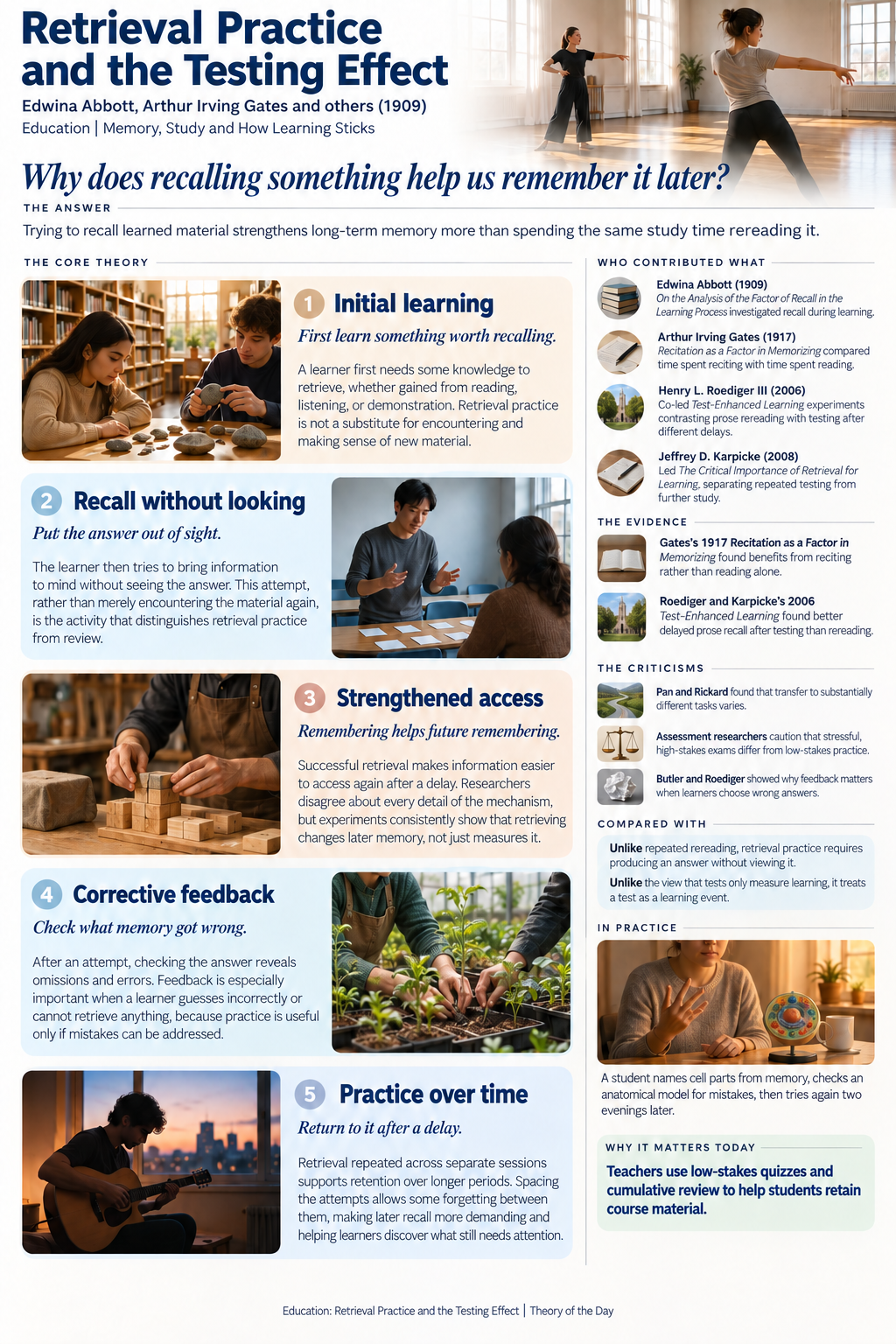
Retrieval practice grew out of a practical question about memorization: is it better to spend study time looking at material again, or trying to recall it? Early experimental work by Edwina Abbott in 1909 examined recall during learning, and Arthur Irving Gates’s 1917 research compared recitation with reading. The subject gained new prominence in the early twenty-first century, when researchers tested whether the benefits of recall would last beyond the study session. In education, “testing effect” refers to improved later memory caused by an earlier attempt to retrieve information—not merely to a test revealing what a learner already knows.
The basic procedure is simple. A learner encounters material, puts it out of view, and tries to produce an answer. The answer might be spoken, written, or selected in response to a question. Retrieving information changes how readily it can be accessed later; a practice test is therefore part of learning as well as a check on it. Checking answers afterward helps correct errors, particularly when a learner guesses or cannot recall anything. Repeating retrieval on separate days supports longer-term retention. Researchers continue to investigate the precise psychological mechanisms, so no single explanation accounts for every finding.
Abbott’s early work treated recall as an active factor in learning, rather than just an end-of-session measure. Gates studied how allocating time to recitation instead of further reading affected memorization. Henry L. Roediger III and Jeffrey D. Karpicke brought renewed attention to the issue with their 2006 experiments on learning prose passages. Their work highlighted an important distinction: rereading can produce strong immediate performance while testing produces better recall after a delay. Karpicke later led experiments that separated the effects of repeated retrieval from those of additional study, clarifying why another attempt to remember could be valuable even after material had already been learned.
In Roediger and Karpicke’s 2006 study, students who read and then recalled passages remembered more after a delay than students who repeatedly studied them, despite an initial advantage for repeated study on an immediate assessment. Gates’s earlier memorization research had also found benefits from recitation. Subsequent experiments extended the question beyond verbatim recall: Jeffrey Karpicke and Janell Blunt reported in 2011 that retrieval practice outperformed concept mapping for later questions about studied science material, including questions requiring inference. Together, these studies support a benefit that is not confined to simply repeating an answer immediately after seeing it.
The finding has limits. Practice questions must connect meaningfully to what learners need to know; improvement on one kind of question does not guarantee broad transfer to very different problems. Steven Pan and Timothy Rickard’s review found that transfer varies across conditions. Wrong answers also need attention: feedback helps learners correct them, and attempts that repeatedly fail without support are not an effective study plan. Moreover, low-stakes self-quizzing should not be confused with high-stakes examinations, where anxiety and grading can change the experience. Retrieval practice complements explanation, understanding, and other forms of study rather than replacing them.
The theory matters because it changes what counts as studying. A learner may feel fluent while rereading familiar pages yet discover, with the page closed, that the information is hard to produce. Brief, low-stakes questions make that gap visible while offering a chance to improve memory. A teacher might revisit earlier lessons through short quizzes; a student might explain a concept aloud, check omissions, and try again several days later. The practical lesson is not to test constantly or abandon reading. It is to build opportunities for supported recall into learning, especially when knowledge needs to last.
The argument in four steps
- Learning gives people information they can later try to recall.
- Recalling it requires access without the material in view.
- Further attempts strengthen access, while feedback corrects mistakes.
- Therefore, well-designed recall practice produces more durable memory than repeated review.
How it works
- After studying, a learner puts the source aside and attempts an answer from memory.
- An effortful attempt exercises access to the material; feedback helps resolve missing or incorrect answers.
- Later attempts, spaced over time, determine whether the learner can still retrieve it.
Who contributed what
- Edwina Abbott (1909): On the Analysis of the Factor of Recall in the Learning Process investigated recall during learning.
- Arthur Irving Gates (1917): Recitation as a Factor in Memorizing compared time spent reciting with time spent reading.
- Henry L. Roediger III (2006): Co-led Test-Enhanced Learning experiments contrasting prose rereading with testing after different delays.
- Jeffrey D. Karpicke (2008): Led The Critical Importance of Retrieval for Learning, separating repeated testing from further study.
Compared with rival views
- Unlike repeated rereading, retrieval practice requires producing an answer without viewing it.
- Unlike the view that tests only measure learning, it treats a test as a learning event.
Further reading
- Henry L. Roediger III and Jeffrey D. Karpicke, Test-Enhanced Learning: Taking Memory Tests Improves Long-Term Retention (2006)
- John Dunlosky and colleagues, Improving Students’ Learning With Effective Learning Techniques: Promising Directions From Cognitive and Educational Psychology (2013)
- Peter C. Brown, Henry L. Roediger III, and Mark A. McDaniel, Make It Stick: The Science of Successful Learning (2014)