Infographic of: Symbolic Anthropology: The Forest of Symbols
Anthropology: Foundations and Schools of Thought
Symbolic Anthropology: The Forest of Symbols
Victor Turner (1967)
Ritual symbols carry several meanings at once, connecting personal feelings with social relationships and shared values.
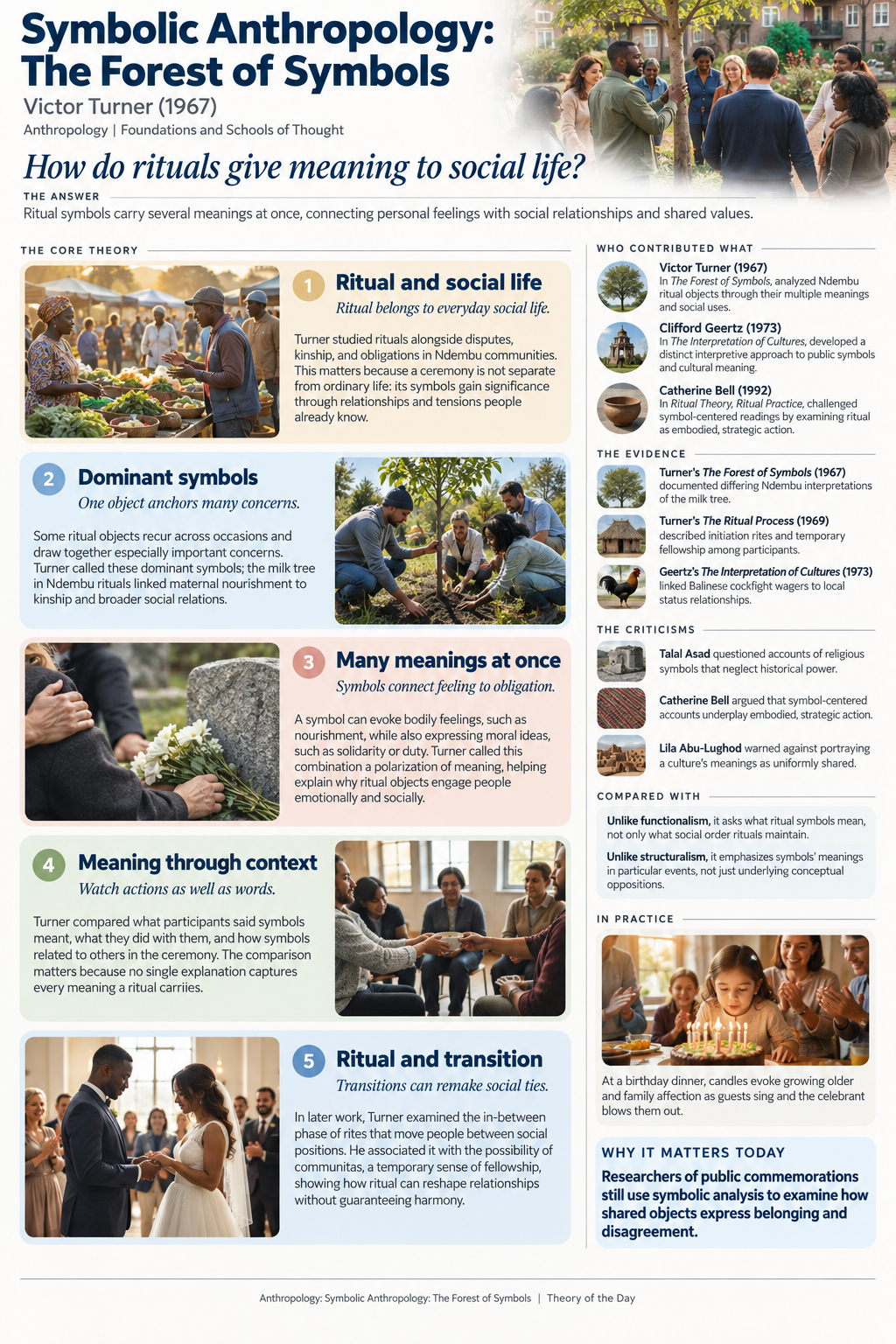
Victor Turner developed his account of ritual symbols through research among the Ndembu of what is now Zambia. In The Forest of Symbols: Aspects of Ndembu Ritual (1967), he examined ceremonies in the context of kinship, disputes, illness, and social obligations. Mid-twentieth-century anthropology had often asked what institutions did for social order. Turner also asked what the objects and actions in a ceremony meant to participants, and why those meanings mattered when relationships were strained or changing. His work became a major contribution to symbolic anthropology, though that wider approach was developed by other scholars too.
For Turner, a ritual symbol is not simply a coded message with one fixed translation. A prominent object can connect several concerns at once: bodily experiences, emotions, moral expectations, and social relationships. He described symbols that recur and organize a ceremony as dominant symbols. To interpret one, an anthropologist should compare participants' explanations with what they do and with the symbol's place among other symbols. Meaning emerges through this combination of public action and social context. Ritual thus offers a setting in which people express concerns about their relationships, though it does not necessarily settle them.
Turner supplied the close analysis of Ndembu rites and, in later work, explored the transitional phases of ritual and the temporary fellowship he called communitas. Clifford Geertz developed a related but distinct interpretive anthropology. In The Interpretation of Cultures (1973), he treated culture as public patterns of meaning that an ethnographer must interpret closely, rather than explaining behavior only by its practical effects. Catherine Bell subsequently questioned approaches that treat ritual primarily as a set of symbols to decode. Her Ritual Theory, Ritual Practice (1992) emphasized how people produce distinctions and exercise power through embodied ritual action.
Turner's discussion of the milk tree is a classic example of his method. In Ndembu ritual settings, participants associated the tree and its milky latex with breastfeeding, maternal relationships, and social ties; those associations took on different emphases in different contexts. His later account of initiation in The Ritual Process (1969) explored what happens when participants move between recognized social positions. Geertz's account of the Balinese cockfight offered another kind of ethnographic evidence: wagers and rivalries made local status relationships visible. These are interpretive case studies, not experiments establishing that every participant understands a symbol in the same way.
The approach has important limits. An ethnographer may read more coherence into a ceremony than its participants experience, or overlook disagreement among them. Talal Asad challenged accounts of religious symbols that set aside the histories and power relations shaping their meanings. Bell argued that describing what a rite signifies cannot replace studying what people do when they perform it. Lila Abu-Lughod likewise warned against writing as though a community possesses one bounded, uniformly shared culture. Later scholarship has therefore paid closer attention to practice, inequality, historical change, and competing interpretations.
Turner's enduring contribution is a way to ask better questions of public ceremonies. Why does one object attract such strong feeling? How do participants connect a physical act to kinship, obligation, or belonging? Who interprets that act differently? Researchers studying commemorations, rites of passage, and public disputes still use close attention to symbols, often alongside analysis of power and practice. The lesson is not that rituals have a hidden answer waiting to be decoded. It is that their visible details help people make social relationships meaningful—and sometimes contest what those relationships should be.
The argument in four steps
- Social relationships generate tensions that people encounter in public as well as private life.
- Rituals bring people together around recognizable objects, actions, and occasions.
- Participants associate these symbols with bodily experiences, social duties, and moral ideas.
- So ritual symbols organize how people understand relationships and respond to social tensions.
How it works
- An occasion such as initiation or healing gathers participants around familiar ritual objects and actions.
- Participants' explanations, their actions, and the surrounding symbols shape which associations come to the fore.
- People's responses afterward show whether relationships are reaffirmed, renegotiated, or still disputed.
Who contributed what
- Victor Turner (1967): In The Forest of Symbols, analyzed Ndembu ritual objects through their multiple meanings and social uses.
- Clifford Geertz (1973): In The Interpretation of Cultures, developed a distinct interpretive approach to public symbols and cultural meaning.
- Catherine Bell (1992): In Ritual Theory, Ritual Practice, challenged symbol-centered readings by examining ritual as embodied, strategic action.
Compared with rival views
- Unlike functionalism, it asks what ritual symbols mean, not only what social order rituals maintain.
- Unlike structuralism, it emphasizes symbols' meanings in particular events, not just underlying conceptual oppositions.
Further reading
- Victor Turner, The Forest of Symbols: Aspects of Ndembu Ritual (1967)
- Sherry B. Ortner, Theory in Anthropology since the Sixties (1984)
- Catherine Bell, Ritual Theory, Ritual Practice (1992)