Infographic of: Stages of Moral Development
Psychology: Psychodynamic and Developmental
Stages of Moral Development
Lawrence Kohlberg (1958)
Moral reasoning develops through an ordered sequence, from avoiding punishment to weighing social rules and principles of justice.
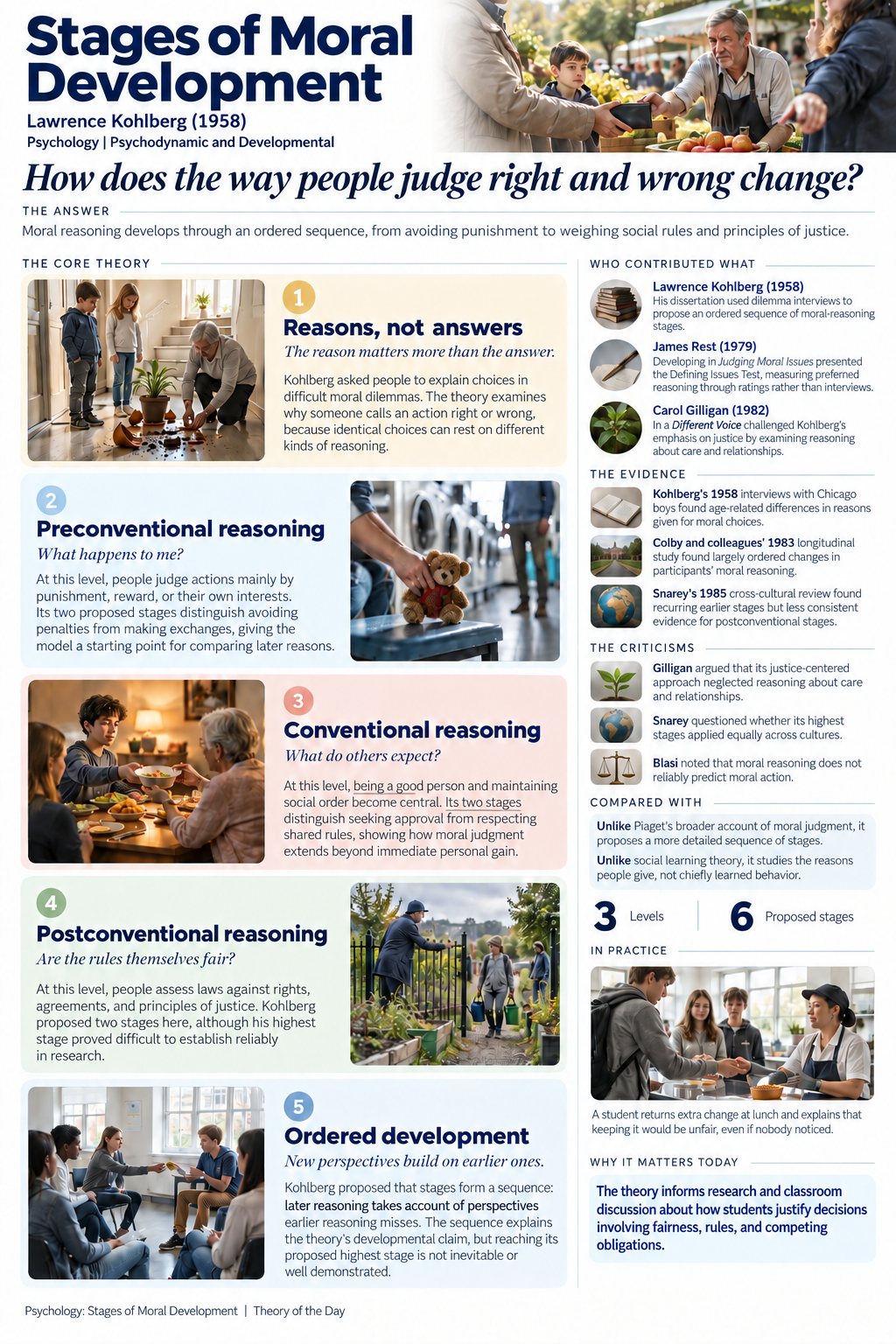
Lawrence Kohlberg first set out his stages of moral development in a 1958 doctoral dissertation based on interviews with boys in Chicago. He wanted to understand how people develop ways of judging right and wrong, not simply which actions they choose. His work built on Jean Piaget's earlier research into children's moral judgment. Where Piaget had described broad changes in how children understand rules, Kohlberg proposed a more detailed sequence of reasoning about moral problems.
Kohlberg presented interviewees with dilemmas and asked them to explain their answers. A person's answer mattered less to him than the reason behind it: two people might make the same choice while giving very different justifications. He grouped these justifications into three levels, each containing two proposed stages. Preconventional reasoning emphasizes punishment, reward, and personal interests. Conventional reasoning emphasizes approval, relationships, and the maintenance of social rules. Postconventional reasoning assesses rules against rights, social agreements, and principles of justice. Kohlberg proposed that people move through the stages in order as their ability to consider different perspectives develops.
Kohlberg supplied the original stage sequence and refined ways to assess it through interviews. James Rest later developed a different measurement approach: his Defining Issues Test asked people to rate the importance of considerations raised by dilemmas, rather than explain their thinking in an interview. Carol Gilligan did not propose Kohlberg's theory. In her 1982 book In a Different Voice, she challenged its emphasis on justice and argued that moral reasoning also attends to care, responsibilities, and relationships. Her critique became central to debates about what the theory leaves out.
Kohlberg's initial interviews found age-related differences in the reasons boys gave for moral choices, although that original group was narrow. A longitudinal study published by Anne Colby and colleagues in 1983 followed participants over time and found largely ordered changes in their moral reasoning, supporting an important part of the developmental account. John Snarey's 1985 review of cross-cultural research found evidence for recurring earlier stages in different societies. It also found that the proposed postconventional stages appeared less consistently, leaving their cultural reach in question.
The theory has substantial limitations. Gilligan argued that a framework centered on justice could undervalue reasoning about care; claims about fixed differences between women's and men's moral reasoning, however, remain disputed. Cross-cultural findings raise questions about treating one account of rights and justice as the endpoint for everyone. Augusto Blasi's research review also emphasized the gap between knowing how to justify a moral choice and acting accordingly. Kohlberg's sixth and highest stage proved particularly difficult to establish reliably, and later research has not shown that everyone reaches it.
The theory still matters because it makes a useful distinction between a moral decision and the thinking used to defend it. Researchers continue to study how people understand fairness, obligations, and rules, while educators use dilemmas to invite students to consider perspectives beyond their own. Kohlberg's stages are best taught as a historically important, testable account of developing moral reasoning—not as a measure of a person's goodness or a complete explanation of moral behavior.
The argument in four steps
- People explain moral choices using reasons that differ in what they treat as important.
- These reasons shift from personal consequences toward relationships, rules, and broader principles.
- Kohlberg grouped the reasons into stages ordered by the complexity of the perspective they take.
- So the model judges moral development by the reasoning behind a choice, not the choice alone.
How it works
- A person encounters a dilemma that makes competing interests or duties hard to reconcile.
- Discussion and exposure to other perspectives challenge reasons that overlook someone's interests.
- The explanation the person gives reveals which perspective their moral judgment takes.
Who contributed what
- Lawrence Kohlberg (1958): His dissertation used dilemma interviews to propose an ordered sequence of moral-reasoning stages.
- James Rest (1979): Developing in Judging Moral Issues presented the Defining Issues Test, measuring preferred reasoning through ratings rather than interviews.
- Carol Gilligan (1982): In a Different Voice challenged Kohlberg's emphasis on justice by examining reasoning about care and relationships.
Compared with rival views
- Unlike Piaget's broader account of moral judgment, it proposes a more detailed sequence of stages.
- Unlike social learning theory, it studies the reasons people give, not chiefly learned behavior.
Further reading
- Lawrence Kohlberg, The Development of Modes of Moral Thinking and Choice in the Years 10 to 16 (1958)
- James Rest, Developing in Judging Moral Issues (1979)
- Carol Gilligan, In a Different Voice: Psychological Theory and Women's Development (1982)