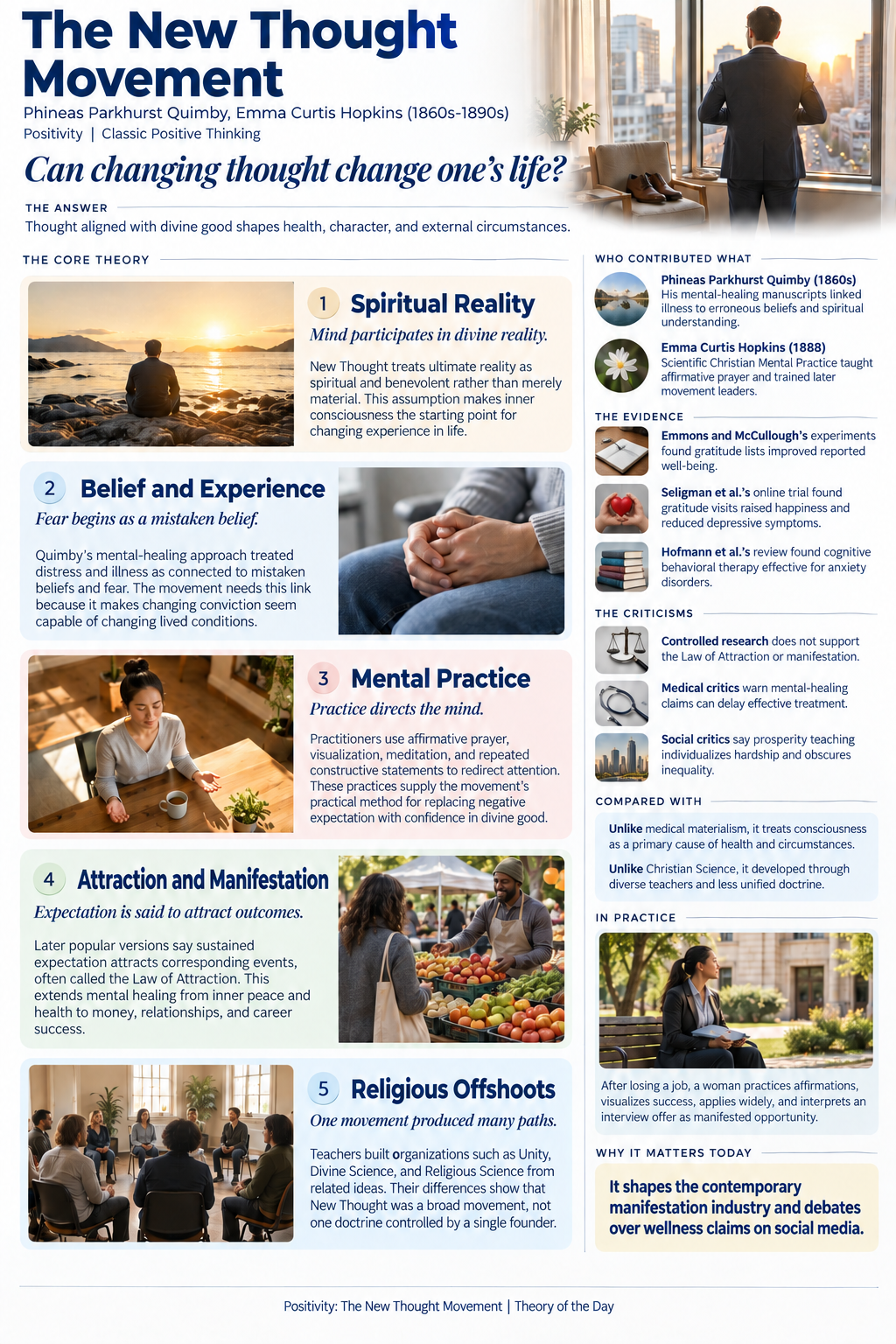
Infographic of: The New Thought Movement
Positivity: Classic Positive Thinking
The New Thought Movement
Phineas Parkhurst Quimby, Emma Curtis Hopkins (1860s-1890s)
Thought aligned with divine good shapes health, character, and external circumstances.
New Thought emerged in the United States between the 1860s and 1890s, amid interest in mesmerism, spiritual healing, liberal Protestantism, and alternatives to conventional medicine. It was not a single academic theory or centrally governed religion. Rather, it became a loose metaphysical movement whose teachers shared the conviction that mind, spiritual truth, and practical well-being were closely connected. Its followers sought healing, moral improvement, and greater prosperity through disciplined thought and prayer.
Its central premise is that reality is ultimately spiritual and that people participate in a benevolent divine mind. From this premise, proponents infer that fear, resentment, and false beliefs produce suffering, while confident and constructive thought brings health and better circumstances. Affirmative prayer, visualization, meditation, and repeated positive statements are intended to displace negative expectations. Later popular versions developed this into the Law of Attraction: the claim that thoughts attract matching events. That stronger claim is not scientifically established.
Phineas Parkhurst Quimby, a Maine healer, is commonly treated as an important precursor because his writings in the 1860s connected suffering with mistaken belief and recovery with spiritual understanding. Historians dispute whether he should be called the sole founder, since New Thought developed through many teachers. Emma Curtis Hopkins gave the movement a more systematic and influential teaching form. Her 1888 work Scientific Christian Mental Practice and her teaching career helped train leaders associated with later movements including Unity, Divine Science, and Religious Science.
Research does not test New Thought as one coherent package, and no controlled evidence demonstrates that thought alone manifests wealth, cures disease, or attracts external events. Some practices associated with it have separate empirical support. Emmons and McCullough’s 2003 gratitude experiments found benefits for self-reported well-being. Seligman and colleagues’ 2005 online intervention study found that a gratitude visit improved happiness and reduced depressive symptoms for a period. Cognitive behavioral therapy, which changes unhelpful thoughts through structured and evidence-based methods, also has substantial evidence, including Hofmann and colleagues’ 2012 review.
The major criticism is that New Thought moves too quickly from the plausible idea that beliefs affect emotion and behavior to the unsupported claim that thoughts directly control external reality. Medical critics object when spiritual explanations of illness discourage diagnosis or treatment. Critics also argue that prosperity teaching can blame people for poverty, disability, discrimination, or bereavement by treating adversity as a failure of attitude. These concerns are especially important because social conditions and chance clearly shape life outcomes.
New Thought still matters as a historical source for self-help culture, positive affirmations, prosperity teaching, and contemporary manifestation discourse. Its useful legacy is partly practical: gratitude, hope, goal-directed action, and reframing can support well-being when used alongside medical care and realistic attention to social circumstances. Its less defensible legacy is the promise that optimism itself controls the world. A careful modern reading separates evidence-supported psychological techniques from metaphysical claims that remain unverified.
The core theory
1. Spiritual Reality
New Thought treats ultimate reality as spiritual and benevolent rather than merely material. This assumption makes inner consciousness the starting point for changing experience in life.
2. Belief and Experience
Quimby’s mental-healing approach treated distress and illness as connected to mistaken beliefs and fear. The movement needs this link because it makes changing conviction seem capable of changing lived conditions.
3. Mental Practice
Practitioners use affirmative prayer, visualization, meditation, and repeated constructive statements to redirect attention. These practices supply the movement’s practical method for replacing negative expectation with confidence in divine good.
4. Attraction and Manifestation
Later popular versions say sustained expectation attracts corresponding events, often called the Law of Attraction. This extends mental healing from inner peace and health to money, relationships, and career success.
5. Religious Offshoots
Teachers built organizations such as Unity, Divine Science, and Religious Science from related ideas. Their differences show that New Thought was a broad movement, not one doctrine controlled by a single founder.
The argument in four steps
- Reality is fundamentally spiritual, and each person participates in divine mind.
- Beliefs and emotions therefore influence bodily experience, conduct, and encountered conditions.
- Affirmative prayer and visualization replace fear with confidence and expectation.
- So disciplined positive thought produces healing, prosperity, and a more harmonious life.
How it works
- People first identify fear, resentment, or illness as mental error rather than fixed fate.
- Repeated affirmations and prayer sustain attention, while doubt and negative talk obstruct the practice.
- Persistence in a confident spiritual outlook decides whether desired conditions are expected to appear.
Who contributed what
- Phineas Parkhurst Quimby (1860s): His mental-healing manuscripts linked illness to erroneous beliefs and spiritual understanding.
- Emma Curtis Hopkins (1888): Scientific Christian Mental Practice taught affirmative prayer and trained later movement leaders.
Compared with rival views
- Unlike medical materialism, it treats consciousness as a primary cause of health and circumstances.
- Unlike Christian Science, it developed through diverse teachers and less unified doctrine.
Further reading
- Phineas Parkhurst Quimby, The Quimby Manuscripts (1921)
- Charles S. Braden, Spirits in Rebellion: The Rise and Development of New Thought (1963)
- Catherine L. Albanese, A Republic of Mind and Spirit: A Cultural History of American Metaphysical Religion (2007)