Infographic of: The Montessori Method
Education: Philosophies and Movements of Education
The Montessori Method
Maria Montessori (1907-1909)
Children learn best by freely choosing purposeful, self-correcting work in a carefully prepared social environment.
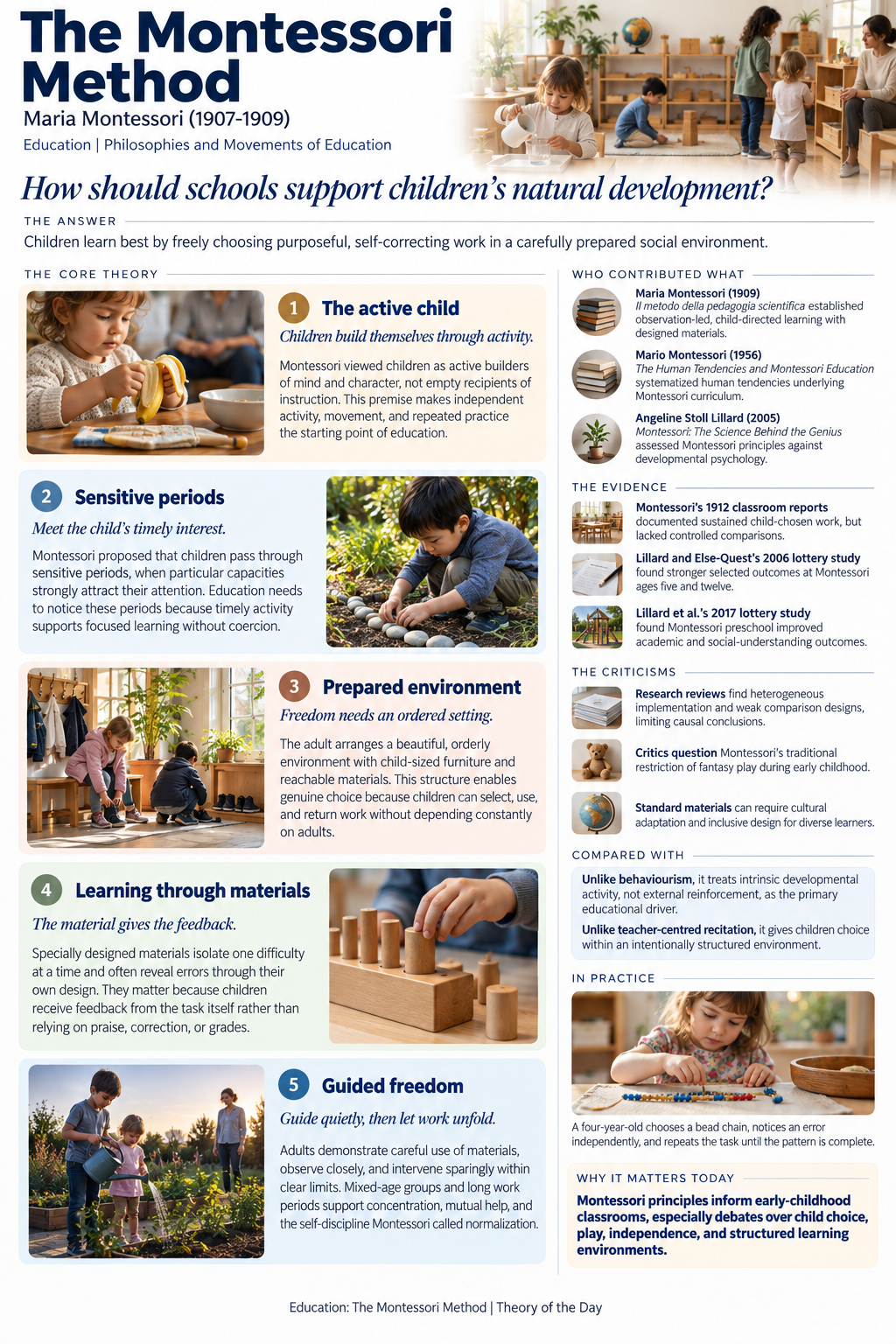
The Montessori Method arose from Maria Montessori's work with young children in Rome at the beginning of the twentieth century. In 1907 she opened the first Casa dei Bambini, or Children's House, in the San Lorenzo district, where she observed children using materials and moving independently in a carefully arranged setting. Her first major account, Il metodo della pedagogia scientifica, appeared in 1909. Montessori presented the method as an alternative to rigid, adult-directed schooling, drawing on clinical observation, earlier work with children with disabilities, and European reform-education ideas.
Its central claim is that children actively construct their capacities through purposeful activity. Montessori held that development includes sensitive periods, times when children are especially drawn to acquiring particular abilities such as order, language, movement, or social coordination. Adults should prepare an orderly environment containing accessible, developmentally appropriate materials, then observe rather than continuously direct. Children choose work within limits, repeat activities, move about, and learn from materials designed to make errors noticeable. The teacher gives concise demonstrations and protects concentration rather than serving mainly as a lecturer.
Maria Montessori developed the distinctive apparatus, classroom practices, and wider developmental philosophy. Her later work extended the approach beyond preschool into elementary education and adolescence. Her son, Mario Montessori, helped preserve and systematize aspects of the movement after her death, including the idea of human tendencies that underlie learning and culture. Much later, psychologist Angeline Stoll Lillard compared Montessori principles with findings in developmental psychology, distinguishing between claims supported by research and claims needing stronger evidence.
Evidence for Montessori education includes Montessori's own detailed observational reports, although these were not controlled experiments. More recent studies have used stronger designs. A 2006 study by Lillard and Nicole Else-Quest compared children admitted through a school lottery with children who were not admitted and found advantages on several outcomes at ages five and twelve. A 2017 lottery-based study by Lillard and colleagues reported benefits from Montessori preschool in academic and social understanding outcomes. These studies are influential, but they concern particular schools and versions of the method rather than every programme using the Montessori name.
Research reviews generally find promising outcomes, especially for some academic, social, and executive-function measures, but also substantial variation among schools. Montessori programmes differ in teacher preparation, length of uninterrupted work time, use of mixed-age groups, and fidelity to the original materials. Critics also question the traditional Montessori caution about fantasy play and note that historic materials and practices may require cultural adaptation. These concerns do not reject child independence or hands-on learning, but they challenge claims that one fixed implementation is universally best.
The method still matters because it offers a coherent account of how autonomy and structure can coexist. Its influence is visible in early-childhood education, classroom design, practical-life activities, and discussions of whether schools should rely less on rewards, testing, and whole-class instruction. Contemporary educators often borrow particular Montessori practices while adapting them to public-school curricula, local cultures, disability inclusion, and newer evidence about child development.
The core theory
1. The active child
Montessori viewed children as active builders of mind and character, not empty recipients of instruction. This premise makes independent activity, movement, and repeated practice the starting point of education.
2. Sensitive periods
Montessori proposed that children pass through sensitive periods, when particular capacities strongly attract their attention. Education needs to notice these periods because timely activity supports focused learning without coercion.
3. Prepared environment
The adult arranges a beautiful, orderly environment with child-sized furniture and reachable materials. This structure enables genuine choice because children can select, use, and return work without depending constantly on adults.
4. Learning through materials
Specially designed materials isolate one difficulty at a time and often reveal errors through their own design. They matter because children receive feedback from the task itself rather than relying on praise, correction, or grades.
5. Guided freedom
Adults demonstrate careful use of materials, observe closely, and intervene sparingly within clear limits. Mixed-age groups and long work periods support concentration, mutual help, and the self-discipline Montessori called normalization.
The argument in four steps
- Children possess an inner drive to build abilities through purposeful activity.
- Developmental windows make particular skills especially compelling and readily learned.
- Orderly, accessible materials let children choose and repeat developmentally fitting work.
- Therefore guided freedom and concentrated practice produce independent, disciplined learners.
How it works
- First, the adult observes each child and offers an appropriate presentation when interest appears.
- Choice, movement, repetition, and self-correction sustain concentration; unnecessary adult control interrupts it.
- The outcome depends on a well-prepared environment, skilled observation, and freedom bounded by respectful classroom rules.
Who contributed what
- Maria Montessori (1909): Il metodo della pedagogia scientifica established observation-led, child-directed learning with designed materials.
- Mario Montessori (1956): The Human Tendencies and Montessori Education systematized human tendencies underlying Montessori curriculum.
- Angeline Stoll Lillard (2005): Montessori: The Science Behind the Genius assessed Montessori principles against developmental psychology.
Compared with rival views
- Unlike behaviourism, it treats intrinsic developmental activity, not external reinforcement, as the primary educational driver.
- Unlike teacher-centred recitation, it gives children choice within an intentionally structured environment.
Further reading
- Maria Montessori, Il metodo della pedagogia scientifica (1909)
- Angeline Stoll Lillard, Montessori: The Science Behind the Genius (2005)
- Rita Kramer, Maria Montessori: A Biography (1976)