Infographic of: Classical Republicanism
Politics: Political Philosophy
Classical Republicanism
Marcus Tullius Cicero, James Harrington and others (c. 350 BCE-1656)
Political freedom depends on citizens governing for the common good through virtuous participation and institutions that prevent arbitrary power.
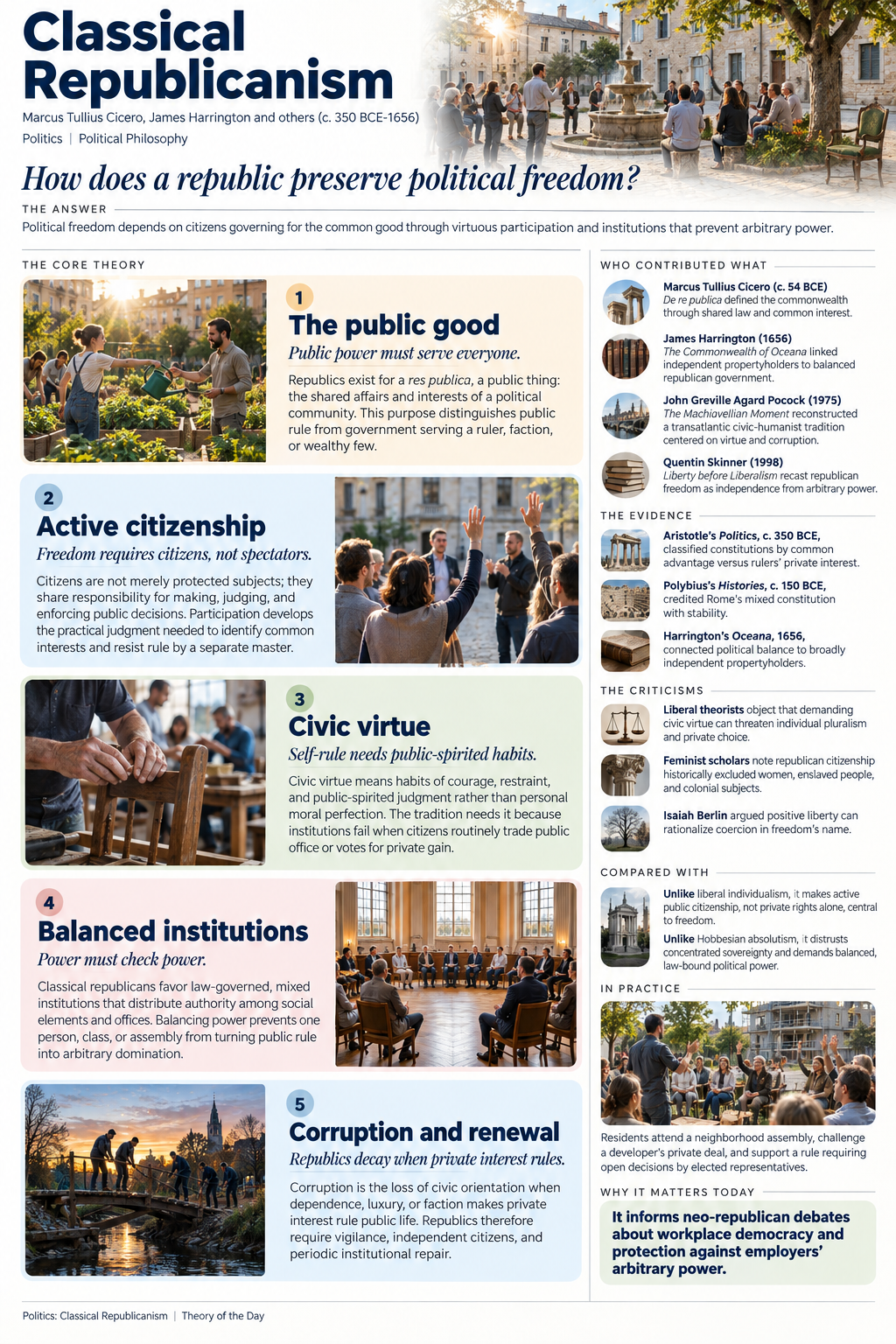
Classical republicanism is a modern name for a family of arguments that emerged in Greek and Roman thought and were adapted in early modern Europe. Its immediate Roman formulation is associated with Cicero's De re publica, written around 54-51 BCE, yet it drew deeply on Aristotle's earlier account of citizenship and constitutions. It arose from the problem of preserving a self-governing community against tyranny, oligarchy, faction, and civic decay.
The tradition understands liberty as living under public laws rather than another person's arbitrary will. It does not treat citizens as private individuals who merely receive protection from the state. Citizens must take part in collective judgment, military or public service, and political office where appropriate. Their participation is expected to cultivate civic virtue: habits of placing the common good above narrow private advantage.
Cicero described a commonwealth as a people united by agreement about law and shared interest, and defended a mixed constitution. James Harrington's Commonwealth of Oceana, published in 1656, adapted these themes to English conditions by connecting political independence to a broad distribution of property. In The Machiavellian Moment of 1975, J. G. A. Pocock reconstructed a long civic-humanist tradition organized around virtue and corruption. Quentin Skinner later emphasized a related neo-Roman account of liberty as freedom from dependence on arbitrary power.
The evidence for this tradition is mainly textual and historical, rather than experimental. Aristotle's Politics classified regimes according to whether they served common advantage or rulers' private interest. Polybius's Histories explained Roman durability through a balance among monarchical, aristocratic, and popular elements. Cicero, Machiavelli, and Harrington used Roman and contemporary political experience to argue that institutions and civic character had to support each other.
The theory has important limits. It was never one fully unified doctrine, and historical republics often excluded women, enslaved people, poor people, and colonized populations from citizenship. Liberal critics object that strong expectations of civic virtue can burden private life and suppress legitimate disagreement. Feminist scholarship has shown that republican claims about civic equality were frequently built upon unequal households. Historians also dispute how coherent, continuous, and politically uniform the tradition reconstructed by Pocock was.
Classical republicanism still matters because it frames freedom as protection against domination, not simply non-interference. Contemporary neo-republicans apply this idea to unaccountable state power, economic dependence, workplace authority, and civic education. Its enduring question is whether people are genuinely free when they possess formal rights but remain dependent on powerful actors who can interfere at will.
The core theory
1. The public good
Republics exist for a res publica, a public thing: the shared affairs and interests of a political community. This purpose distinguishes public rule from government serving a ruler, faction, or wealthy few.
2. Active citizenship
Citizens are not merely protected subjects; they share responsibility for making, judging, and enforcing public decisions. Participation develops the practical judgment needed to identify common interests and resist rule by a separate master.
3. Civic virtue
Civic virtue means habits of courage, restraint, and public-spirited judgment rather than personal moral perfection. The tradition needs it because institutions fail when citizens routinely trade public office or votes for private gain.
4. Balanced institutions
Classical republicans favor law-governed, mixed institutions that distribute authority among social elements and offices. Balancing power prevents one person, class, or assembly from turning public rule into arbitrary domination.
5. Corruption and renewal
Corruption is the loss of civic orientation when dependence, luxury, or faction makes private interest rule public life. Republics therefore require vigilance, independent citizens, and periodic institutional repair.
The argument in four steps
- People are free only within a self-governing political community ordered to a shared good.
- Self-government requires citizens to deliberate, serve, and place public duties above private advantage.
- Unchecked power and luxury foster dependence, faction, and corruption, destroying civic independence.
- Therefore republics preserve freedom through virtuous participation, laws, and balanced institutions.
How it works
- Citizens acquire civic habits through participation, public service, and laws that reward responsibility.
- Private dependence, factional rivalry, and luxury weaken these habits and concentrate influence.
- Durable liberty depends on whether institutions channel conflict toward public judgment rather than domination.
Who contributed what
- Marcus Tullius Cicero (c. 54 BCE): De re publica defined the commonwealth through shared law and common interest.
- James Harrington (1656): The Commonwealth of Oceana linked independent propertyholders to balanced republican government.
- John Greville Agard Pocock (1975): The Machiavellian Moment reconstructed a transatlantic civic-humanist tradition centered on virtue and corruption.
- Quentin Skinner (1998): Liberty before Liberalism recast republican freedom as independence from arbitrary power.
Compared with rival views
- Unlike liberal individualism, it makes active public citizenship, not private rights alone, central to freedom.
- Unlike Hobbesian absolutism, it distrusts concentrated sovereignty and demands balanced, law-bound political power.
Further reading
- Aristotle, Politics (c. 350 BCE)
- John Greville Agard Pocock, The Machiavellian Moment (1975)
- Quentin Skinner, Liberty before Liberalism (1998)