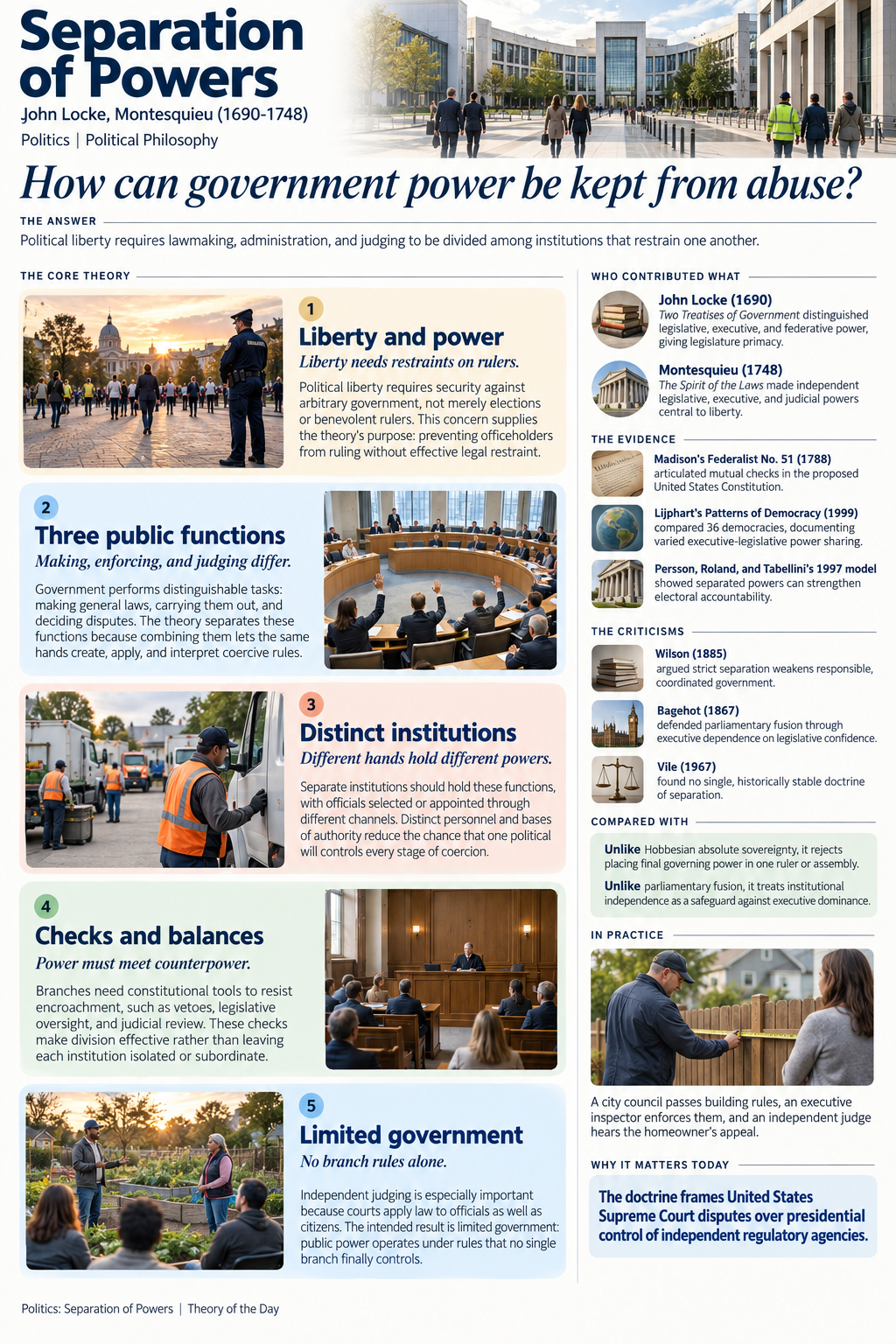
Infographic of: Separation of Powers
Politics: Political Philosophy
Separation of Powers
John Locke, Montesquieu (1690-1748)
Political liberty requires lawmaking, administration, and judging to be divided among institutions that restrain one another.
The separation of powers emerged from early modern arguments against arbitrary rule. John Locke wrote after England's seventeenth-century constitutional conflicts, especially the struggle over royal authority. In Two Treatises of Government, published in 1690, he distinguished legislative, executive, and federative powers. Montesquieu gave the doctrine its classic form in The Spirit of the Laws in 1748, responding to fears of despotism and seeking institutional conditions for political liberty.
Its central claim is that liberty is endangered when one person or body makes laws, executes them, and judges alleged breaches of them. Montesquieu therefore distinguished legislative, executive, and judicial functions. A legislature establishes general rules; an executive administers law and conducts public affairs; courts decide particular cases. The doctrine does not demand that these bodies never interact. Rather, it requires sufficient institutional independence that no branch can permanently dominate the others.
Locke was an important predecessor, but his third category was federative power: foreign affairs and external security. He also treated legislative power as supreme within government. Montesquieu made adjudication more clearly distinct and argued that liberty depended on power checking power. Later American constitution-makers adapted rather than simply copied him. James Madison, especially in Federalist No. 51 of 1788, emphasized checks and balances: separate institutions need practical constitutional weapons against one another's overreach.
The theory is principally a normative constitutional doctrine, so it has no single decisive experiment proving it. Its historical evidence includes constitutional designs and their operation. The United States Constitution of 1787 created separately constituted branches and became its most influential institutional example. Comparative political science has shown that democracies vary substantially in executive-legislative relations. Arend Lijphart's Patterns of Democracy, published in 1999, compared 36 democracies and documented different arrangements of power sharing rather than one universal model.
Critics argue that a strict version is either impossible or undesirable. Walter Bagehot's 1867 account of British government defended parliamentary fusion, where the executive depends on legislative confidence and can be removed by it. Woodrow Wilson similarly argued in 1885 that rigid division can impede responsible and coordinated government. M. J. C. Vile's historical study, Constitutionalism and the Separation of Powers, published in 1967, showed that the doctrine has always contained competing meanings. Modern constitutions commonly mix separated functions with parliamentary accountability, party government, and administrative agencies.
The doctrine still matters because it provides a vocabulary for judging concentrated authority. Debates over executive emergency powers, judicial review, legislative oversight, and independent regulators ask whether one institution has taken functions that should remain subject to another's control. Its enduring lesson is not that government branches must be wholly isolated, but that liberty and legality require durable institutional restraints on those who exercise public power.
The core theory
1. Liberty and power
Political liberty requires security against arbitrary government, not merely elections or benevolent rulers. This concern supplies the theory's purpose: preventing officeholders from ruling without effective legal restraint.
2. Three public functions
Government performs distinguishable tasks: making general laws, carrying them out, and deciding disputes. The theory separates these functions because combining them lets the same hands create, apply, and interpret coercive rules.
3. Distinct institutions
Separate institutions should hold these functions, with officials selected or appointed through different channels. Distinct personnel and bases of authority reduce the chance that one political will controls every stage of coercion.
4. Checks and balances
Branches need constitutional tools to resist encroachment, such as vetoes, legislative oversight, and judicial review. These checks make division effective rather than leaving each institution isolated or subordinate.
5. Limited government
Independent judging is especially important because courts apply law to officials as well as citizens. The intended result is limited government: public power operates under rules that no single branch finally controls.
The argument in four steps
- People who hold public power pursue interests and are vulnerable to abusing authority.
- Concentrating lawmaking, execution, and judging removes effective restraints on those who govern.
- Assigning these functions to distinct institutions creates independent sources of authority.
- So separate branches restrain one another and protect political liberty.
How it works
- A legislature makes general rules, executives administer them, and courts decide cases under them.
- Vetoes, oversight, appointments, and judicial review enable branches to resist unlawful encroachment.
- The outcome depends on constitutional rules and political independence allowing genuine mutual restraint.
Who contributed what
- John Locke (1690): Two Treatises of Government distinguished legislative, executive, and federative power, giving legislature primacy.
- Montesquieu (1748): The Spirit of the Laws made independent legislative, executive, and judicial powers central to liberty.
Compared with rival views
- Unlike Hobbesian absolute sovereignty, it rejects placing final governing power in one ruler or assembly.
- Unlike parliamentary fusion, it treats institutional independence as a safeguard against executive dominance.
Further reading
- Montesquieu, The Spirit of the Laws (1748)
- M. J. C. Vile, Constitutionalism and the Separation of Powers (1967)
- Bruce Ackerman, The New Separation of Powers (2000)