Infographic of: Autosuggestion: "Every Day, in Every Way"
Positivity: Classic Positive Thinking
Autosuggestion: "Every Day, in Every Way"
Émile Coué (1922)
Repeated optimistic phrases influence unconscious processes, producing gradual improvement in health, confidence, and everyday functioning.
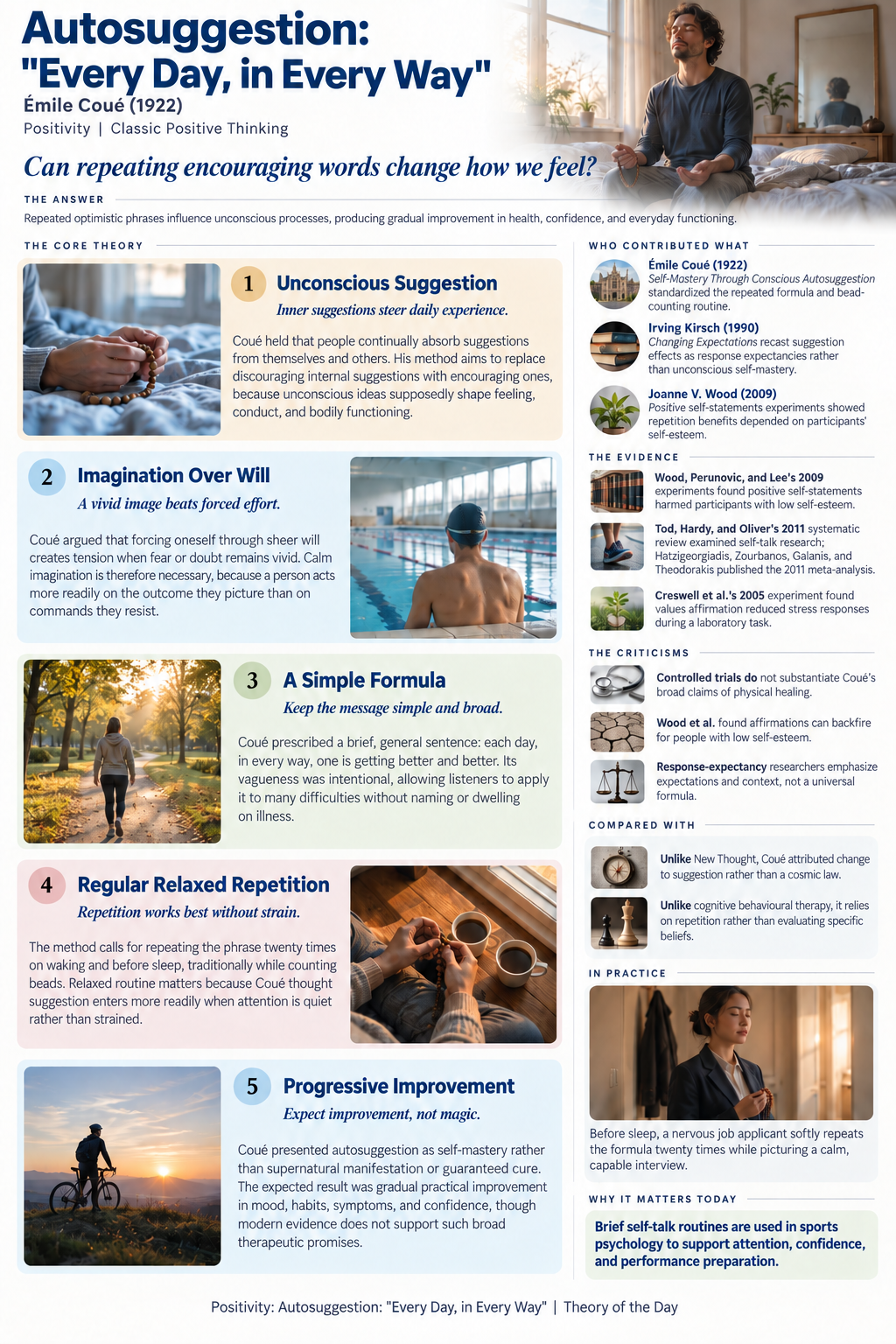
Autosuggestion became internationally famous through the French pharmacist Émile Coué, especially after his 1922 book, Self-Mastery Through Conscious Autosuggestion. Working in Nancy, where medical interest in hypnosis and suggestion had been prominent, Coué sought a practical alternative to formal hypnosis. He believed people were already influenced by suggestions from doctors, families, and their own inner speech. His innovation was to make beneficial self-suggestion a simple daily practice available to ordinary people.
Coué’s best-known formula was, in English, “Every day, in every way, I am getting better and better.” He advised repeating it twenty times upon waking and before sleep, traditionally while moving along a string of twenty knots or beads. The phrase was deliberately broad and did not demand a specific cure. Coué maintained that imagination usually defeats willpower in a conflict: trying hard not to be anxious, for example, keeps anxiety vividly in mind, whereas relaxed repetition encourages a different expectation.
Coué was the central developer of the method and called it conscious autosuggestion. He did not present it as magic or as a cosmic law, although later positive-thinking movements have sometimes blurred those distinctions. The Swiss psychologist Charles Baudouin gave an early theoretical account of suggestion and autosuggestion, linking them to broader psychological processes. Much later, Irving Kirsch’s response-expectancy theory offered a more testable account: suggestions affect experience partly because people expect particular responses, rather than because an autonomous unconscious mechanism obeys a formula.
Direct modern evidence for Coué’s full method is limited. Research on neighboring practices offers qualified support for some elements. Tod, Hardy, and Oliver’s 2011 meta-analysis found that self-talk interventions improved sporting performance overall, though these interventions were usually task-specific rather than Coué’s general formula. Creswell and colleagues’ 2005 experiment found that values affirmation reduced stress responses in a laboratory task. Such findings support the idea that words, attention, and expectations can affect coping, but they do not demonstrate that repetition cures illness or ensures broad life improvement.
The central criticism is that Coué made claims too expansive for the evidence available. His approach can also be counterproductive when it asks people to state beliefs that feel implausible. In 2009, Joanne Wood, W.Q. Elaine Perunovic, and John W. Lee found that positive self-statements harmed mood among participants with low self-esteem. Cognitive behavioural therapies therefore usually ask people to examine specific thoughts, test predictions, and change behaviour, rather than repeat universal optimistic phrases. Medical symptoms also require assessment and treatment rather than autosuggestion alone.
Autosuggestion still matters as a landmark in the history of self-help, psychotherapy, and positive thinking. Its core insight—that expectation and inner speech can shape attention, emotion, and action—has descendants in self-talk training, placebo research, relaxation methods, and some affirmation exercises. Its limitations are equally instructive: encouragement works best when it is credible, connected to practical action, and never substituted for professional care.
The core theory
1. Unconscious Suggestion
Coué held that people continually absorb suggestions from themselves and others. His method aims to replace discouraging internal suggestions with encouraging ones, because unconscious ideas supposedly shape feeling, conduct, and bodily functioning.
2. Imagination Over Will
Coué argued that forcing oneself through sheer will creates tension when fear or doubt remains vivid. Calm imagination is therefore necessary, because a person acts more readily on the outcome they picture than on commands they resist.
3. A Simple Formula
Coué prescribed a brief, general sentence: each day, in every way, one is getting better and better. Its vagueness was intentional, allowing listeners to apply it to many difficulties without naming or dwelling on illness.
4. Regular Relaxed Repetition
The method calls for repeating the phrase twenty times on waking and before sleep, traditionally while counting beads. Relaxed routine matters because Coué thought suggestion enters more readily when attention is quiet rather than strained.
5. Progressive Improvement
Coué presented autosuggestion as self-mastery rather than supernatural manifestation or guaranteed cure. The expected result was gradual practical improvement in mood, habits, symptoms, and confidence, though modern evidence does not support such broad therapeutic promises.
The argument in four steps
- Mental images and expectations influence bodily sensations, emotions, and habitual responses.
- The imagination outweighs deliberate will when the two conflict.
- Simple repeated phrases establish helpful suggestions without effortful struggle.
- So daily optimistic repetition produces progressive improvement across life.
How it works
- Morning and evening, a person repeats a short positive formula in a calm, low-effort state.
- Fearful images, self-doubt, and forceful striving obstruct the receptive attitude Coué sought.
- Repeated expectation directs attention, emotion, and behaviour toward the improvement the person envisages.
Who contributed what
- Émile Coué (1922): Self-Mastery Through Conscious Autosuggestion standardized the repeated formula and bead-counting routine.
- Irving Kirsch (1990): Changing Expectations recast suggestion effects as response expectancies rather than unconscious self-mastery.
- Joanne V. Wood (2009): Positive self-statements experiments showed repetition benefits depended on participants' self-esteem.
Compared with rival views
- Unlike New Thought, Coué attributed change to suggestion rather than a cosmic law.
- Unlike cognitive behavioural therapy, it relies on repetition rather than evaluating specific beliefs.
Further reading
- Émile Coué, Self-Mastery Through Conscious Autosuggestion (1922)
- Charles Baudouin, Suggestion and Autosuggestion (1920)
- Irving Kirsch, Changing Expectations: A Key to Effective Psychotherapy (1990)