Infographic of: Object Relations Theory
Psychology: Psychodynamic and Developmental
Object Relations Theory
Melanie Klein, William Ronald Dodds Fairbairn, Donald Woods Winnicott (1932-1960s)
Early relationships become internal patterns that organize the self and later relationships.
Object relations theory arose within psychoanalysis in Britain from the 1930s onward, partly in response to theories that treated instinctual drives as the main source of mental life. Its central concern was the child’s emotional relationship with important others, especially early caregivers. In this vocabulary, an “object” usually means a person, or a part-aspect of a person such as a comforting or frustrating caregiver, rather than a physical thing.
The theory proposes that early encounters are taken inward as internal objects: linked representations of another person, oneself, and the feeling between them. These representations influence later expectations of care, rejection, dependence, and hostility. Melanie Klein argued that acute infant anxiety leads to splitting, which keeps idealized and feared aspects of a caregiver apart. Development involves greater integration, allowing a person to recognize that the loved and frustrating caregiver is the same whole person.
Klein’s The Psycho-Analysis of Children (1932) set out her account of early object relations, unconscious phantasy, splitting, projection, and the paranoid-schizoid and depressive positions. William Ronald Dodds Fairbairn’s 1944 paper, “Endopsychic Structure Considered in Terms of Object Relationships,” departed from classical drive theory by arguing that libido fundamentally seeks relationships, not merely pleasure. Donald Woods Winnicott broadened the tradition through ideas of the holding environment, sufficiently reliable caregiving, and transitional objects, especially in his 1953 paper on transitional phenomena.
Much of the original evidence came from clinical work, particularly interpretations of children’s play and adult patients’ transference in analysis. These observations are rich but difficult to test independently. Later attachment research offered related empirical support for the general importance of early relationship representations. Ainsworth and colleagues’ 1978 Strange Situation research identified differing infant attachment patterns associated with caregiving, while Main, Kaplan, and Cassidy’s 1985 work linked parents’ attachment narratives with their children’s attachment classifications. Such findings support continuity in relationship expectations, though they do not directly verify Klein’s unconscious fantasy concepts.
The tradition has faced major criticism. Concepts such as internal objects, splitting, and projective identification are not easily operationalized or measured reliably. Adolf Grünbaum’s wider critique of psychoanalysis argued that many psychoanalytic explanations lack sufficiently independent tests. Developmental researchers also question strong claims about complex infant fantasies, preferring direct observation of infant behavior and caregiver interaction. Contemporary object relations writers commonly treat positions as recurring ways of organizing experience rather than literal age-bound stages.
Object relations theory still matters in psychodynamic psychotherapy, where clinicians use it to understand repetitive patterns in close relationships and the feelings that emerge between client and therapist. It has also influenced clinical thinking about personality organization, trauma, parenting, and therapeutic repair. Its enduring contribution is the claim that people do not merely remember early relationships: they carry forward emotionally organized expectations of what relationships are like and who they are within them.
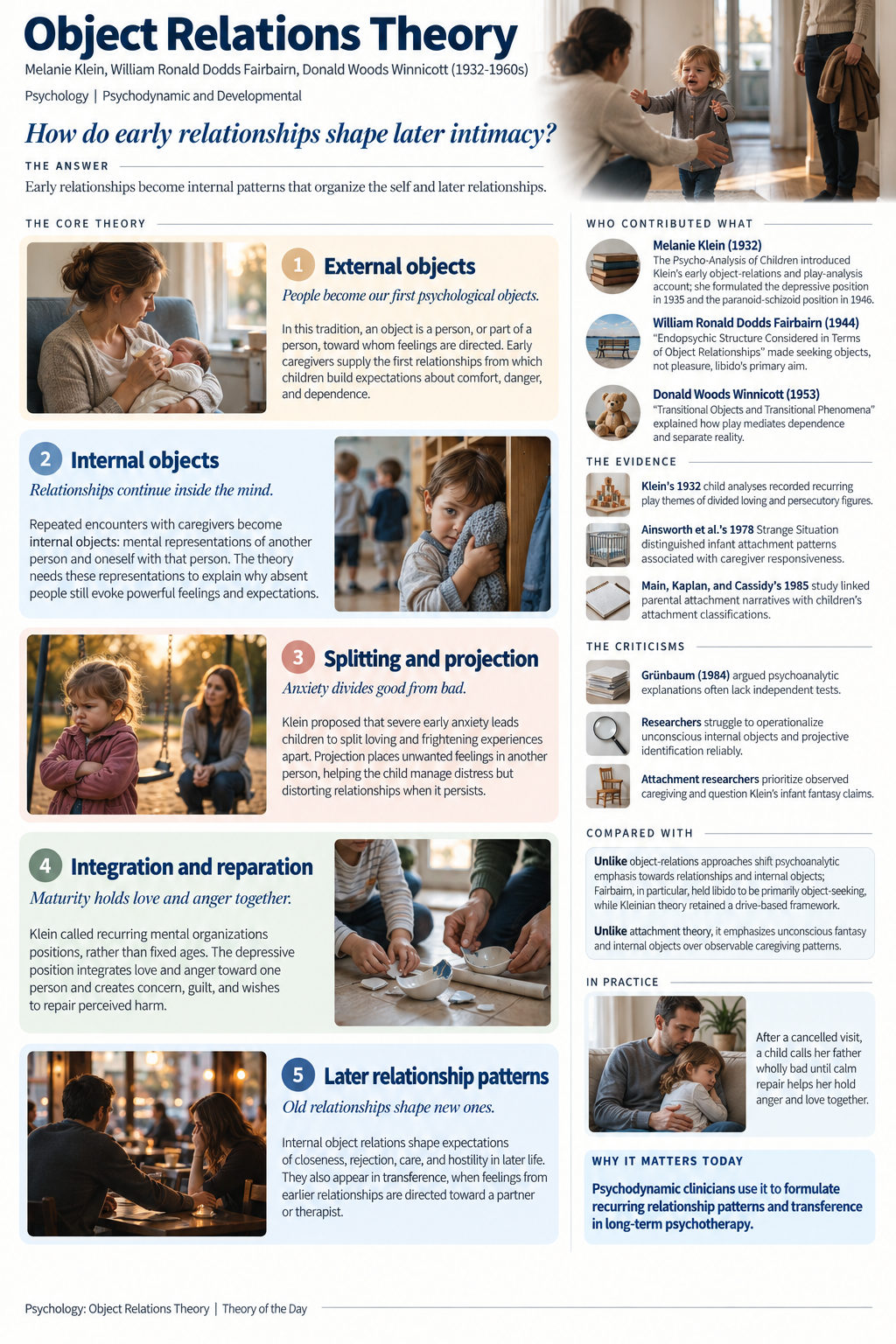
The core theory
1. External objects
In this tradition, an object is a person, or part of a person, toward whom feelings are directed. Early caregivers supply the first relationships from which children build expectations about comfort, danger, and dependence.
2. Internal objects
Repeated encounters with caregivers become internal objects: mental representations of another person and oneself with that person. The theory needs these representations to explain why absent people still evoke powerful feelings and expectations.
3. Splitting and projection
Klein proposed that severe early anxiety leads children to split loving and frightening experiences apart. Projection places unwanted feelings in another person, helping the child manage distress but distorting relationships when it persists.
4. Integration and reparation
Klein called recurring mental organizations positions, rather than fixed ages. The depressive position integrates love and anger toward one person and creates concern, guilt, and wishes to repair perceived harm.
5. Later relationship patterns
Internal object relations shape expectations of closeness, rejection, care, and hostility in later life. They also appear in transference, when feelings from earlier relationships are directed toward a partner or therapist.
The argument in four steps
- Infants depend on caregivers while experiencing intense love, frustration, and anxiety.
- They form mental representations of caregivers and themselves in those relationships.
- Overwhelming anxiety prompts splitting people and feelings into all-good and all-bad parts.
- So integrating these representations establishes stable relationships and a coherent self.
How it works
- Repeated care, frustration, and separation build internal representations of self-with-other.
- Anxiety activates defenses such as splitting and projection, which keep conflicting feelings apart.
- Consistent care and reparative relationships decide whether divided representations integrate or dominate later intimacy.
Who contributed what
- Melanie Klein (1932): The Psycho-Analysis of Children introduced Klein's early object-relations and play-analysis account; she formulated the depressive position in 1935 and the paranoid-schizoid position in 1946.
- William Ronald Dodds Fairbairn (1944): “Endopsychic Structure Considered in Terms of Object Relationships” made seeking objects, not pleasure, libido's primary aim.
- Donald Woods Winnicott (1953): “Transitional Objects and Transitional Phenomena” explained how play mediates dependence and separate reality.
Compared with rival views
- Object-relations approaches shift psychoanalytic emphasis towards relationships and internal objects; Fairbairn, in particular, held libido to be primarily object-seeking, while Kleinian theory retained a drive-based framework.
- Unlike attachment theory, it emphasizes unconscious fantasy and internal objects over observable caregiving patterns.
Further reading
- Melanie Klein, The Psycho-Analysis of Children (1932)
- Jay R. Greenberg and Stephen A. Mitchell, Object Relations in Psychoanalytic Theory (1983)
- Thomas H. Ogden, The Matrix of the Mind: Object Relations and the Psychoanalytic Dialogue (1986)