Infographic of: Culture and Personality: Patterns of Culture
Anthropology: Foundations and Schools of Thought
Culture and Personality: Patterns of Culture
Margaret Mead, Ruth Benedict (1928-1934)
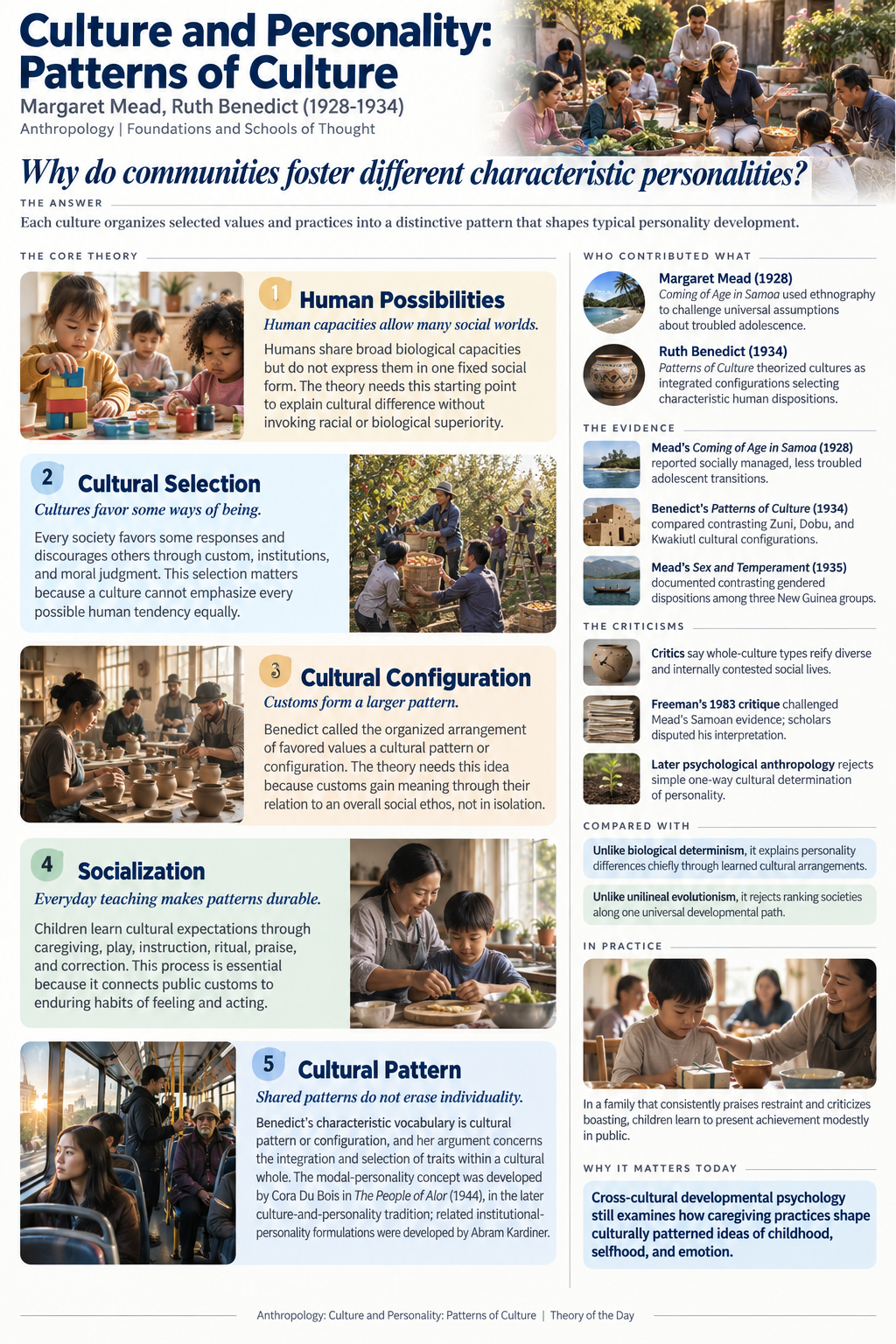
Each culture organizes selected values and practices into a distinctive pattern that shapes typical personality development.
Culture and personality was a major American anthropological approach of the 1920s and 1930s. It grew from Franz Boas's rejection of racial hierarchy and unilineal cultural evolution, at a time when anthropologists increasingly asked how social life shaped individual experience. Its advocates opposed claims that temperament, gender roles, or development followed a single biologically fixed path. The approach linked ethnographic fieldwork with questions previously associated with psychology.
Its central claim was that cultures select and organize certain possibilities of human conduct into relatively coherent patterns. A society may reward restraint, competition, cooperation, emotional display, or other orientations, while treating alternatives less favorably. Through childrearing, ritual, work, schooling, praise, and sanctions, these preferences become familiar habits. The result is not that every person has the same character, but that a culture tends to foster recognizable, recurrent personality orientations.
Margaret Mead helped establish the approach through fieldwork that treated development as culturally variable. In Coming of Age in Samoa, published in 1928, she argued that Samoan adolescence did not display the supposedly universal turmoil familiar to many American readers. Ruth Benedict gave the school its best-known theoretical statement in Patterns of Culture in 1934. She argued that cultures organize traits into configurations, or distinctive overall patterns, and compared the Zuni, Dobu, and Kwakiutl. Mead's later Sex and Temperament in Three Primitive Societies, published in 1935, extended the challenge to fixed assumptions about gendered temperament.
The evidence was primarily comparative ethnography rather than experiments or representative surveys. Mead used participant observation and interviews in Samoa and later in New Guinea. Benedict drew on her own research and on ethnographic records produced by other researchers to compare cultural configurations. These works made differences in adolescence, emotion, morality, and gender central subjects for anthropology. They also encouraged researchers to take ordinary learning and childrearing seriously as routes through which societies reproduce themselves.
The approach has important limits. Benedict's broad cultural types have been criticized for making cultures seem more unified and internally consistent than they are. Individuals occupy different positions of class, gender, age, and power, and they do not absorb shared expectations in identical ways. Derek Freeman's 1983 critique of Mead's Samoan research generated a major controversy, although many scholars challenged his interpretation and methods. Later psychological anthropology retained interest in culture and personhood while favoring more historically specific and less deterministic accounts.
The school still matters because it made cultural learning central to explanations of personality and development. Cross-cultural developmental psychology, anthropology of childhood, and research on cultural models of the self continue to investigate how local routines shape emotion, identity, and moral judgment. Contemporary work is generally more cautious than Benedict's configurations, examining variation within communities as well as differences between them. Its enduring lesson is that what feels natural in personal conduct is often learned through a particular social world.
The core theory
1. Human Possibilities
Humans share broad biological capacities but do not express them in one fixed social form. The theory needs this starting point to explain cultural difference without invoking racial or biological superiority.
2. Cultural Selection
Every society favors some responses and discourages others through custom, institutions, and moral judgment. This selection matters because a culture cannot emphasize every possible human tendency equally.
3. Cultural Configuration
Benedict called the organized arrangement of favored values a cultural pattern or configuration. The theory needs this idea because customs gain meaning through their relation to an overall social ethos, not in isolation.
4. Socialization
Children learn cultural expectations through caregiving, play, instruction, ritual, praise, and correction. This process is essential because it connects public customs to enduring habits of feeling and acting.
5. Cultural Pattern
Benedict's characteristic vocabulary is cultural pattern or configuration, and her argument concerns the integration and selection of traits within a cultural whole. The modal-personality concept was developed by Cora Du Bois in The People of Alor (1944), in the later culture-and-personality tradition; related institutional-personality formulations were developed by Abram Kardiner.
The argument in four steps
- Humans possess broad capacities for emotion, learning, cooperation, and conflict.
- Communities select particular values and practices from these possible human responses.
- Childrearing, ritual, and social approval transmit selected dispositions across generations.
- So each culture forms a pattern that fosters characteristic personality orientations.
How it works
- Children first absorb repeated expectations through care, play, ritual, and everyday approval or disapproval.
- Prestige, rewards, and sanctions reinforce favored dispositions, while conflicting institutions and individual differences limit uniformity.
- Consistency among institutions decides whether a shared ethos produces recognizable modal personality tendencies.
Who contributed what
- Margaret Mead (1928): Coming of Age in Samoa used ethnography to challenge universal assumptions about troubled adolescence.
- Ruth Benedict (1934): Patterns of Culture theorized cultures as integrated configurations selecting characteristic human dispositions.
Compared with rival views
- Unlike biological determinism, it explains personality differences chiefly through learned cultural arrangements.
- Unlike unilineal evolutionism, it rejects ranking societies along one universal developmental path.
Further reading
- Ruth Benedict, Patterns of Culture (1934)
- Anthony F. C. Wallace, Culture and Personality (1961)
- Paul Shankman, The Trashing of Margaret Mead: Anatomy of an Anthropological Controversy (2009)