Infographic of: Scientific Management
Management: Classical and Behavioural Foundations
Scientific Management
Frederick Winslow Taylor, Frank Bunker Gilbreth and others (1903-1911)
Work becomes more productive when managers determine, teach, and reward the most efficient method for each task.
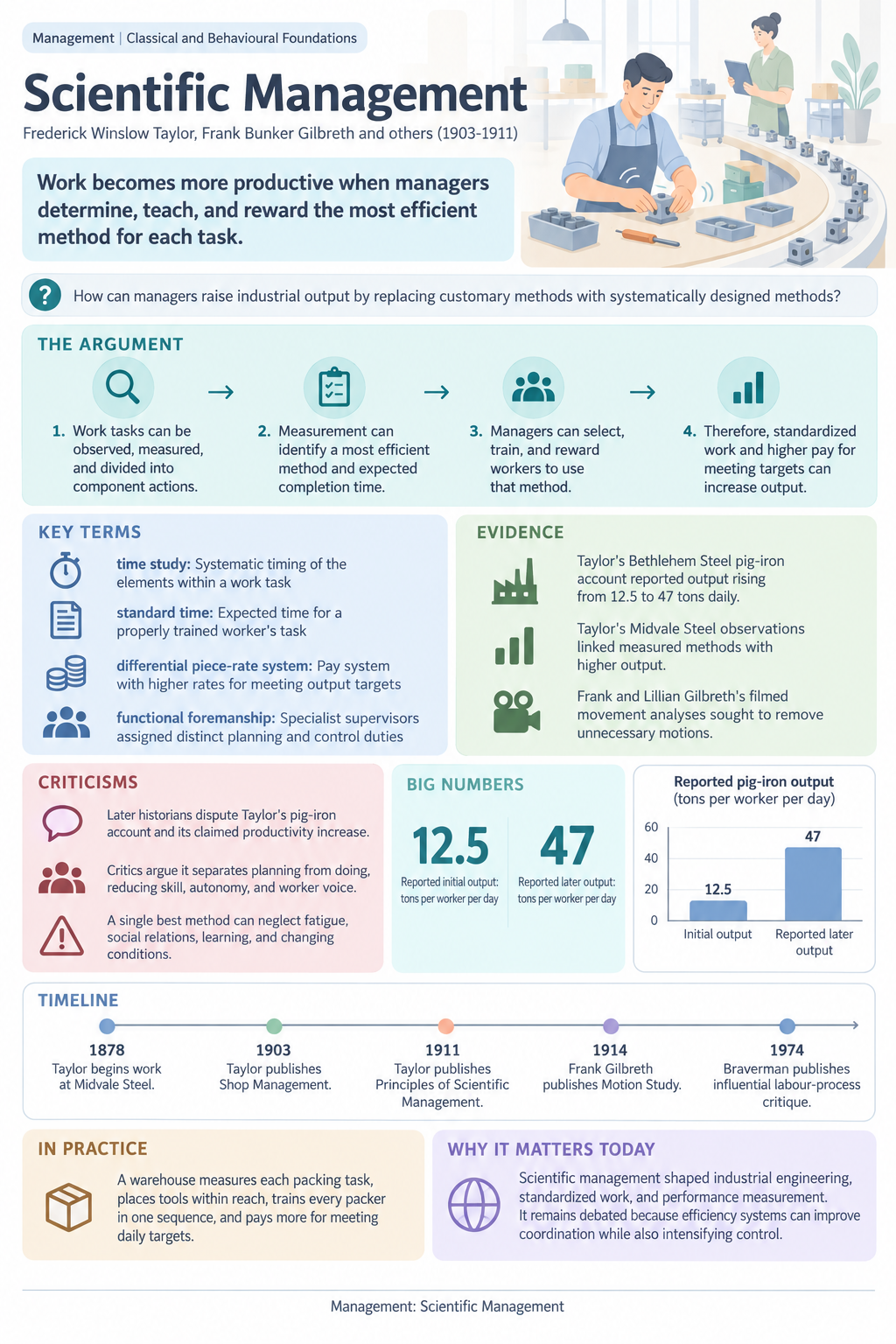
Scientific management arose in the rapidly industrialising United States of the late nineteenth and early twentieth centuries. Frederick Winslow Taylor developed its central ideas from his experience at Midvale Steel, where he began work in 1878, and later as a consultant. He believed many workplaces relied on inherited custom, uneven supervision, and what he called “soldiering”: workers deliberately limiting output. Taylor argued that this arrangement harmed both employers, through waste, and workers, through low wages and insecure employment. His principal statements appeared in Shop Management in 1903 and The Principles of Scientific Management in 1911.
Taylor's central claim was that managers should replace rule-of-thumb methods with systematic investigation. They should study a task, identify its component actions, establish the most efficient method, and specify a standard time for competent performance. Management, rather than individual workers, should assume responsibility for planning work. It should also select and train workers for particular tasks, provide suitable tools and instructions, and cooperate with them to ensure that the prescribed method is followed. Taylor presented this as a route to “maximum prosperity” for employers and employees alike.
Time study was a central technique: an observer timed the elements of a job to establish a standard. Taylor also advocated a differential piece-rate system, in which workers who met the required output received a substantially higher rate of pay. Functional foremanship divided supervisory duties among specialists rather than leaving one foreman responsible for everything. Frank and Lillian Gilbreth extended the efficiency project through detailed analyses, including filmed observations, of workers' movements. Henry Gantt developed related approaches to planning, supervision, and incentive payment.
The best-known evidence is Taylor's account of pig-iron handling at Bethlehem Steel. In The Principles of Scientific Management, he reported that selected and trained handlers increased daily output from 12.5 to 47 tons under a redesigned system and higher pay. This example was influential, but it was not a modern controlled experiment. Later historical research has questioned aspects of the account, including its presentation of workers and the scale of the claimed result. More generally, Taylor and his associates drew heavily on workplace observation and practical intervention rather than independently replicated research.
Scientific management was strongly criticised by labour scholars and critics of industrial capitalism. They argued that transferring planning from workers to managers could reduce craft knowledge, discretion, and control over pace. Its emphasis on measurable output could also overlook fatigue, cooperation, motivation beyond pay, and variation among tasks and workers. Yet its influence remains substantial. Standard operating procedures, process improvement, work measurement, logistics design, and many forms of performance management retain Taylorian features. Contemporary management debates therefore concern not whether efficiency matters, but how to pursue it without treating workers merely as instruments of production.
The argument in four steps
- 1. Work tasks can be observed, measured, and divided into component actions.
- 2. Measurement can identify a most efficient method and expected completion time.
- 3. Managers can select, train, and reward workers to use that method.
- 4. Therefore, standardized work and higher pay for meeting targets can increase output.
Key terms
- time study: Systematic timing of the elements within a work task
- standard time: Expected time for a properly trained worker's task
- differential piece-rate system: Pay system with higher rates for meeting output targets
- functional foremanship: Specialist supervisors assigned distinct planning and control duties
Further reading
- Frederick Winslow Taylor, The Principles of Scientific Management (1911)
- Daniel Nelson, Frederick W. Taylor and the Rise of Scientific Management (1980)
- Harry Braverman, Labor and Monopoly Capital: The Degradation of Work in the Twentieth Century (1974)