Infographic of: Progressive Education: Experience and Education
Education: Philosophies and Movements of Education
Progressive Education: Experience and Education
John Dewey (1916-1938)
Education should deliberately shape learners' experiences so activity leads to further learning and democratic participation.
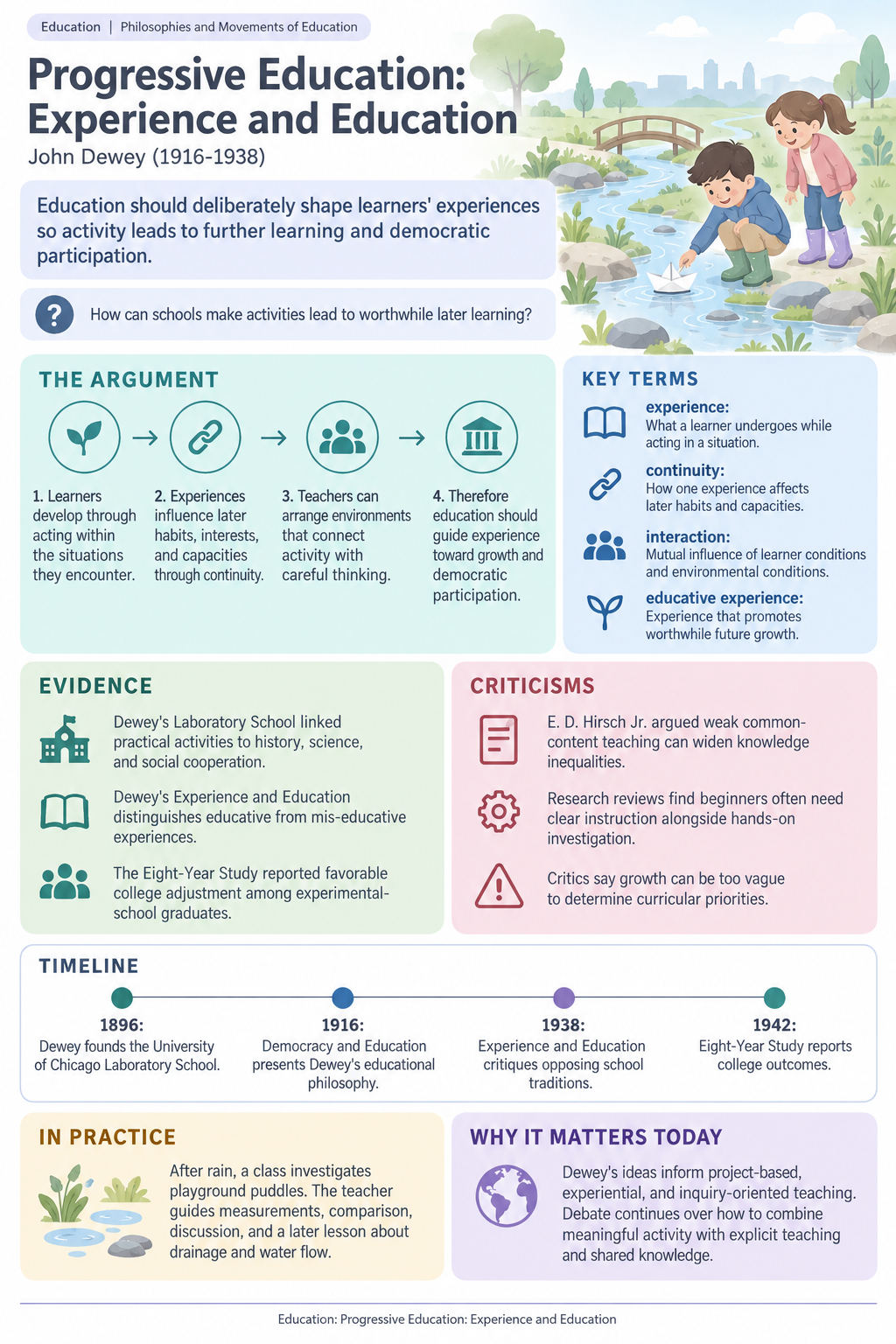
Progressive education was a diverse reform movement rather than a single doctrine. John Dewey gave it its most influential philosophical statement in the United States, first in Democracy and Education (1916) and then, more directly, in Experience and Education (1938). It arose amid criticism of schooling organized around recitation, rigid subjects, and passive obedience. Dewey, a pragmatist philosopher, wanted schools to prepare people for intelligent participation in a democratic society, not merely to transmit settled information.
Dewey did not argue that any enjoyable activity educates. He treated experience as what a learner undergoes while acting in a particular situation. Its educational quality depends on continuity—the way an experience affects later habits, interests, and capacities—and interaction—the mutual influence of the learner and the environment. An educative experience opens worthwhile future possibilities; a mis-educative one narrows them. Teachers therefore have a demanding role: they select materials, arrange social settings, connect practical activity to subject matter, and help pupils think through consequences. Freedom means guided participation, not the absence of direction.
The case for this approach was initially philosophical and observational, not a single decisive experiment. Dewey drew on work at the University of Chicago Laboratory School, founded in 1896, where activities such as cooking, building, and investigation were connected to history, science, and social cooperation. Later, the Eight-Year Study of experimental American high schools reported in 1942 that their graduates adjusted favorably to college on several measures. That study is often cited by progressive educators, although its design cannot establish that pedagogy alone produced the outcomes.
Critics have worried that experience-centered teaching may leave important knowledge to chance, especially when teachers lack time or expertise to make strong connections. E. D. Hirsch Jr. argued that schools need shared background knowledge because unequal access to it can deepen social inequality. Research on learning also indicates that beginners commonly benefit from clear explanation and practice as well as investigation. These objections partly correct popular caricatures of Dewey: he repeatedly rejected unplanned learning by doing and criticized progressive schools that treated children's immediate preferences as sufficient curriculum.
Dewey's account remains important because it frames teaching as the deliberate design of conditions in which learners can act, reflect, and grow. It informs project-based learning, inquiry-oriented teaching, experiential education, and democratic-school traditions. Contemporary debate centers on how to combine meaningful activity with systematic disciplinary knowledge, explicit teaching, assessment, and equitable access. Thus Experience and Education is less a recipe than a continuing standard for judging whether school experiences enlarge learners' future capacities.
The argument in four steps
- Learners develop through acting within the situations they encounter.
- Experiences influence later habits, interests, and capacities through continuity.
- Teachers can arrange environments that connect activity with careful thinking.
- Therefore education should guide experience toward growth and democratic participation.
Key terms
- experience: What a learner undergoes while acting in a situation.
- continuity: How one experience affects later habits and capacities.
- interaction: Mutual influence of learner conditions and environmental conditions.
- educative experience: Experience that promotes worthwhile future growth.
Further reading
- John Dewey, Experience and Education (1938)
- Robert B. Westbrook, John Dewey and American Democracy (1991)
- E. D. Hirsch Jr., The Schools We Need and Why We Don't Have Them (1996)