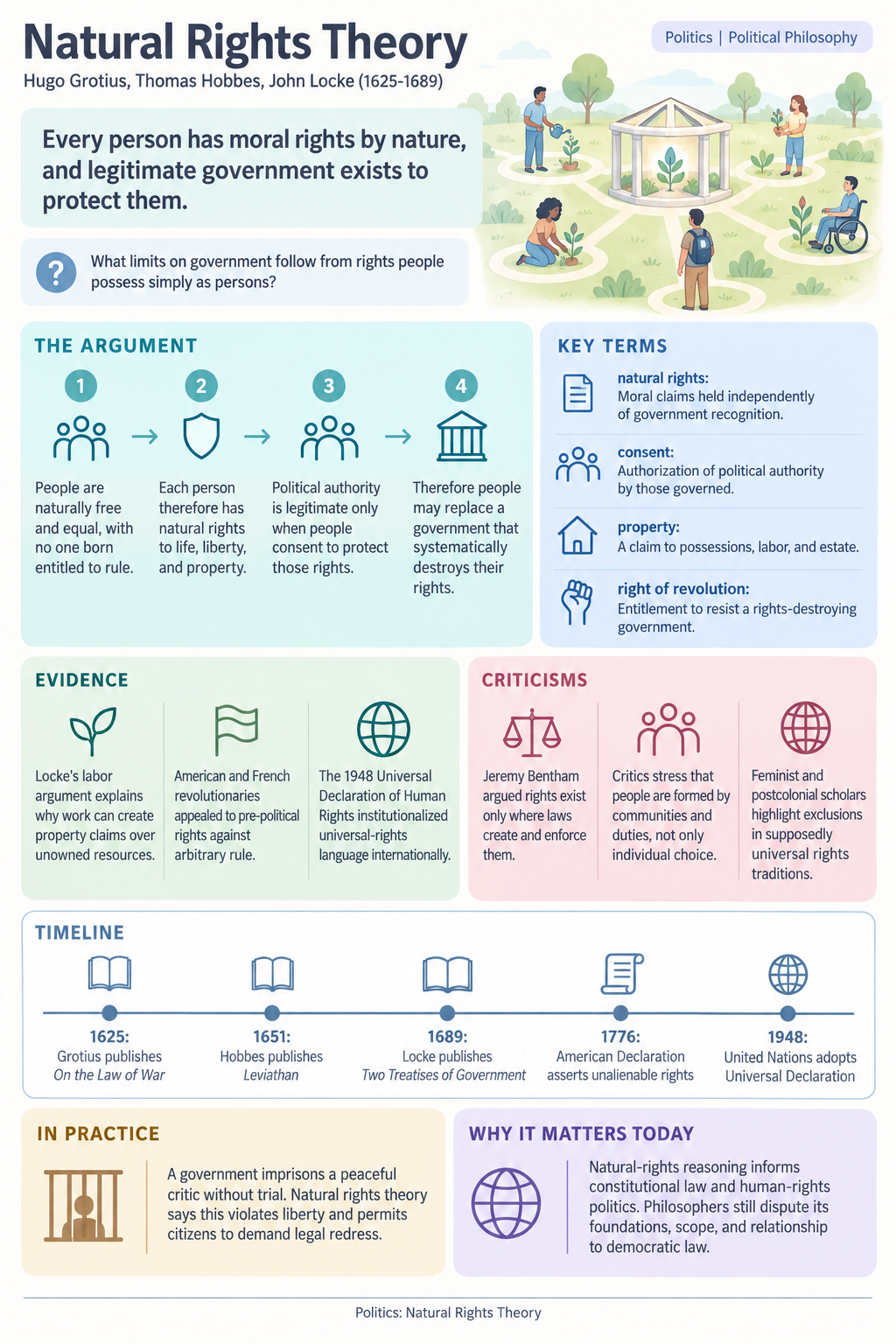
Infographic of: Natural Rights Theory
Politics: Political Philosophy
Natural Rights Theory
Hugo Grotius, Thomas Hobbes, John Locke (1625-1689)
Every person has moral rights by nature, and legitimate government exists to protect them.
Natural rights theory is a family of arguments holding that persons possess certain moral claims independently of the laws or decisions of particular states. Its modern form emerged in early modern Europe amid religious conflict, debates over absolute monarchy, and the search for principles of political order that could apply across political communities. Hugo Grotius’s On the Law of War and Peace (1625) helped systematize a rights-based natural-law tradition. Thomas Hobbes and John Locke then gave sharply different accounts of individual rights and political authority. Locke’s Two Treatises of Government, published in 1689, became the most influential source for liberal versions of the theory.
The central idea is that people are naturally free and equal: none is born with a general right to command another. Natural rights are moral entitlements that exist before government and set limits on it. Locke identified life, liberty, and property as central rights. His broad idea of property included a person’s life, freedom, and material possessions. Government becomes legitimate through the consent of free persons and is entrusted to protect their rights. If rulers systematically violate that trust, Locke argued, the people may resist or replace them. Hobbes also began with a natural right of self-preservation, but he drew a more authoritarian conclusion: security requires subjects to authorize a powerful sovereign.
Natural rights theory is primarily a philosophical theory, so it is not supported by laboratory experiments in the usual sense. Its evidence consists largely of moral arguments and historical uptake. Locke’s famous property argument maintains that a person can acquire a claim over previously unowned resources by mixing labor with them, subject to limits. Rights language was also prominent in the American Declaration of Independence of 1776 and the French Declaration of the Rights of Man and of the Citizen of 1789. After the Second World War, the Universal Declaration of Human Rights of 1948 expressed the idea that every human being has equal rights by virtue of human status.
The theory has faced sustained criticism. Jeremy Bentham rejected natural rights as imaginary, arguing that enforceable rights depend on law. Other critics argue that the theory pictures persons too abstractly, underplaying the communities, relationships, and duties through which people develop. Marxist critics have linked liberal rights, especially property rights, to unequal economic power. Feminist and postcolonial scholars have noted the historical gap between universal language and the exclusion of women, enslaved people, colonized populations, and others from full political standing. Defenders reply that such exclusions betray rather than refute the universal principle.
Natural rights theory still shapes constitutional arguments about liberty, privacy, religious freedom, ownership, and resistance to oppression. It also remains central to debates over human rights, where philosophers disagree about whether rights rest on natural law, human dignity, autonomy, basic interests, or political agreement. Its enduring force lies in its demand that state power answer to moral claims held by persons rather than treating those claims as gifts from rulers.
The argument in four steps
- People are naturally free and equal, with no one born entitled to rule.
- Each person therefore has natural rights to life, liberty, and property.
- Political authority is legitimate only when people consent to protect those rights.
- Therefore people may replace a government that systematically destroys their rights.
Key terms
- natural rights: Moral claims held independently of government recognition.
- consent: Authorization of political authority by those governed.
- property: A claim to possessions, labor, and estate.
- right of revolution: Entitlement to resist a rights-destroying government.
Further reading
- John Locke, Two Treatises of Government (1689)
- Richard Tuck, Natural Rights Theories: Their Origin and Development (1979)
- A. John Simmons, The Lockean Theory of Rights (1992)