Infographic of: Psychosexual Stages of Development
Psychology: Psychodynamic and Developmental
Psychosexual Stages of Development
Sigmund Freud (1905)
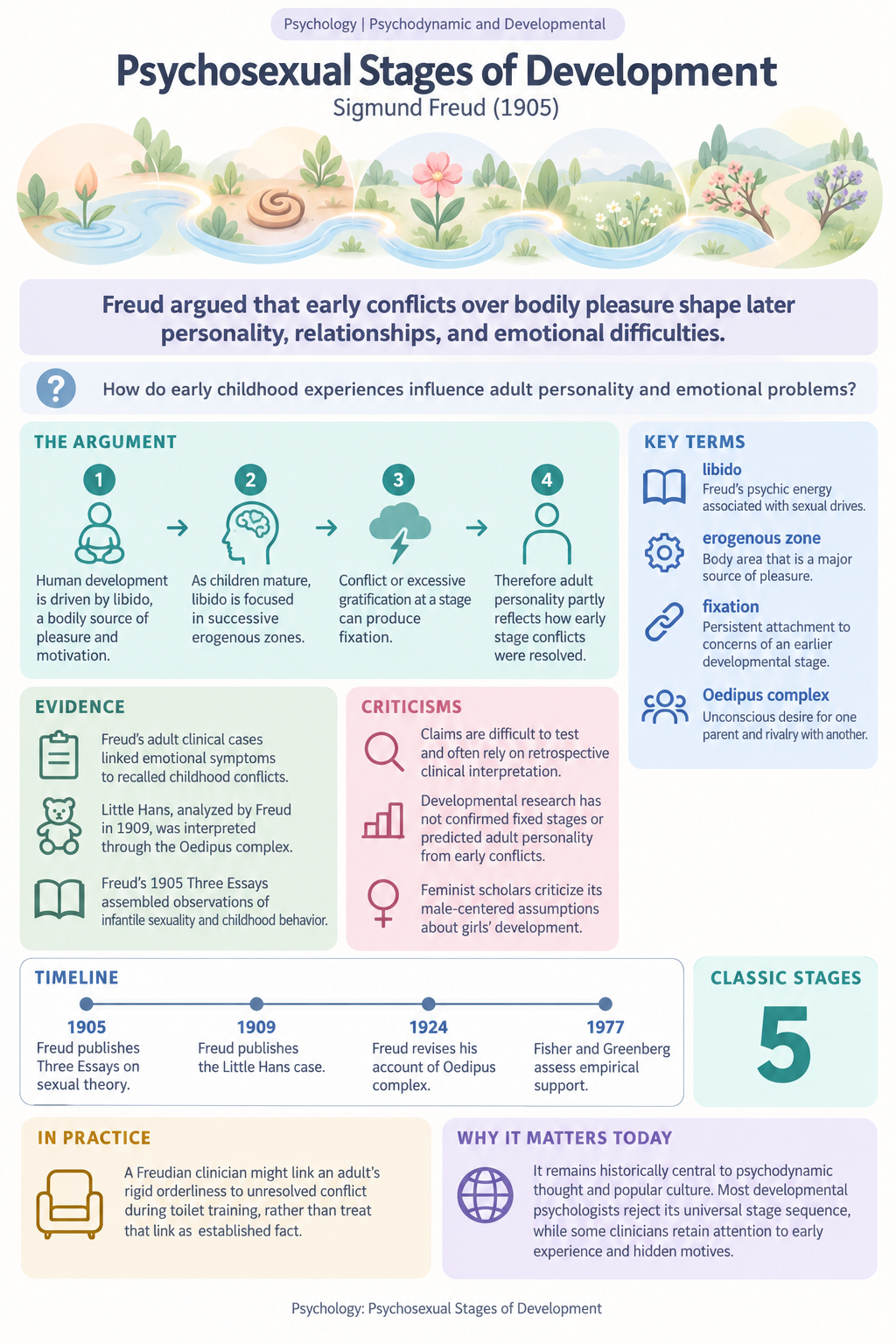
Freud argued that early conflicts over bodily pleasure shape later personality, relationships, and emotional difficulties.
Sigmund Freud developed the psychosexual stages theory within early psychoanalysis in Vienna. It was first set out in his 1905 Three Essays on the Theory of Sexuality, where he challenged the then-common assumption that sexuality began only at puberty. Freud used “sexuality” broadly, referring to bodily pleasure, desire, and attachment rather than only adult sexual activity. The theory arose from his attempts to explain emotional symptoms in adult patients by tracing them to unconscious wishes and conflicts originating in childhood.
Freud proposed that libido, the energy of the sexual drives, is concentrated successively in different erogenous zones. In the oral stage, roughly the first year, pleasure centers on sucking and feeding. In the anal stage, commonly linked to the toddler years, control of bodily elimination becomes important. The phallic stage, around ages three to six, centers on the genitals and includes the Oedipus complex. A latency period follows, in which sexual interests are relatively less prominent, before the genital stage begins with puberty and involves mature sexual relationships.
The central mechanism is fixation. Freud argued that frustration, anxiety, or excessive gratification during a stage could leave a person especially attached to its concerns. He therefore connected later traits and symptoms to early conflicts: for example, he associated unusual concern with order or control with difficulties during the anal stage. His evidence came chiefly from psychoanalytic treatment of adults, who discussed dreams, memories, and associations, and from a small number of child cases. The best known is the 1909 analysis of “Little Hans,” whose fear of horses Freud interpreted in relation to the Oedipus complex.
These materials do not meet modern standards for strong developmental evidence. Freud's interpretations were often based on retrospective reports, small and socially narrow clinical samples, and inferences that cannot readily be independently tested. Later research has not supported a universal, fixed sequence in which particular childhood conflicts reliably produce specific adult traits. Critics also object that Freud's account of girls' development was less developed and reflected male-centered assumptions. Many later psychodynamic theorists shifted attention from bodily stages toward early caregiving relationships, emotion regulation, and the development of the self.
The theory still matters because it made childhood central to psychological explanation and established the idea that early experience may influence later emotional life. It also helped create psychoanalytic vocabulary that remains widely known, especially libido, fixation, and the Oedipus complex. In contemporary psychology, it is generally taught as an influential historical theory rather than as a validated account of normal development. Its continuing value lies mainly in its impact on clinical thought, culture, and debates about how childhood shapes adulthood.
The argument in four steps
- Human development is driven by libido, a bodily source of pleasure and motivation.
- As children mature, libido is focused in successive erogenous zones.
- Conflict or excessive gratification at a stage can produce fixation.
- Therefore adult personality partly reflects how early stage conflicts were resolved.
Key terms
- libido: Freud's psychic energy associated with sexual drives.
- erogenous zone: Body area that is a major source of pleasure.
- fixation: Persistent attachment to concerns of an earlier developmental stage.
- Oedipus complex: Unconscious desire for one parent and rivalry with another.
Further reading
- Sigmund Freud, Three Essays on the Theory of Sexuality (1905)
- Seymour Fisher and Roger P. Greenberg, The Scientific Credibility of Freud's Theories and Therapy (1977)
- Frank J. Sulloway, Freud, Biologist of the Mind (1979)