Infographic of: Positivism and the Law of Three Stages
Sociology: Classical Foundations
Positivism and the Law of Three Stages
Auguste Comte (1822-1842)
Human thought develops from supernatural explanations through abstractions toward scientific inquiry into observable regularities.
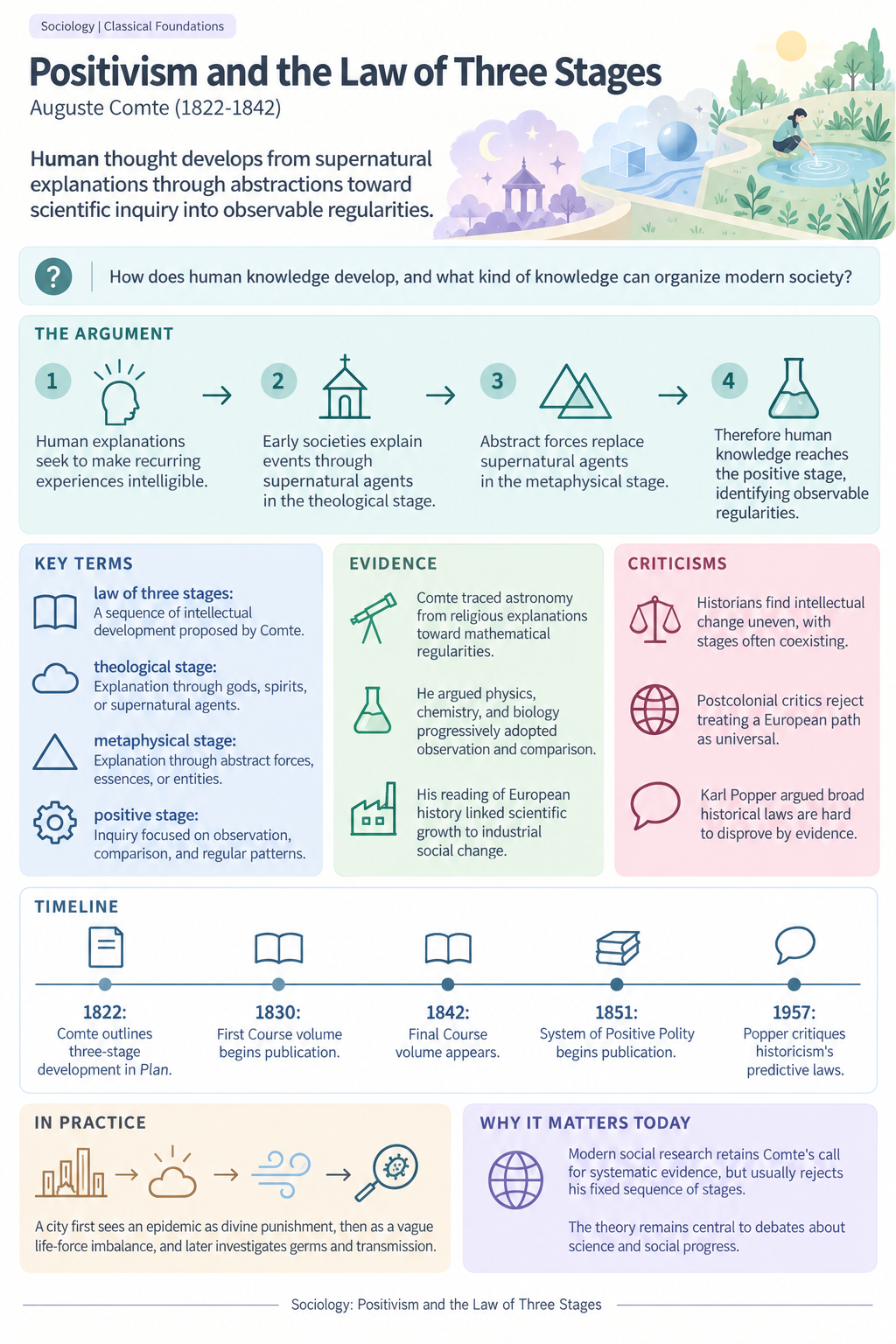
Positivism and the Law of Three Stages were developed by the French thinker Auguste Comte during the political and intellectual upheavals that followed the French Revolution. Comte first sketched the law in 1822 and developed it most fully in his six-volume Cours de philosophie positive, published from 1830 to 1842. He believed that European society needed a new intellectual basis after the decline of older religious and monarchical forms of authority. Scientific knowledge, in his view, could provide the basis for both understanding society and restoring social order.
Comte's law holds that human thought develops through three broad stages. In the theological stage, people explain events by reference to gods, spirits, or other supernatural agents. In the metaphysical stage, these agents are replaced by abstract entities and forces, such as “nature” or essences. In the positive stage, inquiry gives up the search for ultimate causes and instead seeks observable relations, regularities, and laws. For Comte, the positive stage did not mean merely being optimistic. It meant using observation, comparison, and, where possible, experiment to establish reliable knowledge.
The law was intended to apply both to the historical development of societies and to branches of knowledge. Comte presented astronomy as an especially advanced science because it had moved toward mathematical observation earlier than other fields. He placed sciences in a hierarchy, from mathematics and astronomy through physics, chemistry, and biology to the study of society. He initially called this final science “social physics” and later used the term sociology. Sociology, he argued, should identify the conditions of social order and the forces of social change.
Comte's support for the law was principally philosophical and historical rather than based on controlled studies. He offered a selective reconstruction of the history of European thought, especially the development of the natural sciences. Critics have argued that this history is too neat: religious, metaphysical, and scientific forms of explanation frequently coexist within the same society or person. The theory has also been criticized as Eurocentric because it treats a particular account of Western European development as a universal path. Karl Popper later objected more generally to theories claiming large-scale laws of historical development, arguing that their predictions are difficult to test.
Comte later gave positivism a more prescriptive form, proposing a “Religion of Humanity” with secular rituals and moral obligations. This development complicates the image of positivism as simply a defense of detached science. Today, few sociologists accept the Law of Three Stages as a universal account of history. Yet Comte remains important because he helped establish the ambition that society could be studied systematically, while also prompting enduring arguments about whether scientific methods can explain social life and whether knowledge necessarily represents progress.
The argument in four steps
- Human explanations seek to make recurring experiences intelligible.
- Early societies explain events through supernatural agents in the theological stage.
- Abstract forces replace supernatural agents in the metaphysical stage.
- Therefore human knowledge reaches the positive stage, identifying observable regularities.
Key terms
- law of three stages: A sequence of intellectual development proposed by Comte.
- theological stage: Explanation through gods, spirits, or supernatural agents.
- metaphysical stage: Explanation through abstract forces, essences, or entities.
- positive stage: Inquiry focused on observation, comparison, and regular patterns.
Further reading
- Auguste Comte, Cours de philosophie positive (1830-1842)
- Raymond Aron, Main Currents in Sociological Thought (1965)
- Mary Pickering, Auguste Comte: An Intellectual Biography, Volume II: 1830-1842 (2009)