Infographic of: Unilineal Cultural Evolutionism
Anthropology: Foundations and Schools of Thought
Unilineal Cultural Evolutionism
Edward Burnett Tylor, Lewis Henry Morgan (1871-1877)
All human societies were thought to advance through the same stages, although at different speeds.
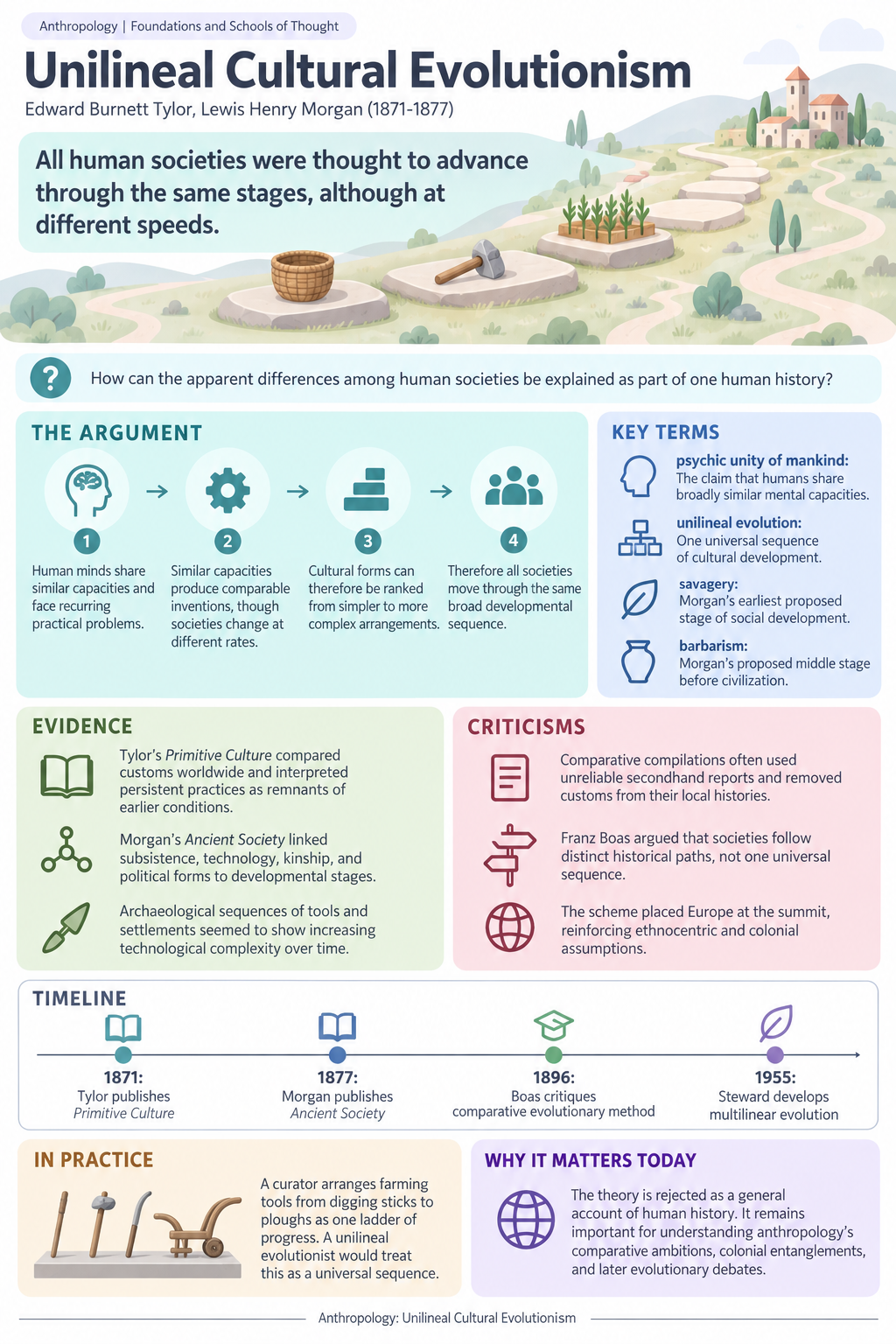
Unilineal Cultural Evolutionism was a major school of nineteenth-century anthropology. It arose in Britain and the United States during an era of European imperial expansion, rapid industrial change, and growing interest in biological evolution after Charles Darwin. Its leading anthropological proponents were Edward Burnett Tylor and Lewis Henry Morgan. Tylor set out an influential version in Primitive Culture in 1871, while Morgan presented a more systematic stage model in Ancient Society in 1877. Both sought a scientific, comparative explanation for the striking diversity of customs reported from around the world.
The theory held that humanity possessed a psychic unity: people everywhere had broadly similar mental capacities. Because human groups faced similar practical challenges, evolutionists reasoned, they would develop comparable institutions and inventions. Yet societies were said to advance at unequal rates. This allowed Tylor and Morgan to treat contemporary societies as occupying different positions on a single historical pathway. Morgan famously divided that pathway into savagery, barbarism, and civilization, with further subdivisions. He associated these stages with changes in subsistence, technology, kinship, property, and political organization.
Tylor used a wide comparative method, assembling reports on religion, marriage, technology, and custom from many places. He argued that apparently puzzling practices could be understood as traces of earlier social conditions. Morgan combined comparative claims with substantial research among Haudenosaunee, especially the Seneca, and used information on kinship systems to support his developmental sequence. Archaeological discoveries also seemed to provide material support: changing tools, settlement forms, and food-production methods could be arranged into sequences of increasing technical complexity.
The theory was strongly criticized from the late nineteenth century onward. Franz Boas argued that broad comparisons often relied on poor-quality secondhand reports and ignored the specific histories through which customs spread, changed, or disappeared. Critics also rejected the assumption that cultural complexity has one direction or that all societies must pass through identical stages. Most importantly, the model ranked European industrial societies as the highest form of civilization and portrayed colonized peoples as earlier versions of Europeans. This ethnocentrism was closely entangled with colonial ideas of progress, even when individual evolutionists opposed some forms of racial hierarchy.
Later anthropologists developed alternatives, including Boasian historical particularism and Julian Steward's multilinear evolution, which examined recurring patterns without claiming one universal route. Some twentieth-century scholars, such as Leslie White, revived broad evolutionary questions but did not restore the old Victorian ranking scheme unchanged. Unilineal Cultural Evolutionism is no longer accepted as an adequate account of human history. It nonetheless remains central to anthropology because it established ambitious comparative questions while illustrating the dangers of treating cultural difference as a ladder of progress.
The argument in four steps
- Human minds share similar capacities and face recurring practical problems.
- Similar capacities produce comparable inventions, though societies change at different rates.
- Cultural forms can therefore be ranked from simpler to more complex arrangements.
- Therefore all societies move through the same broad developmental sequence.
Key terms
- psychic unity of mankind: The claim that humans share broadly similar mental capacities.
- unilineal evolution: One universal sequence of cultural development.
- savagery: Morgan's earliest proposed stage of social development.
- barbarism: Morgan's proposed middle stage before civilization.
Further reading
- Edward Burnett Tylor, Primitive Culture (1871)
- George W. Stocking, Jr., Victorian Anthropology (1987)
- Bruce G. Trigger, A History of Anthropological Thought (2006)