Infographic of: Historical Particularism
Anthropology: Foundations and Schools of Thought
Historical Particularism
Franz Boas (1896)
Each culture results from its own history of local conditions, contact, invention, and borrowing.
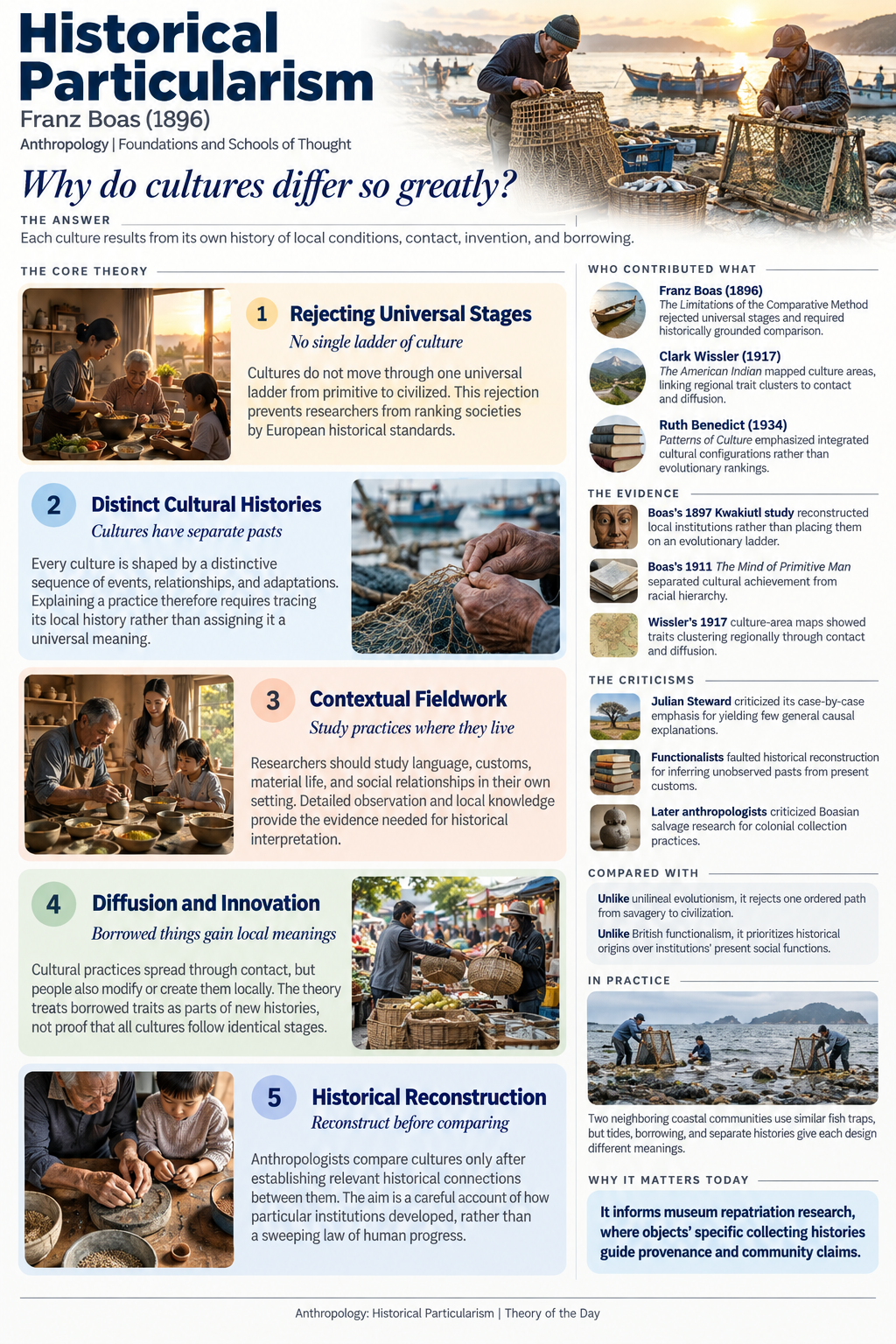
Historical particularism arose in United States anthropology at the end of the nineteenth century, above all through Franz Boas. In his 1896 essay, “The Limitations of the Comparative Method of Anthropology,” Boas challenged the then influential unilineal evolutionism associated with writers such as Edward B. Tylor and Lewis Henry Morgan. Evolutionists commonly arranged societies along a presumed sequence of development. Boas argued that this procedure grouped superficially similar customs before establishing whether they actually shared a history.
The approach holds that a culture is the product of its particular historical circumstances. Local environments matter, but so do migration, trade, conquest, intermarriage, invention, and the borrowing of practices between groups. A custom cannot be adequately explained merely by identifying a supposed evolutionary stage or present function. Researchers should ask how it came to exist in this place, among these people, and in relation to other features of their social life.
Boas developed the central methodological argument and promoted intensive research on language, oral tradition, material culture, and social institutions. His students and associates extended related ideas in different ways. Clark Wissler used culture-area mapping to examine regional distributions of traits and patterns of diffusion. Ruth Benedict's 1934 book Patterns of Culture emphasized that cultures organize values and practices into distinctive configurations, although her account was more concerned with cultural patterns than with detailed historical reconstruction.
Boasian research supplied illustrative cases rather than a single decisive experiment. Boas's 1897 study of Kwakiutl social organization documented institutions in a specific Northwest Coast setting instead of treating them as a rung on an evolutionary ladder. In The Mind of Primitive Man (1911), he criticized racial explanations of cultural achievement. Wissler's 1917 mapping of North American culture areas provided a visual basis for studying regional clustering, contact, and diffusion. Such work encouraged anthropologists to establish historical relationships cautiously before making broad comparisons.
The approach also had limitations. Critics, including Julian Steward, argued that its concentration on unique cases made it difficult to develop general explanations of social change. Functionalists objected that reconstructions of remote history could rest on uncertain inferences from present-day customs. Later scholars further criticized elements of Boasian salvage ethnography, especially research and collecting conducted under colonial conditions. These objections did not restore unilineal evolutionism, but they encouraged more explicit theories of ecology, political economy, power, and global connection.
Historical particularism remains important because it established cultural relativism and historically grounded field research as central anthropological commitments. It cautions against treating differences as evidence of unequal development or assuming that similar practices mean the same thing everywhere. Its influence is especially visible in museum provenance and repatriation work, where an object's meaning and rightful relationships depend on its specific history of making, exchange, collection, and removal.
The core theory
1. Rejecting Universal Stages
Cultures do not move through one universal ladder from primitive to civilized. This rejection prevents researchers from ranking societies by European historical standards.
2. Distinct Cultural Histories
Every culture is shaped by a distinctive sequence of events, relationships, and adaptations. Explaining a practice therefore requires tracing its local history rather than assigning it a universal meaning.
3. Contextual Fieldwork
Researchers should study language, customs, material life, and social relationships in their own setting. Detailed observation and local knowledge provide the evidence needed for historical interpretation.
4. Diffusion and Innovation
Cultural practices spread through contact, but people also modify or create them locally. The theory treats borrowed traits as parts of new histories, not proof that all cultures follow identical stages.
5. Historical Reconstruction
Anthropologists compare cultures only after establishing relevant historical connections between them. The aim is a careful account of how particular institutions developed, rather than a sweeping law of human progress.
The argument in four steps
- Human groups inherit distinct traditions while living under different local conditions.
- Migration, contact, invention, and borrowing alter traditions along separate historical paths.
- Similar customs can have different origins, while unlike customs can arise from shared histories.
- Therefore, each culture requires reconstruction through its particular historical context.
How it works
- Researchers begin with intensive study of a custom, its language, and its place in local social life.
- Migration, trade, conquest, environment, invention, and resistance shape whether practices spread or change.
- The outcome depends on the specific historical connections and meanings established in that community.
Who contributed what
- Franz Boas (1896): The Limitations of the Comparative Method rejected universal stages and required historically grounded comparison.
- Clark Wissler (1917): The American Indian mapped culture areas, linking regional trait clusters to contact and diffusion.
- Ruth Benedict (1934): Patterns of Culture emphasized integrated cultural configurations rather than evolutionary rankings.
Compared with rival views
- Unlike unilineal evolutionism, it rejects one ordered path from savagery to civilization.
- Unlike British functionalism, it prioritizes historical origins over institutions' present social functions.
Further reading
- Franz Boas, The Limitations of the Comparative Method of Anthropology (1896)
- George W. Stocking, Jr., Race, Culture, and Evolution: Essays in the History of Anthropology (1968)
- Regna Darnell, And Along Came Boas: Continuity and Revolution in Americanist Anthropology (2001)