Infographic of: Alienation
Sociology: Classical Foundations
Alienation
Karl Marx (1844)
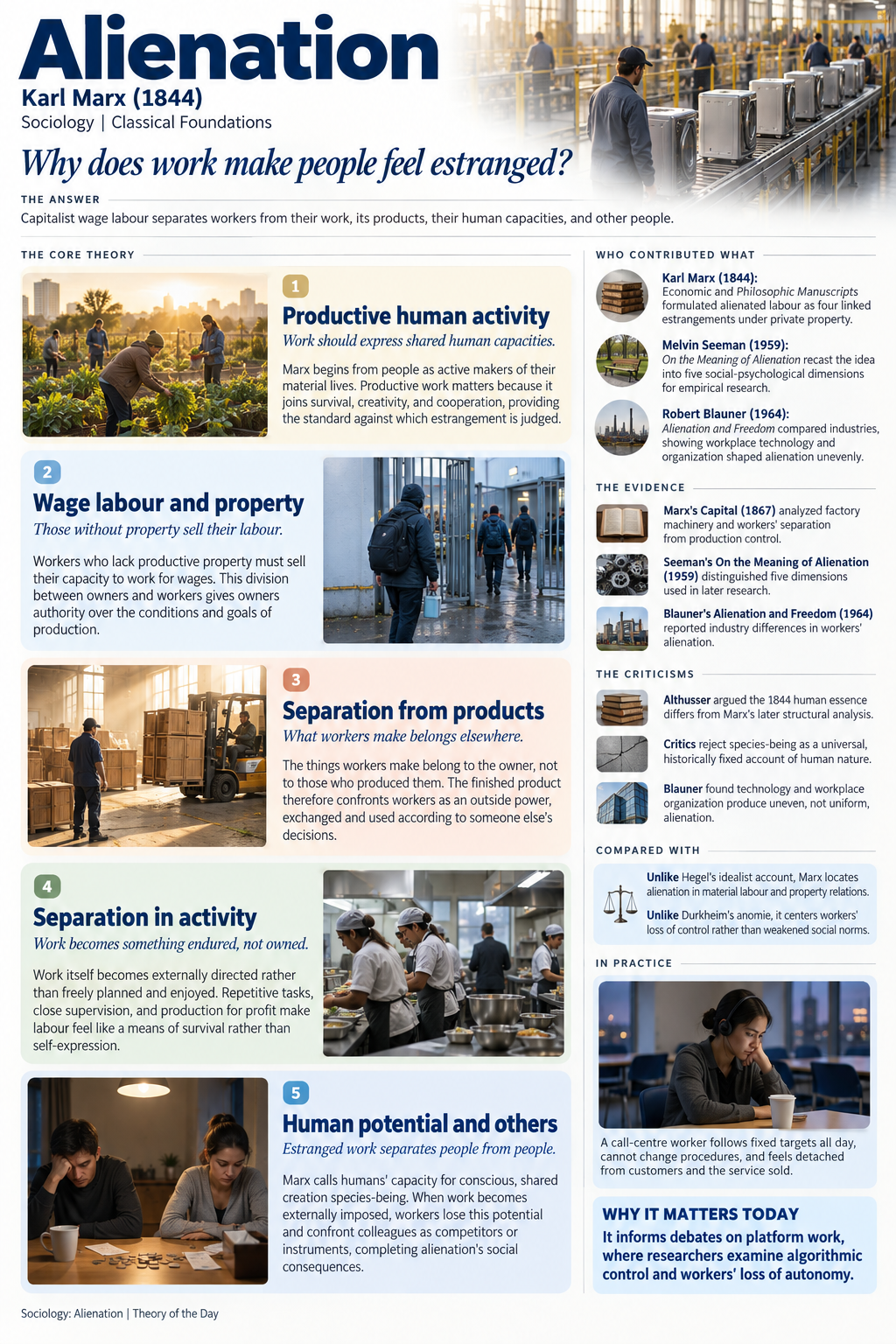
Capitalist wage labour separates workers from their work, its products, their human capacities, and other people.
Marx developed his account of alienation while living in Paris in 1844, amid rapid industrialization and the growth of wage labour in Europe. In the Economic and Philosophic Manuscripts of 1844, published posthumously in 1932, he asked why work that sustains human life so often seems degrading. Marx drew on G. W. F. Hegel's idea of alienation and Ludwig Feuerbach's materialism, but shifted the issue from philosophy and religion to labour, property, and class relations.
Marx's central claim is that capitalist wage labour estranges workers because they do not control the conditions or purposes of production. People must sell their labour power when they lack land, tools, or other productive property. Owners purchase this labour and direct production toward profit. Workers are thereby alienated from the product they make, from the activity of working, from their capacity for conscious and cooperative creation, and from other people, whom capitalist competition tends to position as rivals or means to an end.
Marx supplied the foundational account of alienated labour in 1844 and developed a more systematic critique of capitalist production in Capital, first published in 1867. In 1959, American sociologist Melvin Seeman translated alienation into five dimensions suited to social-scientific research: powerlessness, meaninglessness, normlessness, isolation, and self-estrangement. Robert Blauner's Alienation and Freedom, published in 1964, then compared workers across industries and stressed that particular technologies and workplace arrangements shape alienation differently.
Alienation is primarily a theoretical diagnosis rather than a theory established by one decisive experiment. Marx used observations of industrial capitalism, political economy, and factory production, particularly in Capital, to explain workers' limited control. Seeman's framework enabled surveys and other empirical measures. Blauner's research, based on workers in several industries, found different levels of reported alienation across printing, automobile, textile, and chemical work. This supported the view that workplace organization matters, while complicating claims that all industrial work produces the same experience.
The theory has faced important objections. Critics argue that Marx's idea of species-being relies on a contested account of universal human nature. Louis Althusser argued that the early, humanist language of alienation differs sharply from Marx's later structural analysis of capitalism. Others note that workers can find solidarity, skill, pride, and meaning in employment, even under unequal conditions. Later labour-process research therefore tends to study degrees and forms of worker control rather than treating alienation as identical in every occupation.
Alienation remains important because it connects subjective dissatisfaction to institutional arrangements. It is widely used in research and debate on precarious employment, digital labour, and platform work, where algorithms allocate tasks, monitor performance, and constrain workers' discretion. The theory directs attention beyond individual morale: it asks who owns productive resources, who controls work, and whether people can recognize themselves in the social world they collectively create.
The core theory
1. Productive human activity
Marx begins from people as active makers of their material lives. Productive work matters because it joins survival, creativity, and cooperation, providing the standard against which estrangement is judged.
2. Wage labour and property
Workers who lack productive property must sell their capacity to work for wages. This division between owners and workers gives owners authority over the conditions and goals of production.
3. Separation from products
The things workers make belong to the owner, not to those who produced them. The finished product therefore confronts workers as an outside power, exchanged and used according to someone else's decisions.
4. Separation in activity
Work itself becomes externally directed rather than freely planned and enjoyed. Repetitive tasks, close supervision, and production for profit make labour feel like a means of survival rather than self-expression.
5. Human potential and others
Marx calls humans' capacity for conscious, shared creation species-being. When work becomes externally imposed, workers lose this potential and confront colleagues as competitors or instruments, completing alienation's social consequences.
The argument in four steps
- Humans realize themselves by consciously transforming nature together through productive activity.
- Capitalist private property makes most producers sell their labour power to owners.
- Owners control the product, labour process, and purposes of production.
- Therefore wage labour estranges workers from products, activity, human potential, and one another.
How it works
- Workers enter employment because they lack independent access to land, tools, and productive property.
- Market dependence, division of labour, and managerial authority organize work around profit rather than workers' purposes.
- The degree of worker ownership and control over production decides whether estrangement is overcome.
Who contributed what
- Karl Marx (1844): Economic and Philosophic Manuscripts formulated alienated labour as four linked estrangements under private property.
- Melvin Seeman (1959): On the Meaning of Alienation recast the idea into five social-psychological dimensions for empirical research.
- Robert Blauner (1964): Alienation and Freedom compared industries, showing workplace technology and organization shaped alienation unevenly.
Compared with rival views
- Unlike Hegel's idealist account, Marx locates alienation in material labour and property relations.
- Unlike Durkheim's anomie, it centers workers' loss of control rather than weakened social norms.
Further reading
- Karl Marx, Economic and Philosophic Manuscripts of 1844 (1844)
- David McLellan, Marx's Concept of Man (1963)
- Bertell Ollman, Alienation: Marx's Conception of Man in Capitalist Society (1971)