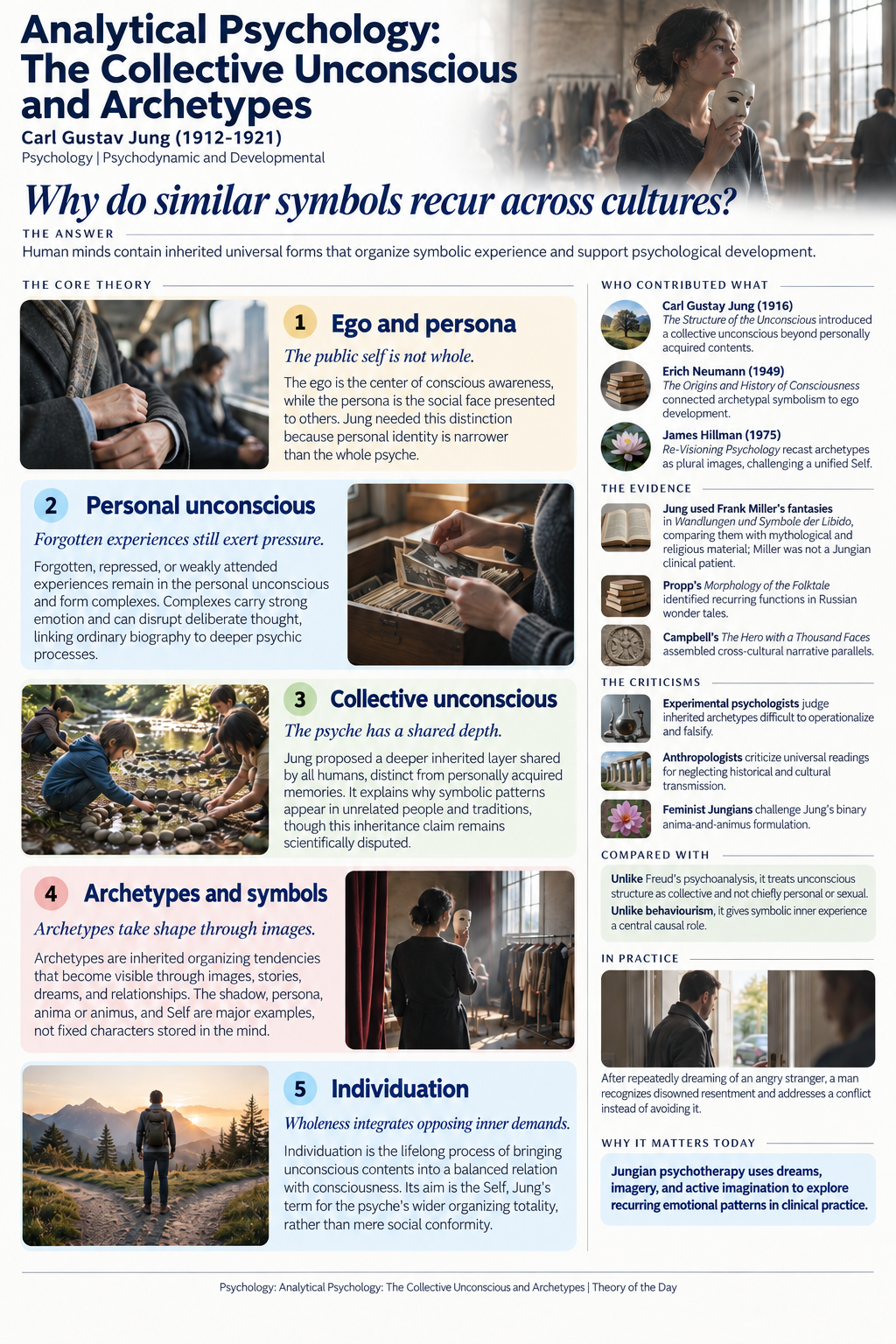
Infographic of: Analytical Psychology: The Collective Unconscious and Archetypes
Psychology: Psychodynamic and Developmental
Analytical Psychology: The Collective Unconscious and Archetypes
Carl Gustav Jung (1912-1921)
Human minds contain inherited universal forms that organize symbolic experience and support psychological development.
Analytical psychology arose from Carl Gustav Jung's break with Sigmund Freud during the years before the First World War. Jung had initially been Freud's prominent collaborator, but he rejected Freud's emphasis on sexual drives and the view that the unconscious was primarily formed by personal repression. Jung interpreted Frank Miller's fantasies alongside mythological and religious material in Wandlungen und Symbole der Libido (1911–1912). The later English title is Symbols of Transformation. Between 1916 and 1921, he set out the ideas that became the framework of analytical psychology.
Jung divided the psyche into consciousness, a personal unconscious, and a collective unconscious. The personal unconscious contains forgotten and repressed experience, often organized in emotionally powerful complexes. The collective unconscious was Jung's more controversial proposal: an inherited psychic layer common to humanity. Its contents are archetypes, which Jung described as organizing forms rather than inherited pictures or memories. Archetypes appear through culturally specific symbols in dreams, fantasies, myths, art, and relationships.
Jung developed the theory himself, introducing the collective unconscious in his 1916 essay The Structure of the Unconscious and further elaborating archetypes in later writings. His 1921 Psychological Types also developed concepts of introversion and extraversion, although these are not themselves archetypes. Erich Neumann extended Jung's approach in The Origins and History of Consciousness in 1949, interpreting mythic images as stages in ego development. In 1975, James Hillman developed archetypal psychology, emphasizing multiple images and questioning Jung's tendency to organize development around a unified Self.
The principal material supporting Jung's interpretations consisted of clinical observations, dreams, comparative mythology, religion, and folklore rather than controlled experiments. The book interpreted the fantasies of Frank Miller, a woman whose material Jung received via Théodore Flournoy; she was not Jung's patient. Vladimir Propp's 1928 analysis of Russian wonder tales identified recurring narrative functions, and Joseph Campbell's 1949 comparative study assembled parallels among hero stories. Such work documents recurring patterns in narratives, but it does not demonstrate that these patterns are biologically inherited archetypes. Cultural contact, shared social problems, and common features of human cognition offer alternative explanations.
The theory has consequently faced major criticism. Experimental psychologists argue that archetypes lack precise operational definitions and generate predictions that are difficult to falsify. Anthropologists warn that universal interpretations can remove stories from their historical settings and understate cultural transmission. Feminist scholars and Jungian practitioners have particularly criticized Jung's gendered anima and animus concepts, which associate femininity and masculinity with fixed inner opposites. Later Jungians have often treated archetypes more cautiously as interpretive patterns rather than literal inherited structures.
Analytical psychology remains important in Jungian psychotherapy, dream interpretation, religious studies, literary criticism, and discussions of myth in popular culture. Its enduring contribution is a vocabulary for thinking about symbolic experience, disowned aspects of personality, and psychological integration. Its strongest contemporary use is therefore interpretive and clinical, not as a confirmed biological account of a universal inherited unconscious.
The core theory
1. Ego and persona
The ego is the center of conscious awareness, while the persona is the social face presented to others. Jung needed this distinction because personal identity is narrower than the whole psyche.
2. Personal unconscious
Forgotten, repressed, or weakly attended experiences remain in the personal unconscious and form complexes. Complexes carry strong emotion and can disrupt deliberate thought, linking ordinary biography to deeper psychic processes.
3. Collective unconscious
Jung proposed a deeper inherited layer shared by all humans, distinct from personally acquired memories. It explains why symbolic patterns appear in unrelated people and traditions, though this inheritance claim remains scientifically disputed.
4. Archetypes and symbols
Archetypes are inherited organizing tendencies that become visible through images, stories, dreams, and relationships. The shadow, persona, anima or animus, and Self are major examples, not fixed characters stored in the mind.
5. Individuation
Individuation is the lifelong process of bringing unconscious contents into a balanced relation with consciousness. Its aim is the Self, Jung's term for the psyche's wider organizing totality, rather than mere social conformity.
The argument in four steps
- Conscious awareness is limited, while forgotten experiences remain active as emotionally charged personal complexes.
- Across cultures, dreams, myths, and rituals display recurrent symbolic patterns beyond individual biography.
- These patterns express archetypes, inherited organizing forms rather than fully formed images or memories.
- Therefore, development requires integrating archetypal contents with consciousness around the regulating Self.
How it works
- Emotional conflict activates a complex and draws attention away from the ego's usual plans.
- Dreams, fantasies, and relationships give conflict symbolic form; repression and one-sided attitudes resist recognition.
- Individuation succeeds when conscious life integrates these contents into a balanced relation with the Self.
Who contributed what
- Carl Gustav Jung (1916): The Structure of the Unconscious introduced a collective unconscious beyond personally acquired contents.
- Erich Neumann (1949): The Origins and History of Consciousness connected archetypal symbolism to ego development.
- James Hillman (1975): Re-Visioning Psychology recast archetypes as plural images, challenging a unified Self.
Compared with rival views
- Unlike Freud's psychoanalysis, it treats unconscious structure as collective and not chiefly personal or sexual.
- Unlike behaviourism, it gives symbolic inner experience a central causal role.
Further reading
- Carl Gustav Jung, The Archetypes and the Collective Unconscious (1959)
- Andrew Samuels, Jung and the Post-Jungians (1985)
- Sonu Shamdasani, Jung and the Making of Modern Psychology (2003)