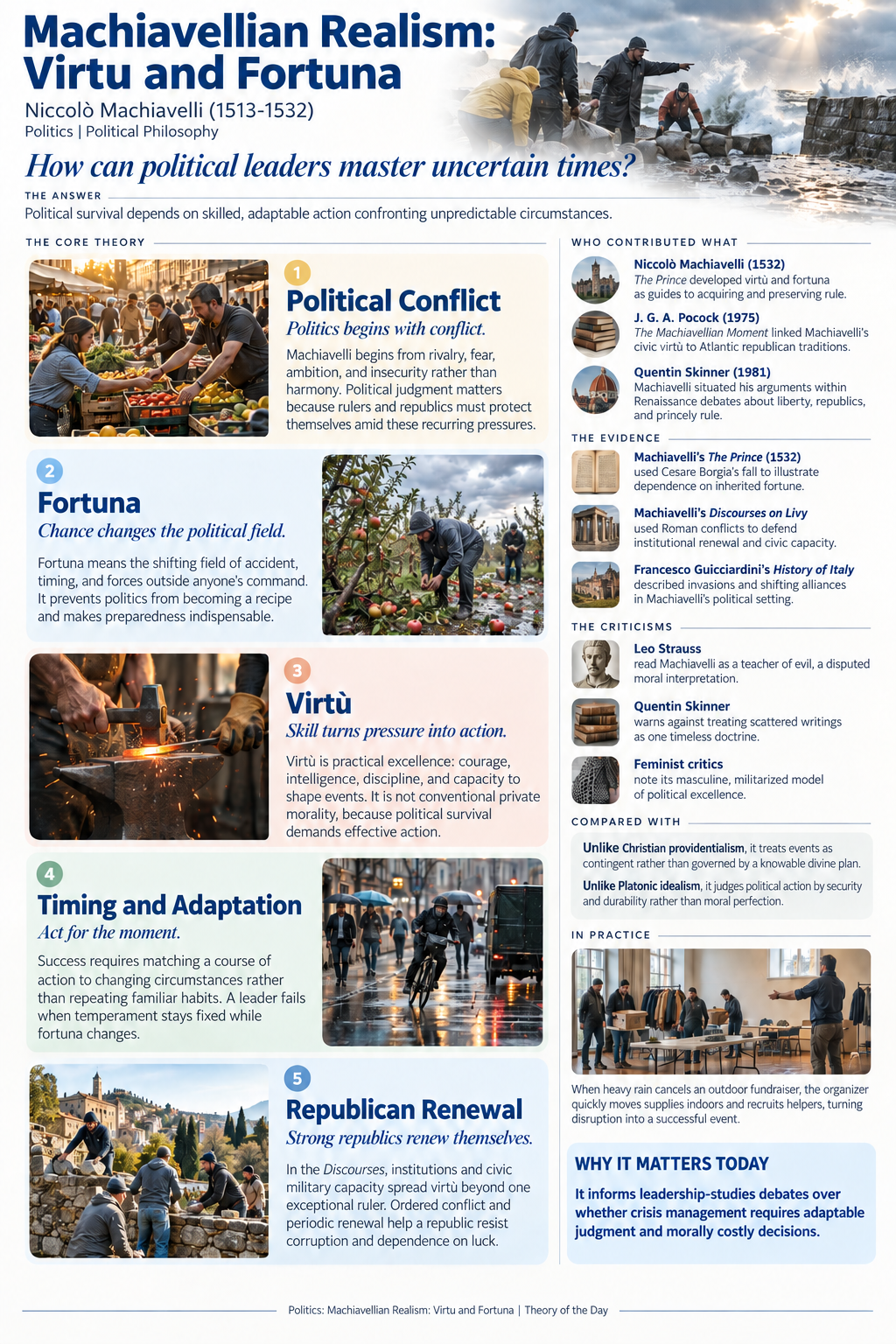
Infographic of: Machiavellian Realism: Virtu and Fortuna
Politics: Political Philosophy
Machiavellian Realism: Virtu and Fortuna
Niccolò Machiavelli (1513-1532)
Political survival depends on skilled, adaptable action confronting unpredictable circumstances.
Machiavellian realism arose from the political turbulence of Renaissance Italy. Niccolò Machiavelli served the Florentine republic from 1498 until the Medici family returned to power in 1512, after which he was dismissed and briefly imprisoned. In enforced retirement he wrote The Prince in 1513; it was published posthumously in 1532. He also developed republican arguments in the Discourses on Livy, drafted mainly during the 1510s and published in 1531. The label “Machiavellian realism” is modern, but it captures his rejection of comforting assumptions that politics follows conventional morality or stable rules.
The central terms are virtù and fortuna. Fortuna means contingency: accidents, shifting alliances, invasions, public moods, natural events, and inherited circumstances that lie partly beyond human control. Virtù does not simply mean moral virtue. It is a practical political capacity combining courage, intelligence, resolve, strategic flexibility, and the ability to recognize a moment for action. Machiavelli argues that no leader controls events completely, but passive dependence on fortune is politically disastrous. Those who adapt their conduct to circumstances are better placed to preserve a state or seize an opportunity.
Machiavelli made this argument most sharply in The Prince, where he addressed the problems of new and insecure principalities. He used examples from ancient history and contemporary Italian politics, notably Cesare Borgia, to examine how power is gained and lost. In the Discourses, he extended related concerns to republics. There he stressed civic participation, citizen soldiers, institutional checks, and the productive role of conflict between social groups. J. G. A. Pocock’s 1975 The Machiavellian Moment influentially traced this civic language through later republican thought, while Quentin Skinner’s 1981 study placed Machiavelli in the specific disputes of Renaissance political language.
This is not a modern empirical theory supported by controlled experiments. Its evidence consists mainly of historical interpretation, examples, and political judgment. The Prince draws lessons from Borgia’s rapid rise and collapse, as well as from Roman and Greek precedents. The Discourses uses Livy’s history of Rome to argue that conflict between elites and ordinary citizens helped preserve Roman liberty when institutionalized. Francesco Guicciardini’s later History of Italy likewise portrayed the unstable invasions and alliances that made contingency a pressing concern for Italian political thinkers.
Machiavelli is often caricatured as advising rulers simply to be cruel or deceitful. That is too simple. He does allow that rulers may need coercion, deception, or harsh measures when political necessity requires them, but he also condemns actions that create lasting hatred or destroy civic strength. Leo Strauss’s famous interpretation of Machiavelli as a “teacher of evil” remains contested. Other scholars warn that The Prince and the Discourses should not be collapsed into one seamless doctrine: the former centers on princely rule, while the latter gives a larger place to republican liberty. Feminist critics also question the theory’s strongly masculine and military imagery.
The theory still matters because it directs attention to political judgment under uncertainty. It asks leaders to distinguish what they can shape from what they must confront, while warning that yesterday’s successful strategy may fail in altered conditions. In political philosophy, it remains central to debates about realism, emergency power, leadership, republican institutions, and the relationship between ethical ideals and political survival. Its enduring challenge is not that morality is irrelevant, but that political responsibility requires acting effectively in a world that refuses to remain stable.
The core theory
1. Political Conflict
Machiavelli begins from rivalry, fear, ambition, and insecurity rather than harmony. Political judgment matters because rulers and republics must protect themselves amid these recurring pressures.
2. Fortuna
Fortuna means the shifting field of accident, timing, and forces outside anyone's command. It prevents politics from becoming a recipe and makes preparedness indispensable.
3. Virtù
Virtù is practical excellence: courage, intelligence, discipline, and capacity to shape events. It is not conventional private morality, because political survival demands effective action.
4. Timing and Adaptation
Success requires matching a course of action to changing circumstances rather than repeating familiar habits. A leader fails when temperament stays fixed while fortuna changes.
5. Republican Renewal
In the Discourses, institutions and civic military capacity spread virtù beyond one exceptional ruler. Ordered conflict and periodic renewal help a republic resist corruption and dependence on luck.
The argument in four steps
- Political communities face conflict, ambition, external threats, and changing circumstances.
- Chance distributes opportunities and disasters without regard for moral desert.
- Effective rulers read circumstances and act boldly, flexibly, and at the right moment.
- So political survival depends on virtù meeting fortuna through institutions and decisive action.
How it works
- A crisis or opening disrupts established arrangements and exposes leaders to new risks and opportunities.
- Habit, indecision, and dependence on inherited advantages block an effective response to changing conditions.
- The outcome turns on whether disciplined judgment, force, and institutions fit the particular moment.
Who contributed what
- Niccolò Machiavelli (1532): The Prince developed virtù and fortuna as guides to acquiring and preserving rule.
- J. G. A. Pocock (1975): The Machiavellian Moment linked Machiavelli's civic virtù to Atlantic republican traditions.
- Quentin Skinner (1981): Machiavelli situated his arguments within Renaissance debates about liberty, republics, and princely rule.
Compared with rival views
- Unlike Christian providentialism, it treats events as contingent rather than governed by a knowable divine plan.
- Unlike Platonic idealism, it judges political action by security and durability rather than moral perfection.
Further reading
- Niccolò Machiavelli, The Prince (1532)
- J. G. A. Pocock, The Machiavellian Moment (1975)
- Quentin Skinner, Machiavelli (1981)