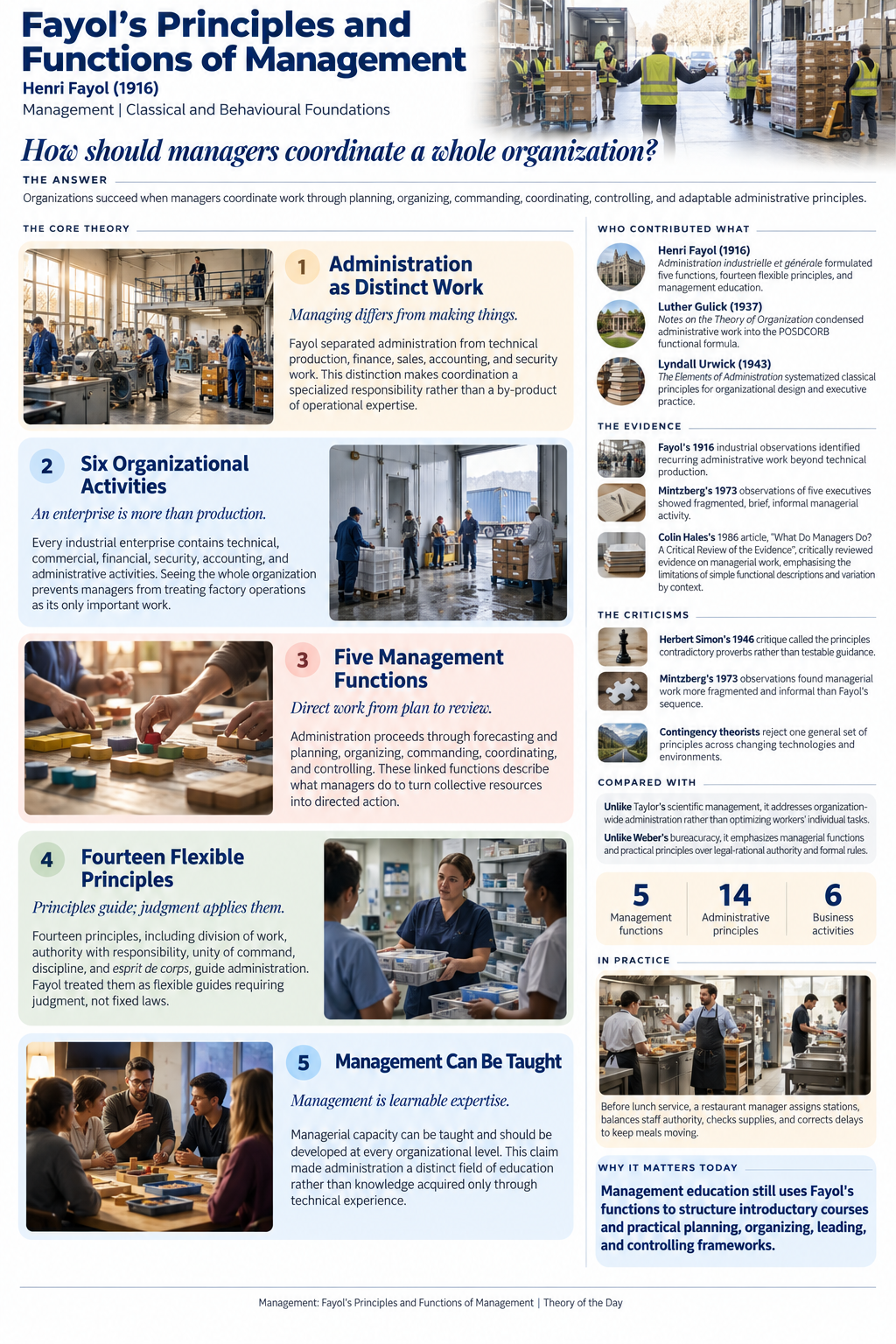
Infographic of: Fayol's Principles and Functions of Management
Management: Classical and Behavioural Foundations
Fayol's Principles and Functions of Management
Henri Fayol (1916)
Organizations succeed when managers coordinate work through planning, organizing, commanding, coordinating, controlling, and adaptable administrative principles.
Henri Fayol developed his administrative theory while working as a French mining engineer and senior executive during a period of expanding industrial enterprises. In Administration industrielle et générale, published in 1916, he addressed a problem that Frederick Winslow Taylor's factory-focused scientific management did not fully cover: how to direct and coordinate an entire organization. Fayol sought to identify recurring work performed by senior administrators across different kinds of enterprise.
Fayol argued that every enterprise includes six broad activities: technical, commercial, financial, security, accounting, and administrative. Administration was distinctive because it integrated the rest. He described five administrative functions: forecasting and planning, organizing, commanding, coordinating, and controlling. In later management language, commanding is often replaced by leading or directing. Managers use these functions to set a course, arrange people and resources, direct action, connect separate efforts, and compare results with plans.
Fayol also set out fourteen principles, including division of work, authority matched with responsibility, discipline, unity of command, unity of direction, scalar chain, initiative, and esprit de corps. He did not present them as inflexible laws: their use required judgment in particular circumstances. Fayol further argued that management could be taught. Luther Gulick extended functional administrative analysis in 1937 through POSDCORB, while Lyndall Urwick systematized classical administrative principles in The Elements of Administration in 1943.
The theory originated primarily in Fayol's accumulated industrial experience rather than controlled empirical research. Its influence is visible in later descriptions of managerial work and management curricula. However, observational research also qualified it. Henry Mintzberg's 1973 study of five chief executives found their work brief, varied, interrupted, and heavily interpersonal, rather than a neat progression through functions. The relevant source is Colin Hales, "What Do Managers Do? A Critical Review of the Evidence" (1986).
The most influential criticism came from Herbert Simon's 1946 essay, "The Proverbs of Administration." Simon argued that many classical principles could point to opposite recommendations: for example, specialization and unity of command could conflict with other organizational needs. Contingency theory later challenged the assumption that general principles work equally well everywhere, stressing that appropriate structures depend on technology, environment, size, and uncertainty. Critics also note that Fayol's language of command reflects the hierarchical industrial setting of his time.
Fayol still matters because his framework supplies a durable vocabulary for discussing managerial work. Textbooks commonly organize introductory management around planning, organizing, leading, and controlling, a modernized version of his functions. The theory is most useful as a broad map of management responsibilities rather than as a set of universal rules. It reminds managers that specialized departments cannot achieve organizational goals without deliberate coordination, authority, feedback, and collective purpose.
The core theory
1. Administration as Distinct Work
Fayol separated administration from technical production, finance, sales, accounting, and security work. This distinction makes coordination a specialized responsibility rather than a by-product of operational expertise.
2. Six Organizational Activities
Every industrial enterprise contains technical, commercial, financial, security, accounting, and administrative activities. Seeing the whole organization prevents managers from treating factory operations as its only important work.
3. Five Management Functions
Administration proceeds through forecasting and planning, organizing, commanding, coordinating, and controlling. These linked functions describe what managers do to turn collective resources into directed action.
4. Fourteen Flexible Principles
Fourteen principles, including division of work, authority with responsibility, unity of command, discipline, and esprit de corps, guide administration. Fayol treated them as flexible guides requiring judgment, not fixed laws.
5. Management Can Be Taught
Managerial capacity can be taught and should be developed at every organizational level. This claim made administration a distinct field of education rather than knowledge acquired only through technical experience.
The argument in four steps
- Large organizations combine specialized work, resources, and people whose activities require alignment.
- Operational expertise alone does not integrate interdependent activities across the whole enterprise.
- Managers integrate activity through planning, organizing, commanding, coordinating, and controlling under shared principles.
- Therefore effective administration creates orderly collective effort toward organizational goals.
How it works
- Work begins with forecasting and planning, followed by arranging roles, resources, and lines of authority.
- Conflicting orders, weak discipline, and mismatched authority disrupt coordinated execution.
- Results depend on control: managers compare activity with plans and correct departures.
Who contributed what
- Henri Fayol (1916): Administration industrielle et générale formulated five functions, fourteen flexible principles, and management education.
- Luther Gulick (1937): Notes on the Theory of Organization condensed administrative work into the POSDCORB functional formula.
- Lyndall Urwick (1943): The Elements of Administration systematized classical principles for organizational design and executive practice.
Compared with rival views
- Unlike Taylor's scientific management, it addresses organization-wide administration rather than optimizing workers' individual tasks.
- Unlike Weber's bureaucracy, it emphasizes managerial functions and practical principles over legal-rational authority and formal rules.
Further reading
- Henri Fayol, Administration industrielle et générale (1916)
- Daniel A. Wren, The History of Management Thought (2005)
- Herbert A. Simon, The Proverbs of Administration (1946)