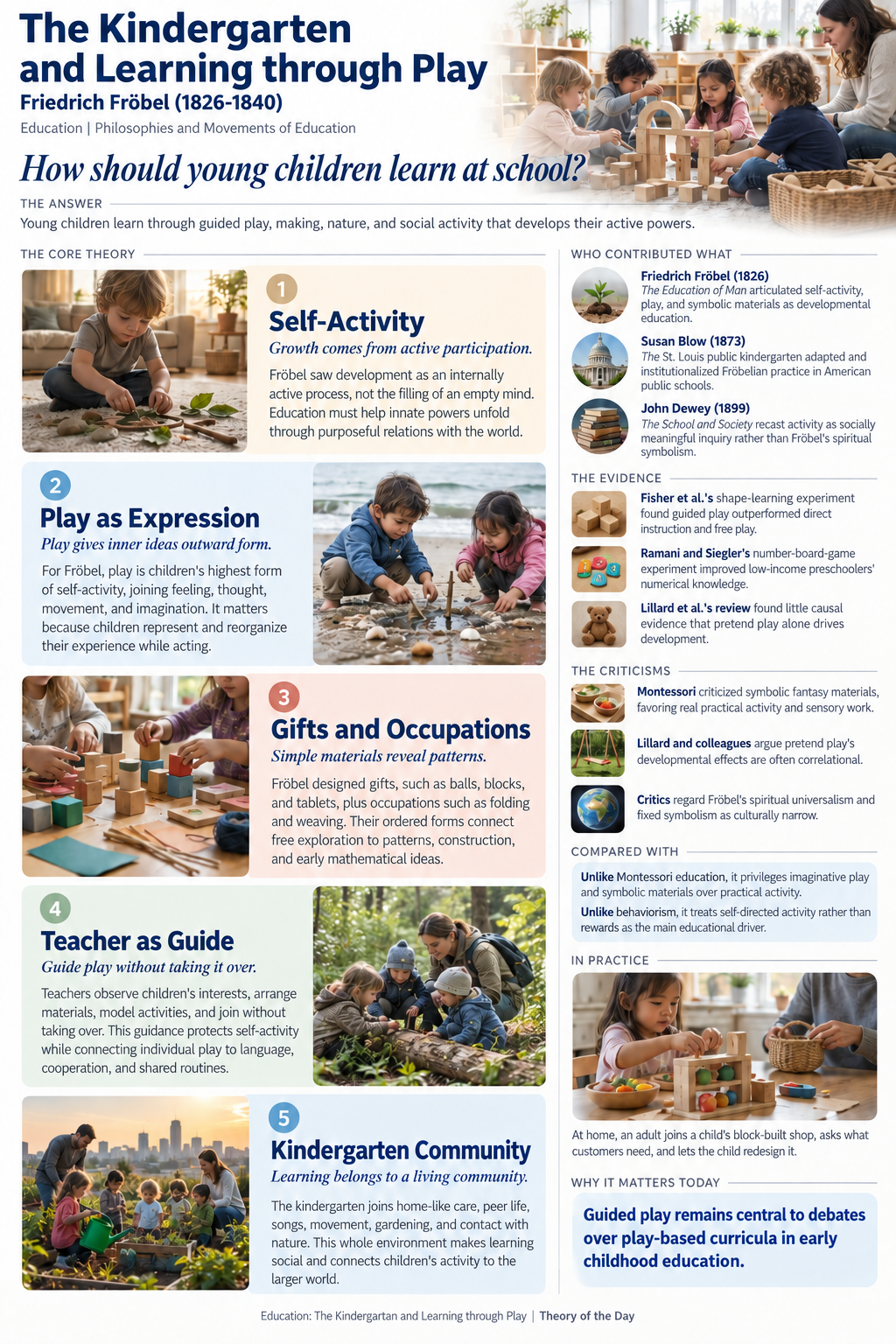
Infographic of: The Kindergarten and Learning through Play
Education: Philosophies and Movements of Education
The Kindergarten and Learning through Play
Friedrich Fröbel (1826-1840)
Young children learn through guided play, making, nature, and social activity that develops their active powers.
The kindergarten philosophy emerged from Friedrich Fröbel's early nineteenth-century German educational thought. Fröbel had been influenced by Romantic ideas about nature, unity, and organic growth, as well as by his experience with Johann Heinrich Pestalozzi's educational work. In The Education of Man of 1826, he described education as the cultivation of powers already active within the child. He established an early childhood institute at Bad Blankenburg in 1837 and adopted the name Kindergarten, or children's garden, in 1840.
Fröbel's central claim was that young children learn through self-activity: purposeful activity initiated and shaped by the child. Play was not merely rest or amusement in this account. It was the leading way children expressed feelings, represented what they had experienced, discovered relationships, and formed ideas. Fröbel did not mean that adults should leave children entirely alone. He proposed carefully arranged activities, materials, songs, movement, gardening, and social routines through which play acquired structure and meaning.
Fröbel created a sequence of play materials called gifts, including balls, blocks, sticks, and tablets, and occupations such as folding, weaving, drawing, and modeling. He believed their forms revealed relationships between parts and wholes and encouraged construction, pattern-making, and symbolic thought. The teacher was to observe children, prepare the environment, demonstrate possibilities, and support cooperation without replacing children's initiative. Susan Blow helped establish Fröbelian kindergartens in United States public schools, beginning in St. Louis in 1873. John Dewey later retained the importance of activity but reinterpreted it as social inquiry rather than an expression of Fröbel's spiritual philosophy.
Fröbel did not test his claims through modern experiments, so present evidence comes chiefly from later developmental research on play and guided learning. Ramani and Robert Siegler's 2008 study found that structured number-board games improved numerical knowledge among low-income preschool children. In 2013, Kathy Hirsh-Pasek's colleagues, led by Kathy Fisher, reported that guided play supported preschoolers' geometric learning more effectively than free play or direct instruction in their experiment. Such findings support structured playful activity, though they do not prove Fröbel's wider philosophical system.
The theory has important limitations. Fröbel's claims about universal spiritual meanings in particular shapes and symbols are difficult to test and are often viewed as culturally narrow. Maria Montessori objected to educational reliance on fantasy and symbolic play, preferring purposeful work with real objects and carefully designed sensory materials. Modern reviewers, including Angeline Lillard and colleagues in 2013, have also warned that evidence does not establish that pretend play by itself causes broad cognitive or social development. Contemporary play-based education therefore distinguishes free play, guided play, games, and adult-led activities rather than treating all play alike.
The kindergarten tradition still matters because it established early childhood education as a distinctive stage with its own methods, materials, and social purposes. Its influence is visible in nursery schools, kindergarten classrooms, block areas, music and movement, outdoor learning, and child-centered teaching. Current policy debates concern how to preserve meaningful play while also supporting literacy, mathematics, inclusion, and equitable access to high-quality early education. Fröbel's enduring question is not whether adults should teach, but how adult guidance can strengthen rather than displace children's active engagement.
The core theory
1. Self-Activity
Fröbel saw development as an internally active process, not the filling of an empty mind. Education must help innate powers unfold through purposeful relations with the world.
2. Play as Expression
For Fröbel, play is children's highest form of self-activity, joining feeling, thought, movement, and imagination. It matters because children represent and reorganize their experience while acting.
3. Gifts and Occupations
Fröbel designed gifts, such as balls, blocks, and tablets, plus occupations such as folding and weaving. Their ordered forms connect free exploration to patterns, construction, and early mathematical ideas.
4. Teacher as Guide
Teachers observe children's interests, arrange materials, model activities, and join without taking over. This guidance protects self-activity while connecting individual play to language, cooperation, and shared routines.
5. Kindergarten Community
The kindergarten joins home-like care, peer life, songs, movement, gardening, and contact with nature. This whole environment makes learning social and connects children's activity to the larger world.
The argument in four steps
- Children possess inner capacities that develop through self-active engagement with people and materials.
- Play lets children express experience, imagine relationships, and connect action with emerging ideas.
- Purposeful materials and guided group activity give play orderly forms and social meaning.
- Therefore kindergarten should cultivate development through guided play, hands-on work, nature, and community.
How it works
- Children choose and transform objects, movement, songs, and make-believe into meaningful activity.
- Adult over-direction and abstract drill interrupt self-activity; attentive guidance sustains it.
- Learning is secured when play links personal experience to practical making, cooperation, and shared forms.
Who contributed what
- Friedrich Fröbel (1826): The Education of Man articulated self-activity, play, and symbolic materials as developmental education.
- Susan Blow (1873): The St. Louis public kindergarten adapted and institutionalized Fröbelian practice in American public schools.
- John Dewey (1899): The School and Society recast activity as socially meaningful inquiry rather than Fröbel's spiritual symbolism.
Compared with rival views
- Unlike Montessori education, it privileges imaginative play and symbolic materials over practical activity.
- Unlike behaviorism, it treats self-directed activity rather than rewards as the main educational driver.
Further reading
- Friedrich Fröbel, The Education of Man (1826)
- Tina Bruce, Friedrich Froebel: A Critical Introduction to Key Themes and Debates (2012)
- Norman Brosterman, Inventing Kindergarten (1997)