Infographic of: Historical Materialism
Sociology: Classical Foundations
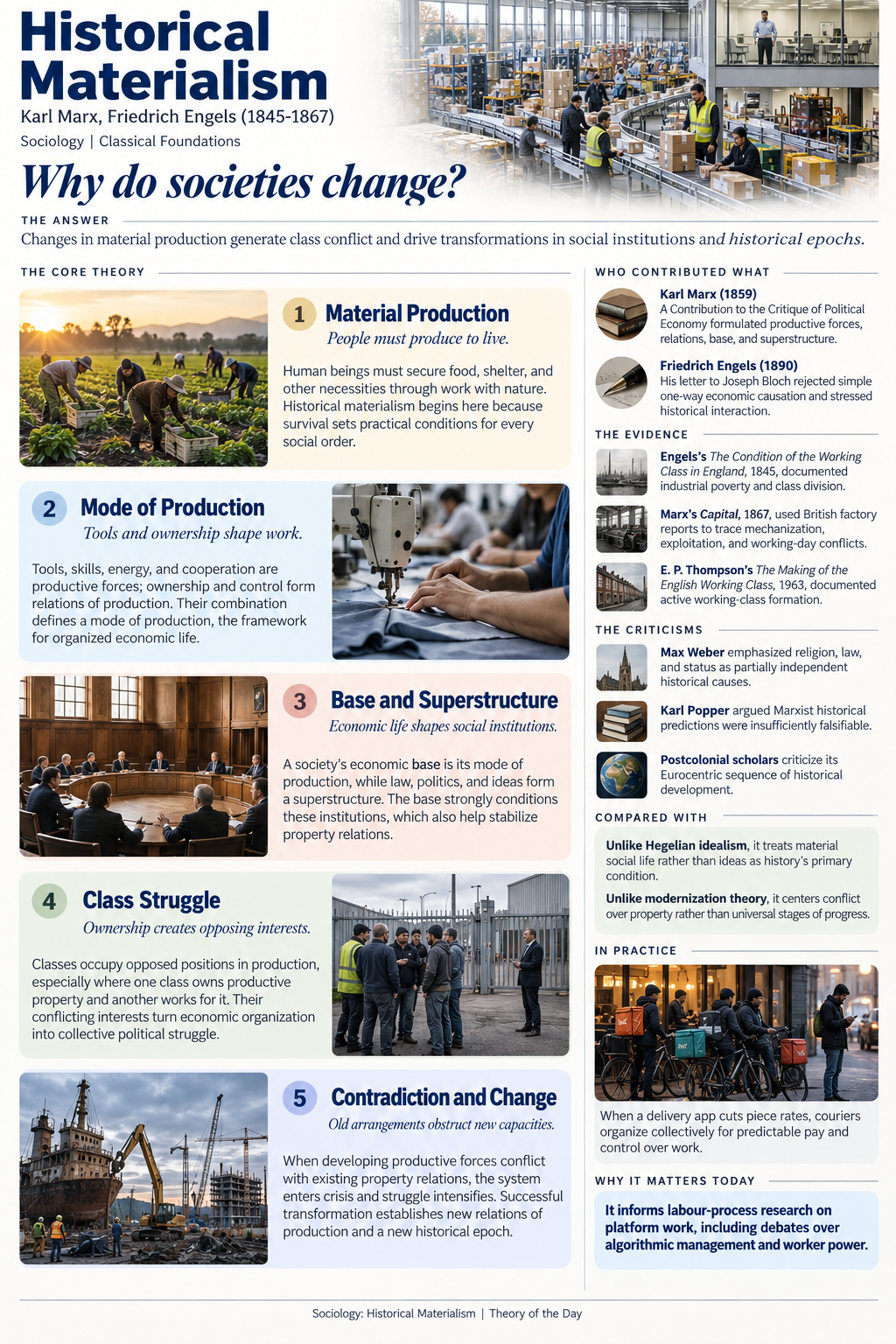
Historical Materialism
Karl Marx, Friedrich Engels (1845-1867)
Changes in material production generate class conflict and drive transformations in social institutions and historical epochs.
Historical materialism still matters because it directs attention to the organization of work, ownership, and power beneath public institutions and social beliefs. It remains important in economic sociology, labour history, political economy, and studies of capitalism. Researchers use it to examine supply chains, automation, precarious employment, and platform labour. Its strongest continuing contribution is not a fixed prediction of inevitable revolution, but a disciplined question: how do changing material conditions and conflicts over control of production reshape social life?
The core theory
1. Material Production
Human beings must secure food, shelter, and other necessities through work with nature. Historical materialism begins here because survival sets practical conditions for every social order.
2. Mode of Production
Tools, skills, energy, and cooperation are productive forces; ownership and control form relations of production. Their combination defines a mode of production, the framework for organized economic life.
3. Base and Superstructure
A society’s economic base is its mode of production, while law, politics, and ideas form a superstructure. The base strongly conditions these institutions, which also help stabilize property relations.
4. Class Struggle
Classes occupy opposed positions in production, especially where one class owns productive property and another works for it. Their conflicting interests turn economic organization into collective political struggle.
5. Contradiction and Change
When developing productive forces conflict with existing property relations, the system enters crisis and struggle intensifies. Successful transformation establishes new relations of production and a new historical epoch.
The argument in four steps
- People must produce food, shelter, and necessities before they can sustain other social activities.
- Production organizes people through particular technologies, property arrangements, and divisions of labour.
- Developing productive forces eventually conflict with inherited property relations and create class antagonism.
- Therefore class struggle transforms production relations and produces new historical epochs.
How it works
- New tools, skills, and productive capacities develop within an existing system of ownership and labour.
- Property relations block further development when they protect established class interests against changing productive conditions.
- The balance of organized class forces decides whether conflict preserves or transforms the production system.
Who contributed what
- Karl Marx (1859): A Contribution to the Critique of Political Economy formulated productive forces, relations, base, and superstructure.
- Friedrich Engels (1890): His letter to Joseph Bloch rejected simple one-way economic causation and stressed historical interaction.
Compared with rival views
- Unlike Hegelian idealism, it treats material social life rather than ideas as history’s primary condition.
- Unlike modernization theory, it centers conflict over property rather than universal stages of progress.
Further reading
- Karl Marx, A Contribution to the Critique of Political Economy (1859)
- G. A. Cohen, Karl Marx's Theory of History: A Defence (1978)
- E. P. Thompson, The Making of the English Working Class (1963)