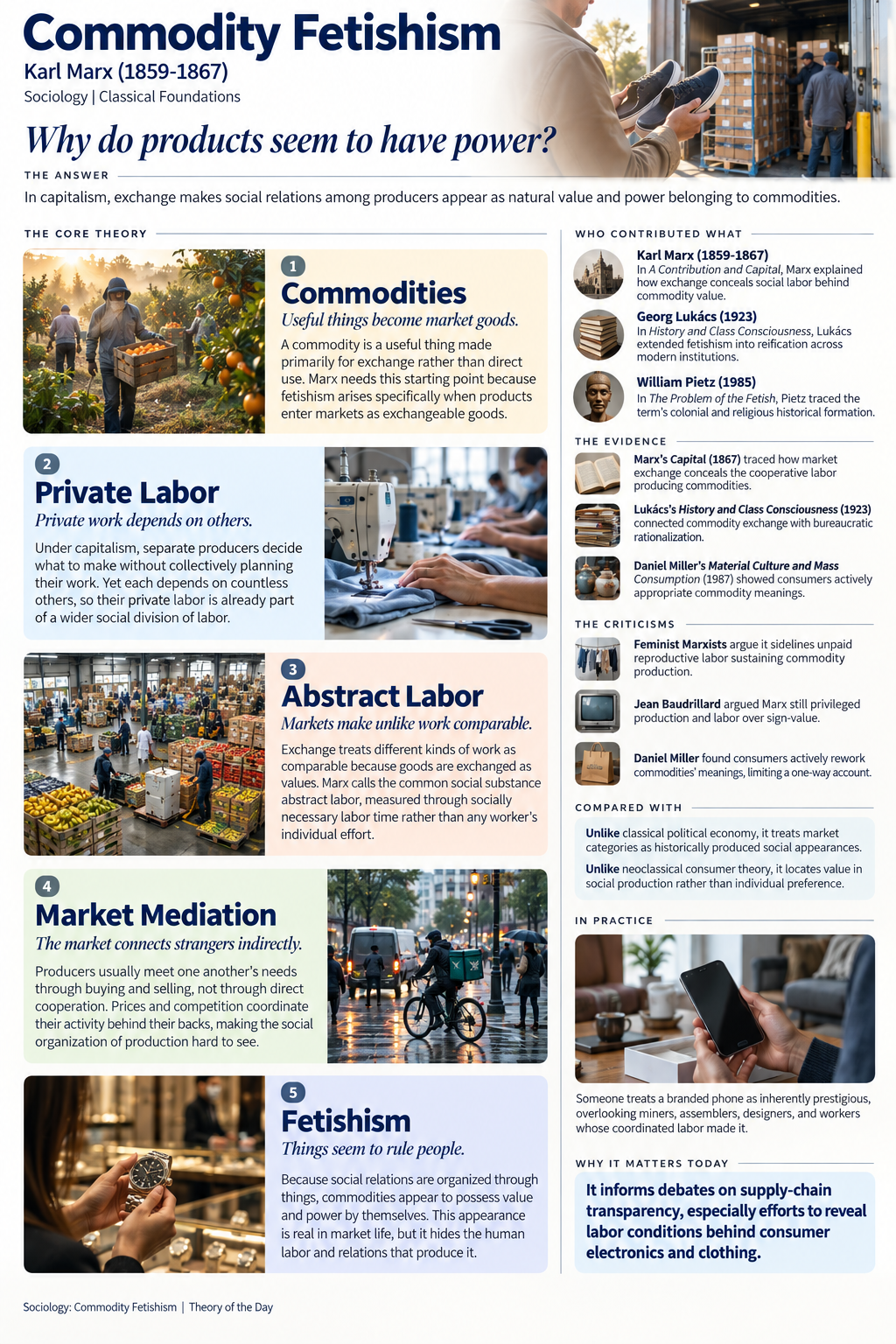
Infographic of: Commodity Fetishism
Sociology: Classical Foundations
Commodity Fetishism
Karl Marx (1859-1867)
In capitalism, exchange makes social relations among producers appear as natural value and power belonging to commodities.
Commodity fetishism arose from Karl Marx's critique of political economy in nineteenth-century Europe, when industrial capitalism was rapidly expanding. Marx first used the idea in A Contribution to the Critique of Political Economy in 1859 and gave its best-known formulation in the opening chapter of Capital, Volume I, published in 1867. He wanted to explain why capitalist market relations appear natural and impersonal rather than historically created by people.
Marx begins with the commodity: a useful object produced for exchange. In a society of separate producers, people do not ordinarily coordinate their work directly. They depend on markets to connect their labor. When goods are exchanged, very different activities, such as weaving, mining, and baking, are treated as comparable values. Marx argues that this comparison expresses abstract social labor, but it appears to buyers and sellers as a property of the goods themselves.
The term fetishism names this reversal of appearance. A social relationship among people takes the form of a relationship among things: commodities, prices, and money seem to act independently. Marx did not mean that people are simply foolish or deceived. Market exchange really does confront individuals as an external system with consequences for their livelihoods. Georg Lukács extended the argument in 1923 through the concept of reification, arguing that commodity-like calculation could shape law, administration, and consciousness. William Pietz later traced the colonial and religious history of the word fetish itself.
The theory is primarily a conceptual and historical analysis, not a hypothesis tested in one experiment. Marx's Capital analyzes the forms of commodity, money, and value to show how market appearances conceal cooperative production. Historical studies of industrial capitalism, including E. P. Thompson's The Making of the English Working Class of 1963, documented the conflicts and social discipline behind apparently impersonal labor markets. Anthropological work such as Daniel Miller's Material Culture and Mass Consumption of 1987 also investigated how people give purchased objects social meanings.
Critics identify important limits. Feminist Marxists argue that Marx's focus on commodities and wage labor can obscure unpaid domestic and care work that reproduces labor power. Jean Baudrillard argued that Marx gave too much explanatory priority to production and labor, underestimating how commodities operate as signs of status and difference. Consumer researchers, including Miller, stress that buyers are not merely passive recipients of market meanings; they creatively incorporate goods into family, cultural, and personal life.
Commodity fetishism remains valuable because it directs attention from attractive objects to the social relations making them possible. It helps analysts ask how brands, prices, and technologies can seem autonomous while depending on workers, resources, logistics, and institutions. In current debates about garment factories, mineral extraction, platform delivery, and electronic supply chains, the concept is used to challenge the apparent separation between consumption and the labor conditions behind it.
The core theory
1. Commodities
A commodity is a useful thing made primarily for exchange rather than direct use. Marx needs this starting point because fetishism arises specifically when products enter markets as exchangeable goods.
2. Private Labor
Under capitalism, separate producers decide what to make without collectively planning their work. Yet each depends on countless others, so their private labor is already part of a wider social division of labor.
3. Abstract Labor
Exchange treats different kinds of work as comparable because goods are exchanged as values. Marx calls the common social substance abstract labor, measured through socially necessary labor time rather than any worker's individual effort.
4. Market Mediation
Producers usually meet one another's needs through buying and selling, not through direct cooperation. Prices and competition coordinate their activity behind their backs, making the social organization of production hard to see.
5. Fetishism
Because social relations are organized through things, commodities appear to possess value and power by themselves. This appearance is real in market life, but it hides the human labor and relations that produce it.
The argument in four steps
- Producers work privately yet depend on one another through exchange.
- Markets compare unlike goods by treating the labor embodied in them as socially equivalent.
- Exchange makes relations among producers appear as value relations among things.
- So commodities seem to possess value and agency independently of the people who make them.
How it works
- Goods enter exchange after separate producers have made them for other people.
- Competition and price movements discipline producers without direct collective planning.
- Repeated exchange stabilizes the appearance that commodities, rather than people, organize social life.
Who contributed what
- Karl Marx (1859-1867): In A Contribution and Capital, Marx explained how exchange conceals social labor behind commodity value.
- Georg Lukács (1923): In History and Class Consciousness, Lukács extended fetishism into reification across modern institutions.
- William Pietz (1985): In The Problem of the Fetish, Pietz traced the term's colonial and religious historical formation.
Compared with rival views
- Unlike classical political economy, it treats market categories as historically produced social appearances.
- Unlike neoclassical consumer theory, it locates value in social production rather than individual preference.
Further reading
- Karl Marx, Capital: A Critique of Political Economy, Volume I (1867)
- Isaak Illich Rubin, Essays on Marx's Theory of Value (1928)
- Michael Taussig, The Devil and Commodity Fetishism in South America (1980)