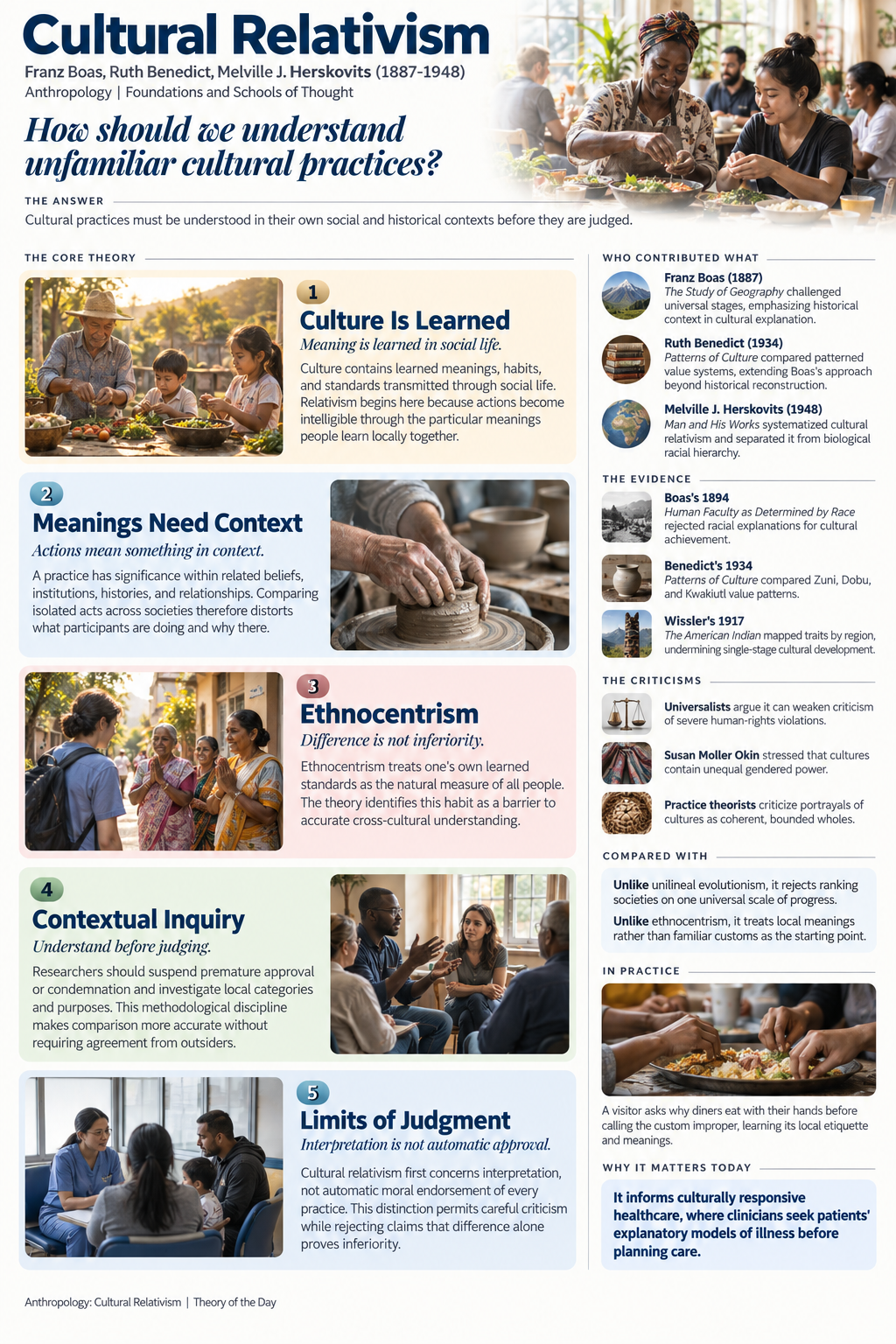
Infographic of: Cultural Relativism
Anthropology: Foundations and Schools of Thought
Cultural Relativism
Franz Boas, Ruth Benedict, Melville J. Herskovits (1887-1948)
Cultural practices must be understood in their own social and historical contexts before they are judged.
Cultural relativism emerged in North American anthropology as a challenge to nineteenth-century evolutionary schemes that ranked societies from “primitive” to “civilized.” Franz Boas, a German-born anthropologist working in the United States, criticized these rankings from the late 1880s onward. He argued that apparent differences among peoples reflected distinct histories, environments, contacts, and learned traditions, not a single universal ladder of development or fixed racial capacities.
The central claim is that a custom must first be understood in relation to the meanings and social arrangements of the people who practise it. Cultural relativism therefore asks researchers to recognize ethnocentrism: the tendency to treat one’s own customs as normal and to judge others by them. Its basic method is contextual inquiry. Anthropologists learn local languages where possible, observe everyday life, and ask how participants themselves explain institutions, values, and actions before making comparisons.
Boas supplied the anti-evolutionist and anti-racial foundations for this approach. His 1887 essay, The Study of Geography, emphasized particular historical processes rather than universal laws of development, while later work directly challenged racial accounts of culture. Ruth Benedict developed a comparative version in Patterns of Culture (1934), arguing that societies organize values and dispositions into distinctive cultural patterns. Melville J. Herskovits gave the position its most systematic mid-century formulation in Man and His Works (1948), including its implications for moral and political judgment.
The evidence was mainly qualitative and comparative rather than experimental. Boas's research among Northwest Coast peoples documented complex institutions that contradicted simple evolutionary rankings. Benedict compared ethnographic accounts of Zuni, Dobu, and Kwakiutl life to show that behaviours praised in one setting could be disapproved in another. Clark Wissler's regional mapping of Native American cultural traits also showed distributions shaped by diffusion and local history, rather than by societies moving through identical developmental stages.
Cultural relativism has always raised a difficult question: does understanding a practice in context prevent moral criticism? Many anthropologists distinguish methodological cultural relativism, which requires contextual interpretation, from ethical or moral relativism, which treats moral standards as culture-bound. Universalist critics argue that strong moral relativism can weaken opposition to human-rights abuses. Feminist critics, including Susan Moller Okin, warned that speaking of “a culture” can conceal internal disagreements and unequal gendered power. Later practice, feminist, and postcolonial approaches also stressed conflict, change, and political inequality within cultural groups.
The approach still matters because professionals regularly encounter practices and values unlike their own. In healthcare, education, migration services, and international development, cultural relativism encourages people to ask what an action means locally before assuming it is irrational, backward, or deficient. It does not require uncritical acceptance. Its enduring lesson is that fair evaluation begins with accurate understanding and that cultural difference alone is not evidence of inferiority.
The core theory
1. Culture Is Learned
Culture contains learned meanings, habits, and standards transmitted through social life. Relativism begins here because actions become intelligible through the particular meanings people learn locally together.
2. Meanings Need Context
A practice has significance within related beliefs, institutions, histories, and relationships. Comparing isolated acts across societies therefore distorts what participants are doing and why there.
3. Ethnocentrism
Ethnocentrism treats one's own learned standards as the natural measure of all people. The theory identifies this habit as a barrier to accurate cross-cultural understanding.
4. Contextual Inquiry
Researchers should suspend premature approval or condemnation and investigate local categories and purposes. This methodological discipline makes comparison more accurate without requiring agreement from outsiders.
5. Limits of Judgment
Cultural relativism first concerns interpretation, not automatic moral endorsement of every practice. This distinction permits careful criticism while rejecting claims that difference alone proves inferiority.
The argument in four steps
- People learn values and practices through the cultural worlds they inhabit.
- Those worlds give actions meanings that outsiders' standards do not automatically capture.
- Judging unfamiliar practices by one's own customs mistakes difference for inferiority.
- Therefore, practices must be interpreted through their local cultural context before evaluation.
How it works
- An observer suspends home-culture standards before interpreting an unfamiliar practice.
- Local meanings, histories, and social relationships guide interpretation; ethnocentrism blocks accurate understanding.
- Judgment rests on evidence about the practice's place within its own cultural system.
Who contributed what
- Franz Boas (1887): The Study of Geography challenged universal stages, emphasizing historical context in cultural explanation.
- Ruth Benedict (1934): Patterns of Culture compared patterned value systems, extending Boas's approach beyond historical reconstruction.
- Melville J. Herskovits (1948): Man and His Works systematized cultural relativism and separated it from biological racial hierarchy.
Compared with rival views
- Unlike unilineal evolutionism, it rejects ranking societies on one universal scale of progress.
- Unlike ethnocentrism, it treats local meanings rather than familiar customs as the starting point.
Further reading
- Franz Boas, The Mind of Primitive Man (1911)
- George W. Stocking Jr., Race, Culture, and Evolution (1968)
- Melville J. Herskovits, Cultural Relativism: Perspectives in Cultural Pluralism (1972)