Infographic of: Integration and Power-With
Management: Classical and Behavioural Foundations
Integration and Power-With
Mary Parker Follett (1924)
Conflict becomes productive when people create joint solutions and build power together rather than over one another.
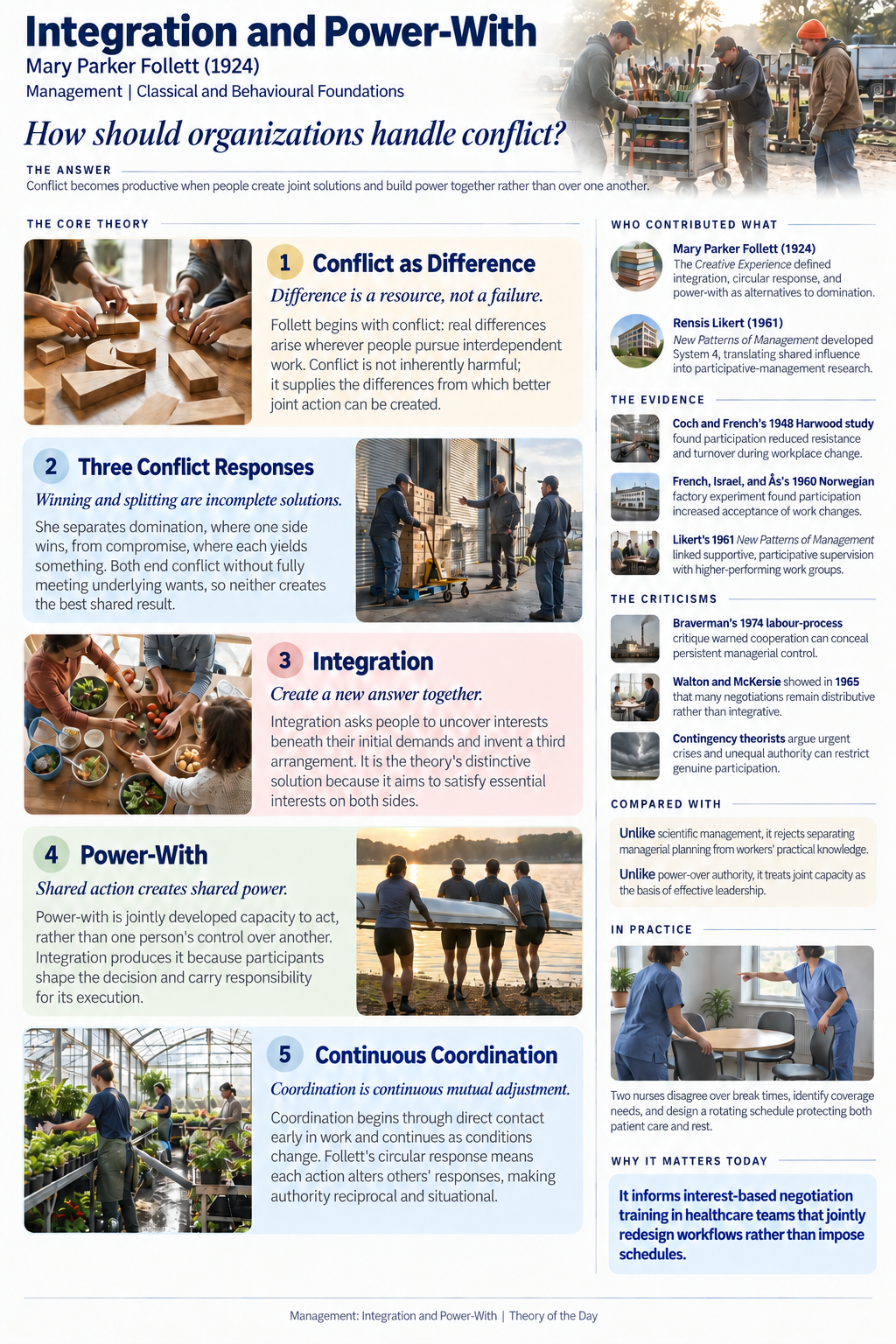
Integration and power-with arose from Mary Parker Follett's effort to rethink management, democracy, and social coordination in the early twentieth century. Writing when factory management often emphasized hierarchy, command, and efficiency, Follett argued that organizations should not treat conflict as a disorder to be suppressed. Her most influential formulation appeared in The Creative Experience in 1924. It connected everyday workplace relations with her wider concern for democratic participation.
Follett began from the fact that people working together have different interests, experiences, and responsibilities. She distinguished three responses to conflict: domination, compromise, and integration. Under domination, one party imposes its will; under compromise, each side gives up something. Integration instead seeks a new arrangement that meets the important interests behind both parties' stated demands. It requires direct contact, early discussion, and close attention to what each person actually needs.
Follett also contrasted power-over with power-with. Power-over is control exercised by one person or group over another. Power-with is the jointly created capacity to accomplish work through coordinated action. Her idea of circular response explained why this matters: people do not simply cause one another's behaviour in a one-way sequence. Each person's action changes the situation to which others respond, and their response in turn changes the first person's next action. Authority therefore should arise from the requirements of the situation, not merely from rank.
Follett was the principal originator of these ideas. Later writers did not simply reproduce her theory, but some developed related approaches. Rensis Likert's New Patterns of Management, published in 1961, used organizational research to advocate participative supervisory systems and developed his System 4 model. Research on participation also supplied relevant support. Coch and French's 1948 study at the Harwood Manufacturing Corporation found that worker participation in production changes reduced resistance and turnover. French, Israel, and Ås reported similar benefits of participation in a Norwegian factory experiment in 1960.
The theory has clear limitations. Integration is difficult where resources are genuinely scarce, where legal authority is unequal, or where one side can impose decisions regardless of discussion. Richard Walton and Robert McKersie's 1965 analysis of labour negotiation distinguished integrative bargaining from distributive bargaining, showing that many conflicts concern dividing fixed gains rather than inventing mutual gains. Labour-process scholars, notably Harry Braverman, also warned that managerial appeals to cooperation can obscure enduring control over workers.
Even with these qualifications, Follett remains important in management education because she offers a demanding alternative to both command and superficial consensus. Her approach asks managers to treat disagreement as information, discover interests beneath positions, and organize conditions for joint problem solving. It is especially relevant to participative management, interprofessional teamwork, workplace mediation, and interest-based negotiation, where durable implementation depends on people having a real role in shaping decisions.
The core theory
1. Conflict as Difference
Follett begins with conflict: real differences arise wherever people pursue interdependent work. Conflict is not inherently harmful; it supplies the differences from which better joint action can be created.
2. Three Conflict Responses
She separates domination, where one side wins, from compromise, where each yields something. Both end conflict without fully meeting underlying wants, so neither creates the best shared result.
3. Integration
Integration asks people to uncover interests beneath their initial demands and invent a third arrangement. It is the theory's distinctive solution because it aims to satisfy essential interests on both sides.
4. Power-With
Power-with is jointly developed capacity to act, rather than one person's control over another. Integration produces it because participants shape the decision and carry responsibility for its execution.
5. Continuous Coordination
Coordination begins through direct contact early in work and continues as conditions change. Follett's circular response means each action alters others' responses, making authority reciprocal and situational.
The argument in four steps
- People in organizations have interdependent but genuinely different interests.
- Domination suppresses one side, while compromise leaves both sides' deeper wants partly unmet.
- Direct discussion reveals underlying interests and enables an integrated solution.
- Therefore joint action generates power-with rather than power-over.
How it works
- Participants meet early and state the interests behind their initial positions.
- Reciprocal influence and shared inquiry drive integration; status, coercion, and fixed positions block it.
- The outcome depends on whether a new arrangement satisfies each side's essential interests.
Who contributed what
- Mary Parker Follett (1924): The Creative Experience defined integration, circular response, and power-with as alternatives to domination.
- Rensis Likert (1961): New Patterns of Management developed System 4, translating shared influence into participative-management research.
Compared with rival views
- Unlike scientific management, it rejects separating managerial planning from workers' practical knowledge.
- Unlike power-over authority, it treats joint capacity as the basis of effective leadership.
Further reading
- Mary Parker Follett, The Creative Experience (1924)
- Pauline Graham, Mary Parker Follett: Prophet of Management (1995)
- Joan C. Tonn, Mary P. Follett: Creating Democracy, Transforming Management (2003)