
On Rahul Bhattacharya's 'Railsong'
A novel of self-discovery intertwined with India's post-independence journey
Acclaimed novelist Rahul Bhattacharya’s latest Railsong is a clear-eyed vision of modern India and its people. His previous outing, The Sly Company of People Who Care, won him the Royal Society of Literature Ondaatje Prize and the Hindu Literary Prize, and was shortlisted for the Man Asian Literary Prize as well as the Commonwealth Book Prize. Railsong, delightfully builds on these literary accolades, as a sweeping historical saga that follows the shifting fate of the Chitol family.
The protagonist, Charu, is a striving woman in post-Independence India, who has lost her mother and is trying to find herself through her work as a census enumerator. The novel opens with this sentence: “I want to count people,” beginning with the Chiton family’s move to a railway township, Bhombalpur.
It is 1961 and the census is being taken. That's when the protagonist develops an interest in counting (she aches "to become something"). Charu, Bhattacharya shows us, is just like India, yearns to make something out of her time here. She will soon run away to big city Bombay (now Mumbai) to fulfil her fate as a railway employee.
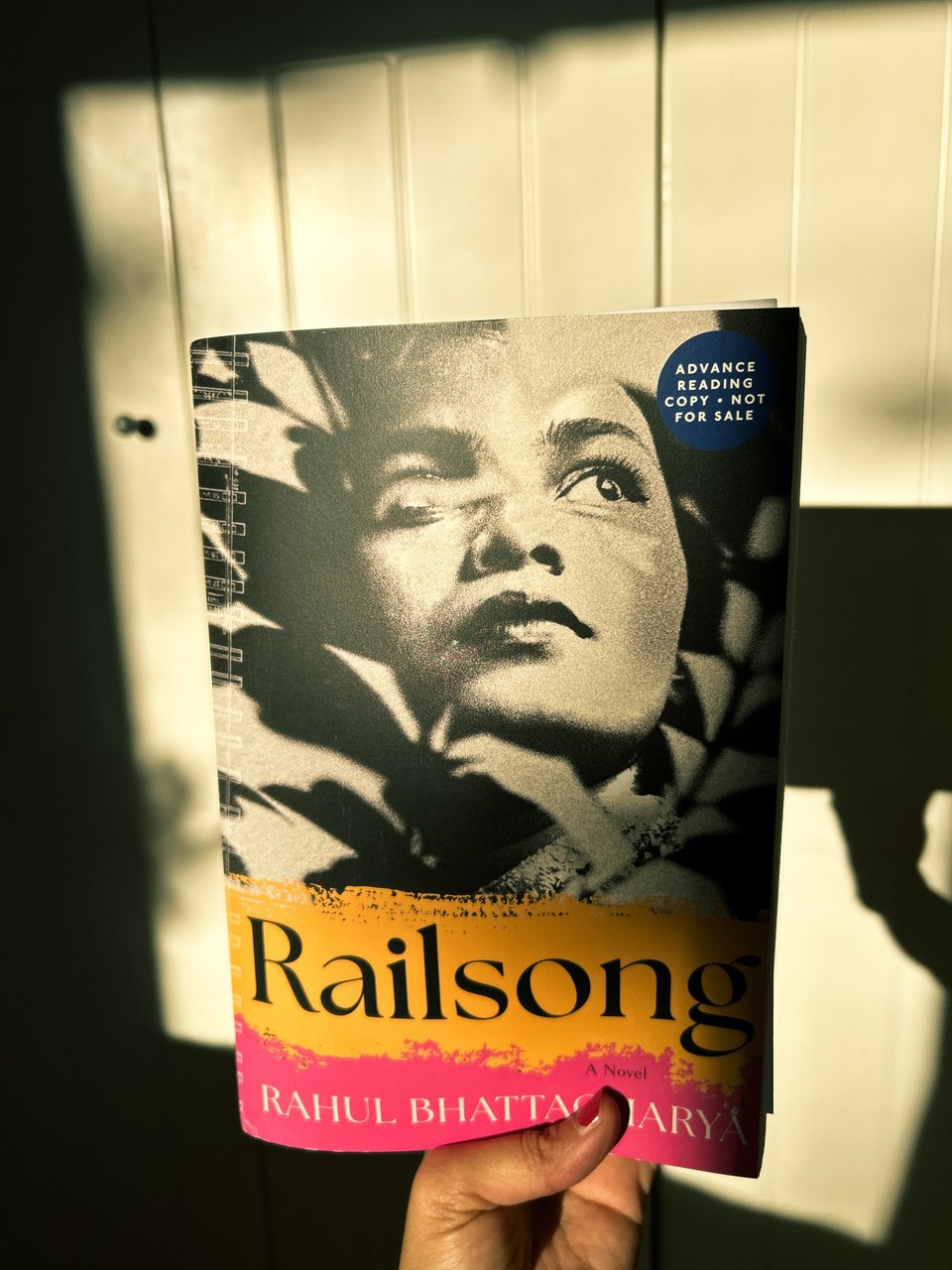
A few years have passed, and the family reflects on their “unrecognisable” town. “Nothing since the establishment of the workshop transformed Bhombalpur like the famine. Thousands of people from hundreds of villages came to the railway town looking for food, looking to be taken away somewhere, anywhere, for work and half a meal a day.” In Bhattacharya’s deft hands, the novel moves poetically, centered on the life of his self-willed protagonist, Charulata “Charu” Chitol, as she navigates life in post-independence India.
Railsong closes in 1992 rather poetically as Charulata, now in her 30s, is back to the railway township, Bhombalpur. Framed by this full circle moment and by Charu’s parallel connection to the railways (and by extension, work), Railsong unfolds as a lavish coming-of-age saga as it establishes all the elements of burgeoning personhood one expects from a decade-spanning novel: loss of a parent, steely determination, selfish rebellion, self-discoveries, financial independence, self doubt. All this while a broadview narrative about the growth of a young nation runs parallel, reflecting on how inevitably interlaced the personal and political are.
Bhattacharya attends to those socio-political times of modern India, while moving through the shifting fates of the Chitol family. In lesser hands, this tapestry could be reduced to forgettable, mediocre simulacra of prize-winning novels. But Bhattacharya makes the red-tape, research and history accrue pivotal meaning to the plot.
We read about economic and sociopolitical upheavals, famines, railway strikes, and the promise of a young nation in the context of Charu’s growth as a person, professional, woman. He writes Railsong in different narrative styles, switching between the first and third person to consolidate his approach.
“She cogitated on matters from two hours ago or from her past life in Bhombalpur; she assessed her behaviour in particular situa-tions, sought to recreate, without meaning to, the precise texture or mood of a conversation or a scene. From benign reflection she could work herself up into little pace-abouts in the balcony or the garden of red mud downstairs, sometimes catching herself talking aloud. Life was a strange and unpredictable journey indeed, but what exactly was she doing with hers?”
As time moves on, so does Charu traveling across India for work. Through these journeys Railsong offers a view on the sociopolitical history of modern India, making it a page-turner that explores themes of connection, freedom, and vagaries of human fate.
Working for the railways, she investigates misrepresentations, fraudulent applicants, searches for dead workers, and looks for families seeking employment on compassionate grounds. These are practical skills that make her a better worker but also build character. Bhattacharya’s flourish is not only the prose but also a deep, abiding research into the cacophony of red-tape that made the India of the time and the people who worked in it.
What comes out of these twin tales is a panoply of India: the inner workings of the well-storied Indian Railways, the sociopolitical growth of the young nation as Nehruvian-ideas fade away, and the growth of women in the workforce of the country.
“The travelling ticket examiner was right: it remained a stop-start night. By morning they were running six hours late. The air had the quality of ash, or maybe it was the trace of cigarette on her palate. The sun did come out, the day did come alive. Vendors and passengers climbed on at every halt.”
Through vignettes like these, Bhattacharya shows us how Charu uses her time during these travels to reflect on her own life.
Railsong is divided into parts across and spreads across a leisurely 40 chapters that gives Bhattacharya room to exercise his literary, poetic prowess. Railsong gets its title from the novel Pather Panchali (Song of the Road) by Bibhutibhushan Bandyopadhyay, as “it evokes the sound of a train on tracks” and “also conjures the idea of the network running like a song through the soul of our country”.
Bhattacharya's earlier work has been compared with that of V.S. Naipaul, and Railsong establishes him as a companion to novels like Arundhati Roy's God of Small Things and Kamila Shamsie’s, Home Fire. Railsong truly represents the majestic Indian railways as a network of people, not a mere thoroughfare of stations and tracks.
In Bhattacharya's telling, we see Charu’s mundane everyday struggles rise above the ether of the ordinary and emerge in a hero-like form. There’s a sense of telescoped infra-ordinary that Georges Perec encouraged us to search for. Railsong sings because Bhattacharya decides to zero in on the everyday lending it the same importance as the big picture developments.
The city of Mumbai, then Bombay, is achingly alive in Bhattacharya’s pen:
“Migrants, runaways, their boxes, bedding rolls, slippers, infants, ambitions, compulsions pouring out on to the platform underneath a tremendous roof of steel and light.”
It is these familiar, unremarkable details that bring out an achingly alive novel, making those parts the most moving. Railsong gestures at the broader architecture of Indian democracy, and what it means for a woman to find her footing in this newly born country. The story of a country coming of age alongside a woman’s story holds importance, but there’s a different valence to them being read in the context of one another. And that is the victory for Bhattacharya.


Add a comment: