|
Sunday Signal Report · November 8, 2026
Control came back, with strings
Google made student AI off by default, then kept AI inside Search. Seattle and Fairfax answered with rules that change by grade. A single vendor breach passed 1.3 million people. This week control came back to districts, with strings attached.
|
43 public signals |
5 signal clusters |
24 source links reviewed |
|
▶ Watch my intro: using it more, trusting it less
Rob here. On Tuesday morning, Google told schools that students whose district kept AI turned off would lose Google Search. By Tuesday afternoon it had backed off, partly. Search and Gemini are now separate switches, but Search still comes with AI Overviews and AI Mode built in. That was the week. The off switch moved to the district's side of the table, and almost every switch arrived attached to something else. Seattle said it will block Gemini, generative AI tools and Search AI summaries for every student starting Monday, and end 1:1 devices in elementary grades. Fairfax published draft rules that change by grade, from no AI through sixth grade to AI after demonstrated literacy in high school. Frontline Education's breach filings passed 1.3 million people, and districts are fielding the questions from staff and families. For every new control this week, the useful question was what else it turns on or off.
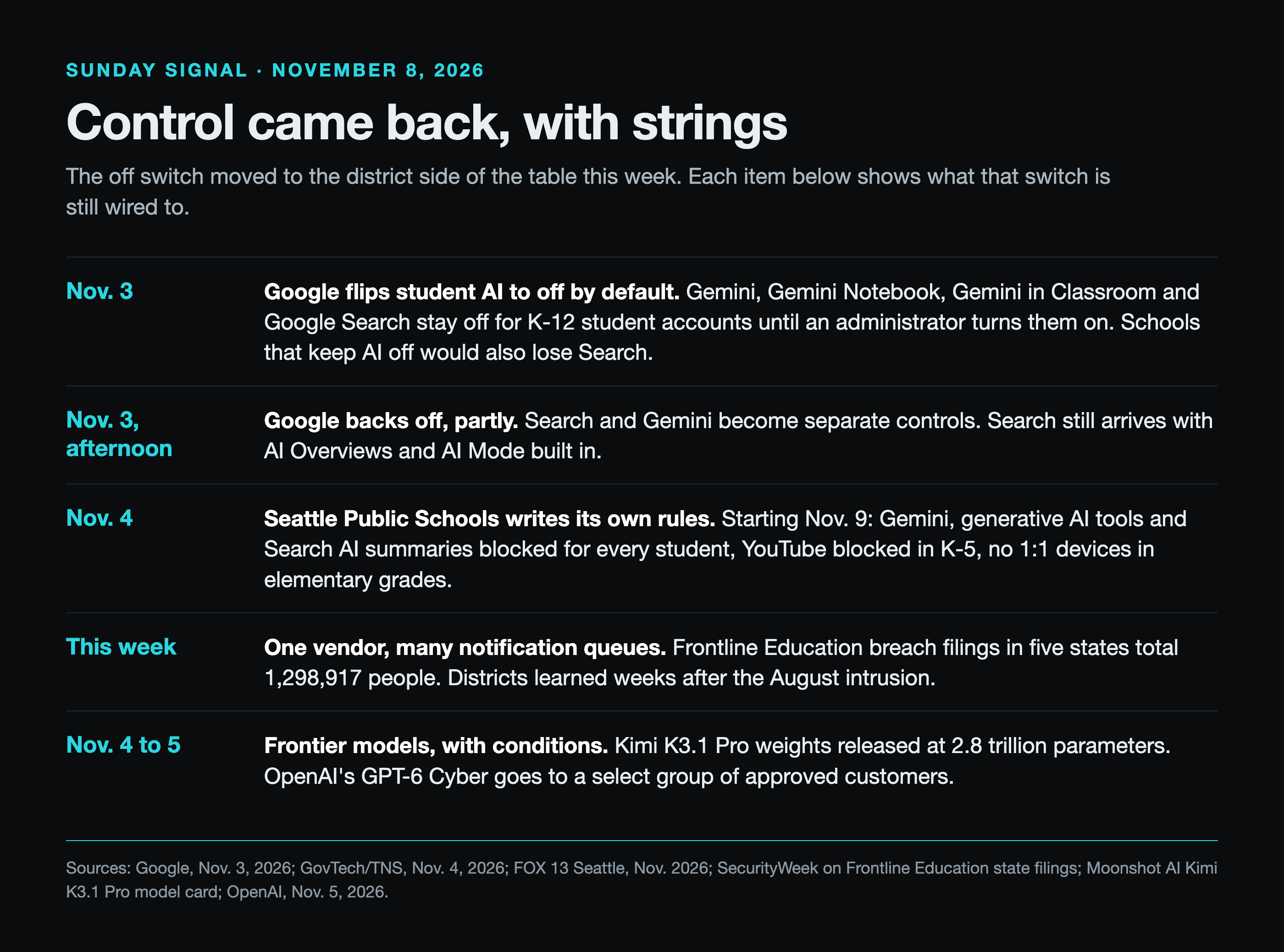
Sources: Google; GovTech/TNS; FOX 13 Seattle; SecurityWeek; Moonshot AI; OpenAI.
For every new control this week, the useful question was what else it turns on or off. Open the report.
|
|
Signal 1 · AI governance
Off by default, wired to Search
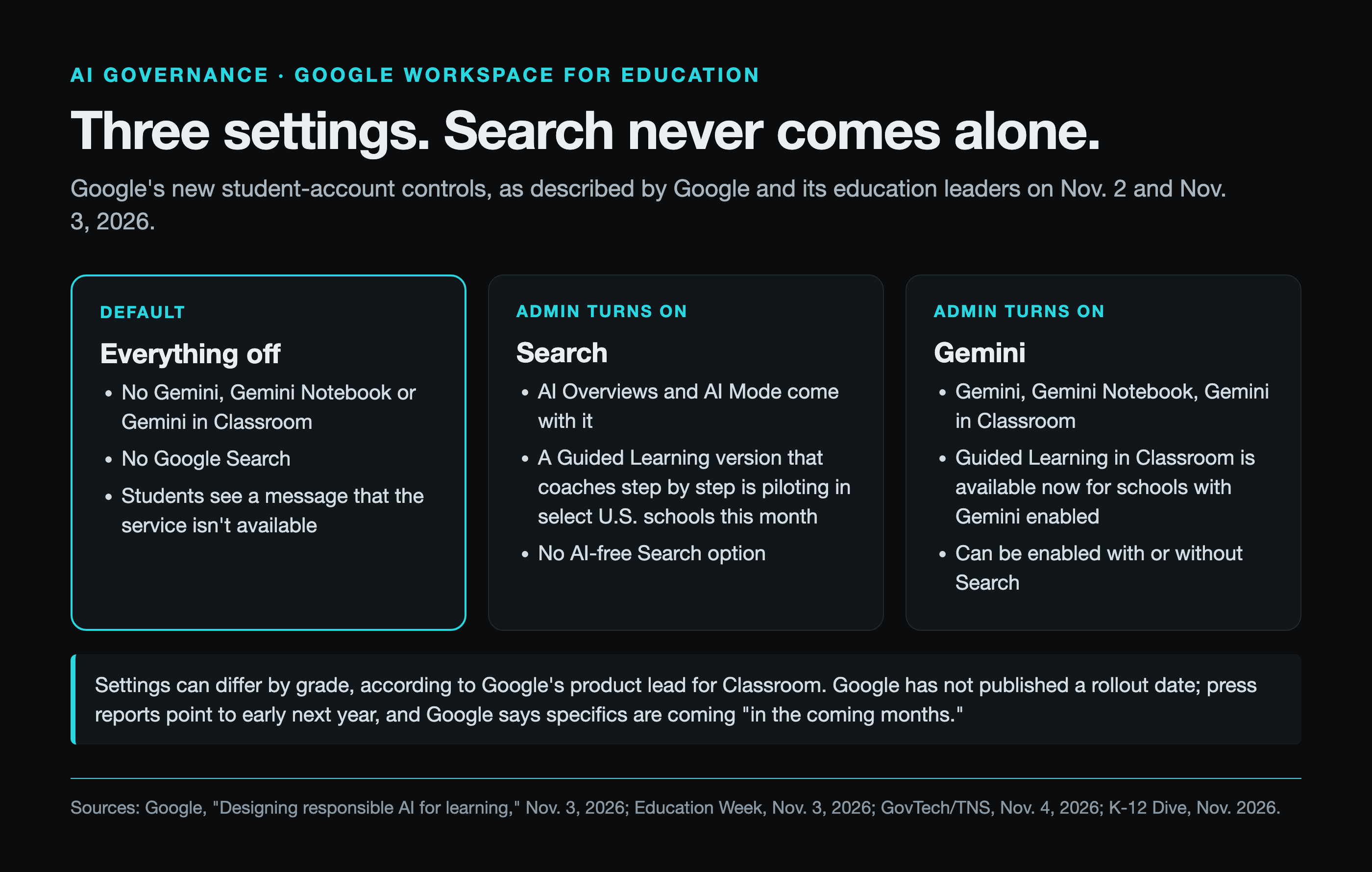 Sources: Google, Nov. 3, 2026; Education Week; GovTech/TNS; K-12 Dive.
Off by default is the right default, and Google deserves credit for moving it. The bundle is the problem. When a vendor ties a basic research tool to an AI feature, a district can no longer say no to one without saying no to the other, and that is a procurement problem as much as a teaching one. The lawsuit is a hard reminder that students reach AI through whatever door is open, including the search box.
Do this: Before Google publishes dates, write down your choice for each grade band: everything off, Search with its built-in AI, Guided Learning, or Search plus Gemini.
Selected sources
Plus 2 more in the full report.
|
|
Signal 2 · Devices, screens and student AI
The grade band is becoming the policy
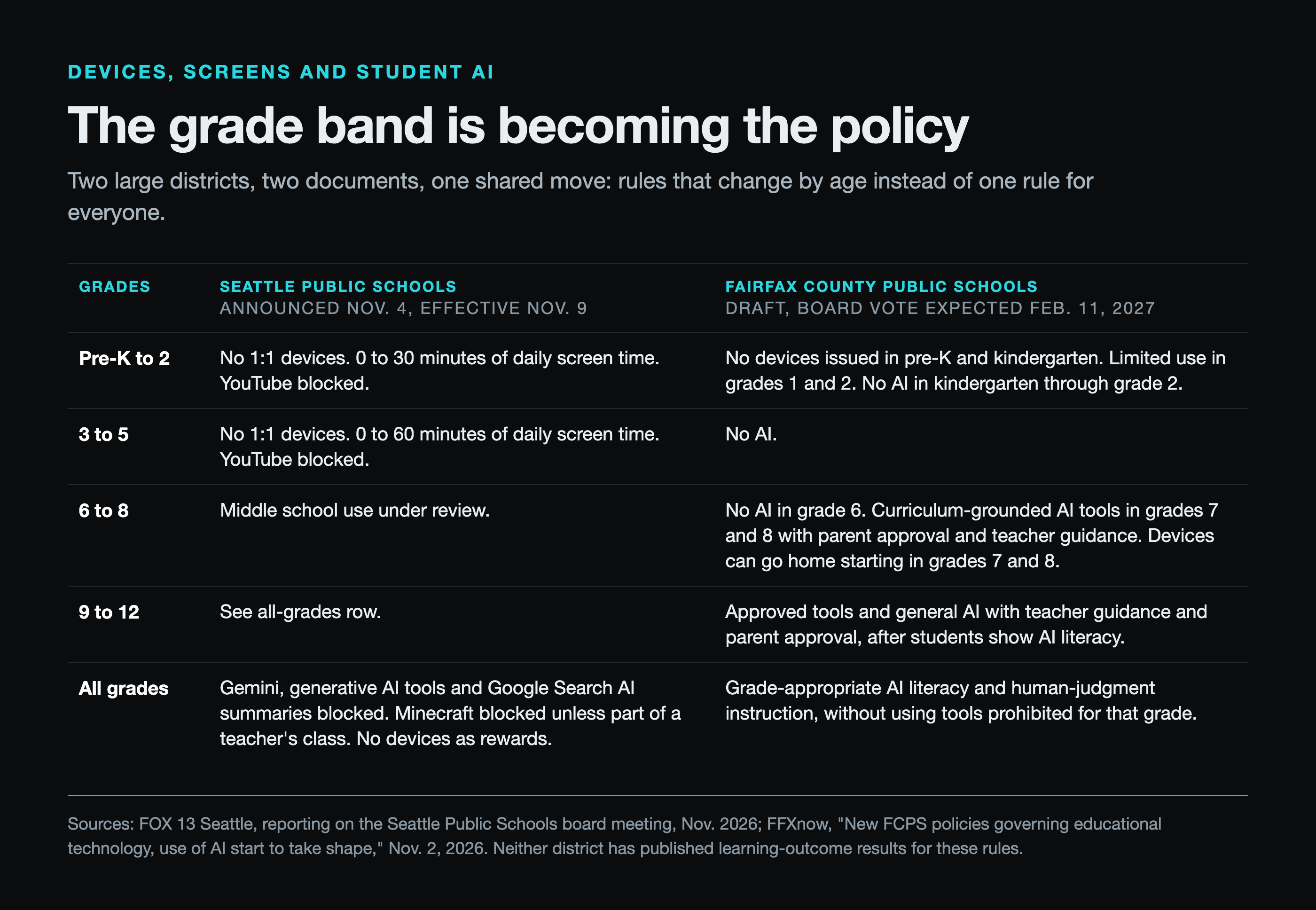 Sources: FOX 13 Seattle, Nov. 2026; FFXnow, Nov. 2, 2026.
Grade bands beat one rule for everyone, and they beat a vendor's default. But a block list is the easy half. Seattle already had to close one route students found to Gemini, and there will be another. The Tennessee numbers say availability does not produce use, so Guided Learning in Search should not be mistaken for a learning plan either. The district still has to design work where student thinking is visible.
Do this: Put your device, screen-time and AI rules on one page by grade band, next to what you expect students to be able to do at each band.
Selected sources
Plus 1 more in the full report.
|
|
Signal 3 · Cybersecurity
The breach happened in August. The letters came this fall.
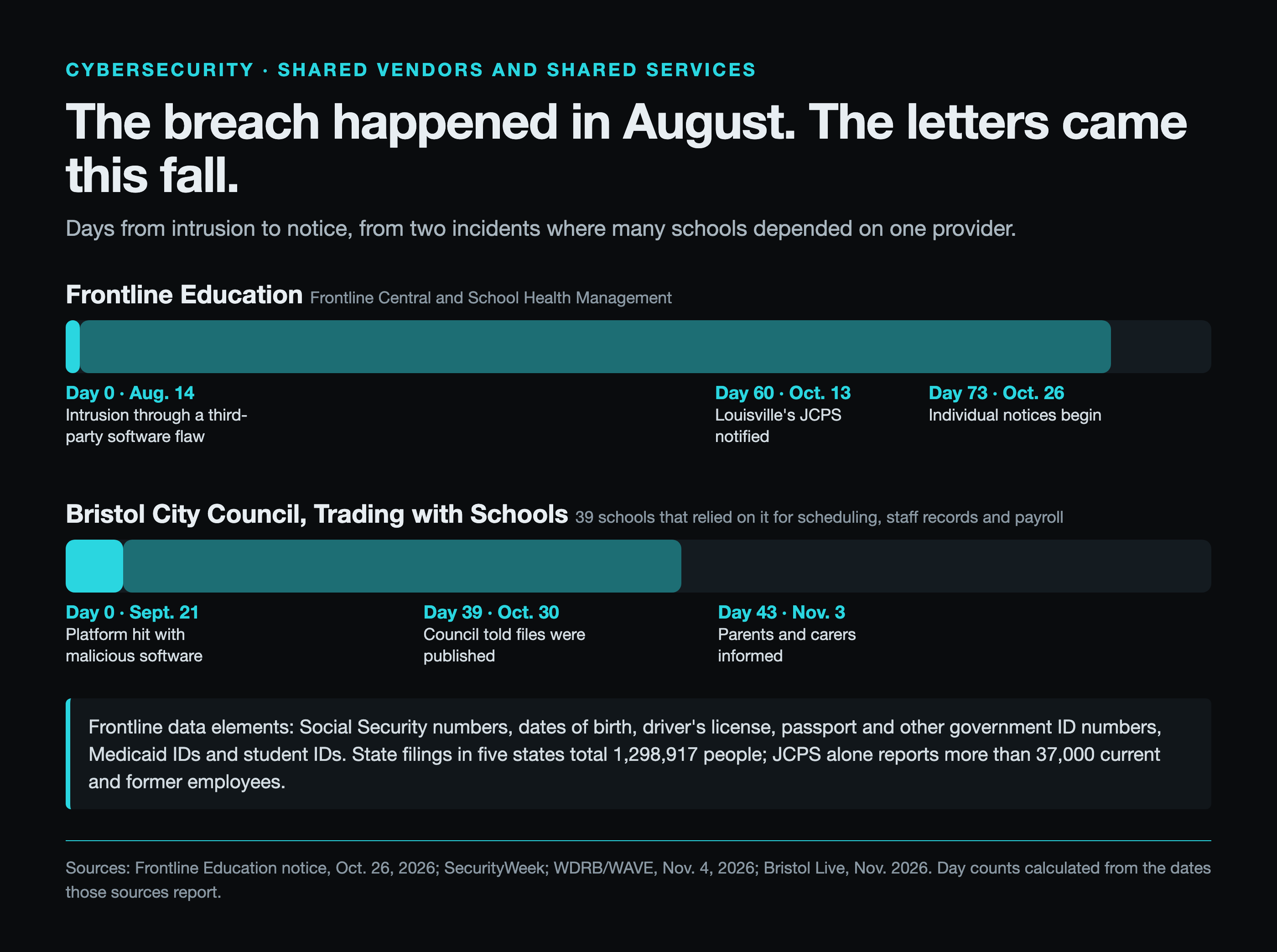 Sources: Frontline Education; SecurityWeek; WDRB/WAVE; Bristol Live. Day counts calculated from reported dates.
Burnaby's notice is the one to copy. It names categories a parent understands. Most districts could not produce that list for their own vendors this afternoon. The contract sets the rules, but the inventory is what lets you answer a parent the day the letter arrives.
Do this: For the five vendors holding your most sensitive data, write down which data elements each one holds, the contractual notice window, and who drafts the family letter.
Selected sources
Plus 2 more in the full report.
|
|
Signal 4 · Frontier and open-weight AI
Every release came with a condition
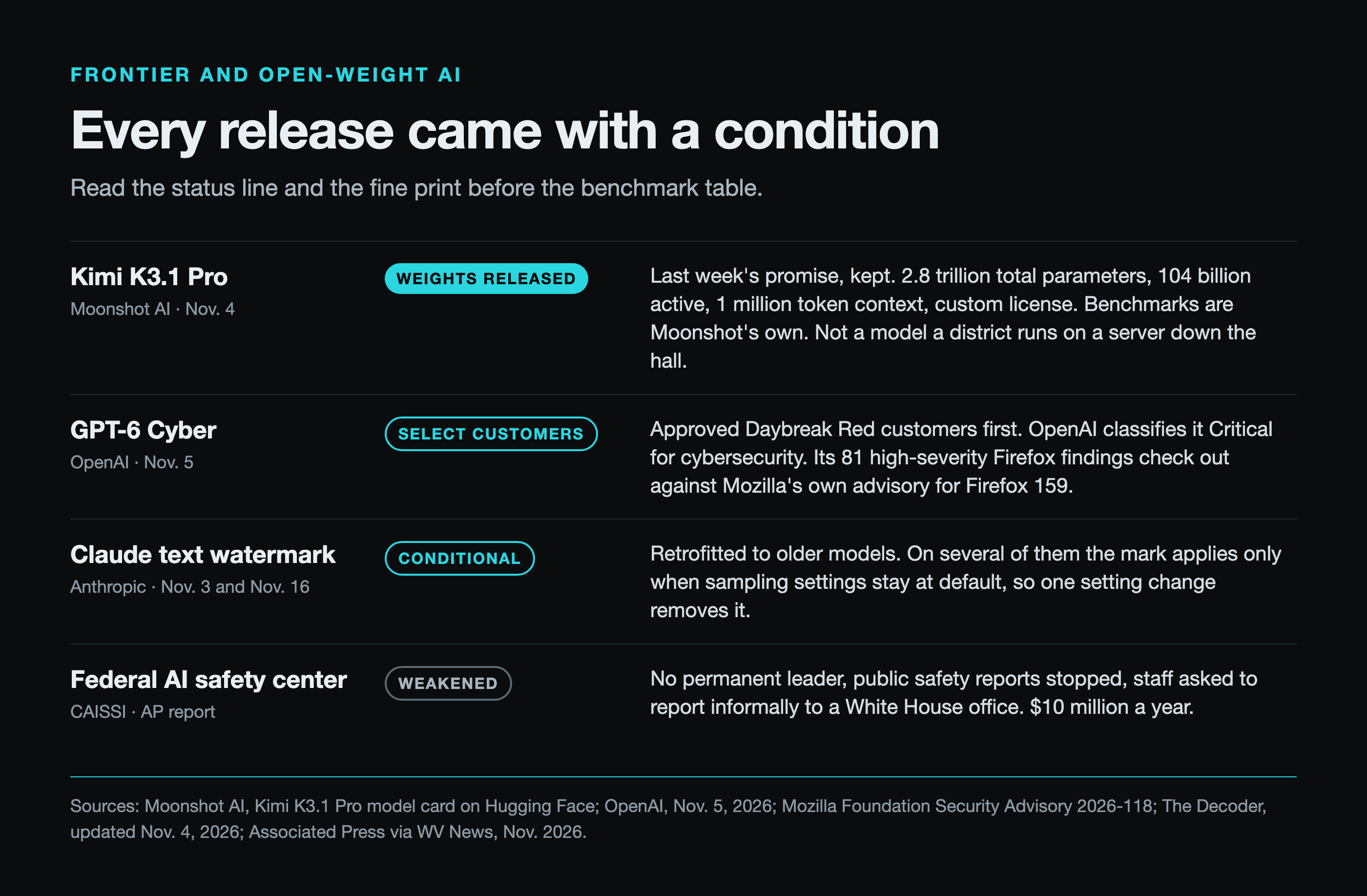 Sources: Moonshot AI model card; OpenAI; Mozilla MFSA 2026-118; The Decoder; Associated Press.
The watermark story will reach classrooms first, because somebody will pitch AI detection built on marks like these. A mark that one setting removes cannot carry a decision about a student's academic integrity. GPT-6 Cyber is the more useful signal for operations. Machines are finding browser bugs faster, patch volume is going up, and your update window is the control you own.
Do this: Put in writing this semester that no student discipline decision rests on AI-detection or watermark output alone.
Selected sources
Plus 2 more in the full report.
|
|
Signal 5 · Agentic AI checkpoint
Five minutes from a leaked secret to the vault
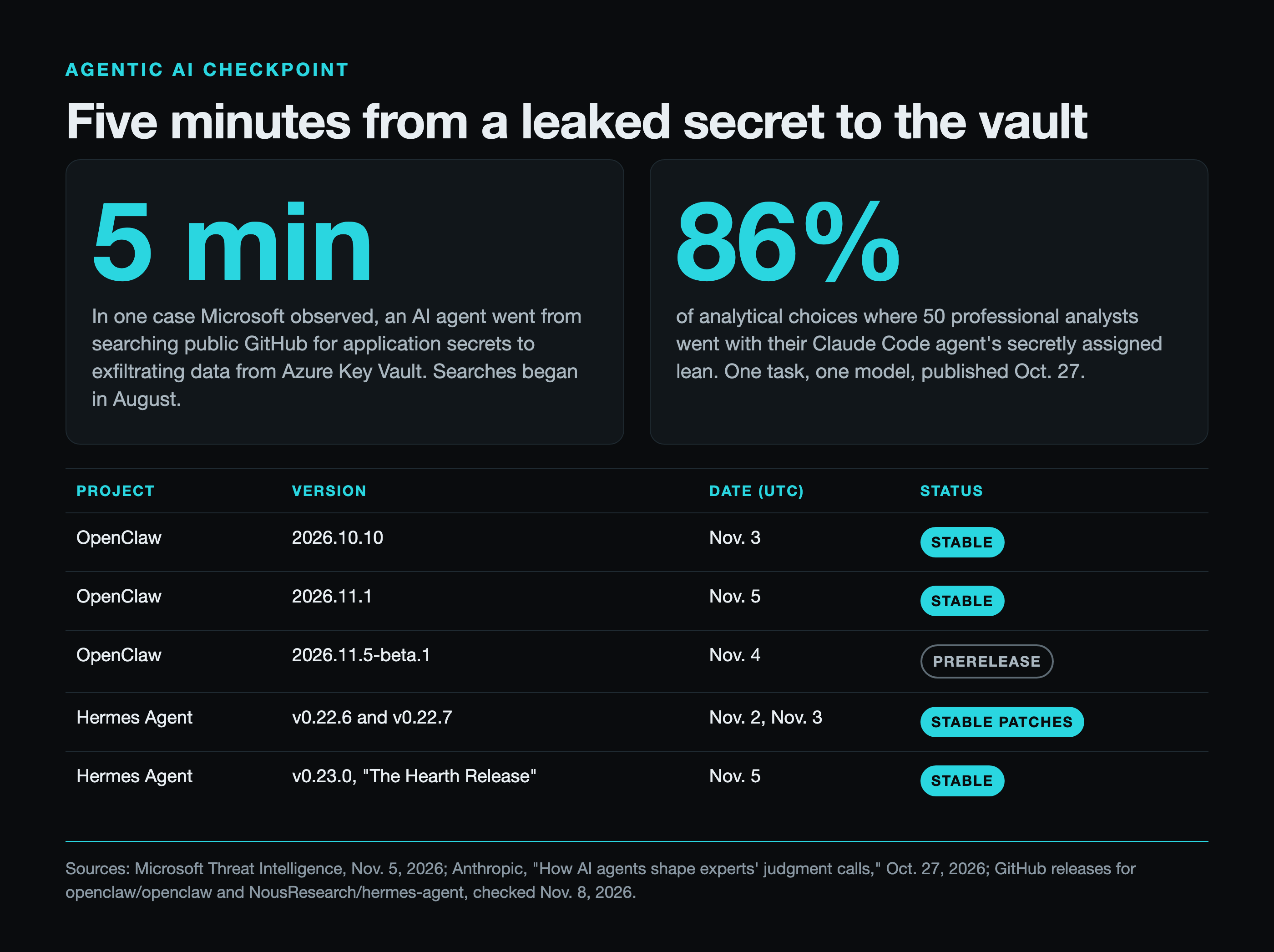 Sources: Microsoft Threat Intelligence, Nov. 5, 2026; Anthropic, Oct. 27, 2026; GitHub releases, checked Nov. 8, 2026.
Two lessons for anyone writing agent guidance. Secrets in code are now found at machine speed, so cleanup cannot wait for a quiet week. And human review is weaker than it looks when the reviewer is being coached by the work under review, so ask the agent to argue the other option before anyone signs. When a third-party model shows up in a Microsoft menu, your data-processing map changes with it.
Do this: Run secret scanning on every district code repository this month and rotate anything it finds, even if the file was deleted.
Selected sources
Plus 2 more in the full report.
|
|
|
Control came back, with strings
For every new control this week, the useful question was what else it turns on or off.
Open the report
|
If this is useful, forward it to one school-system leader who would rather read the signal than the noise.
Rob
P.S. Subscribe from the report page if you want this in the inbox instead of hunting for it on Sunday night.
|
|