
I don't know what I'm doing
Home among the homeless
“What does home mean to you?” I’ve asked many people this question. Answers seem to fall in the following categories: place, people, nature, feeling safe or a feeling in the body. People invariably ask me about my home: ‘do you go back home?’, ‘where are you based?’, ‘where are you from?’ Sometimes I reply: I live here (wherever it is I am), because it is the most true and also the most confusing answer. ‘I grew up in the Netherlands’. This is the most reassuring answer, I see the person relax because they can place me somewhere. ‘I have no home’. But homeless doesn’t seem quite the right response.
Dutch makes a distinction between being ‘roofless’ or ‘homeless’, which I like in that it brings the distinction, that having a roof over your head doesn’t mean you have a home. Six months into my journey and a 100 different roofs covered my head from hotels, to dorms, tents, yurts, apartments, an art studio, trains, boats, vans. I noticed different levels of feeling at home. Whenever I arrive in a new house I feel at ease if I can use the kitchen as I please. The two weeks I was a guest in Italian community of Damanhur for example, I never quite felt completely home. The kitchen shift was fixed and I wasn’t allowed to look in the storage. On the other hand, from the first minute I stayed with Italian relatives in Turin, I immediately felt home, even though I never met them in my whole life. When I arrived there was a note on the table saying: ‘use anything in storage and fridge you can find, here are the housekeys, see you tonight.’ Deep breath out, this is home now. And- not only to cook, but to invite others to share all the cooking experiments.
Home is also for me: people. I am back in Freiburg where I already stayed 2 weeks in February. I return to the same small privately owned gym around the corner. I love the place for its unpretentiousness; old machines without touchscreens or bluetooth, the cat playing in the corner, the ants in the lockerroom and faded posters of tanning studios. The owner - a middleaged German only speaking woman - recognizes me and asked me how I am and gives me a 5 euro discount for no reason. Every day I come in and she greets me with my name and has a lockerkey and boxing gloves ready. Another example- I send a message I’m in town. “I know”, is the reply, “someone spotted you yesterday, how was the concert?’. This type of familiarity goes beyond just 'knowing' people. It feels to me so homely to be recognized. Even if it’s just by face; the hostel receptionist in Barcelona who smiles ‘Welcome back! Here is the key, you know everything’ or the barista that knows your order (by the way, for those who know me as a coffee snob - I have kicked off coffee already since January believe it or not..).

But the most surprising discovery of feeling like home was serendipitously blundering into the yearly Healthcare clowning international meeting in Lausanne. After my dipping a toe into the power of playfulness in our activism on the streets in Constance (see previous post) I got slightly obsessed with clowning. Good old internet searching led me to stumble upon this conference. So I boldly wrote the conference organizers about my quest. If they would please allow me to their conference without paying the entrance fee, since Switserland is so expensive. Somewhat to my surprise I got a very warm and positive response. I was welcome as long as I took care of my own accomodation and travel.

So it happened that I found myself in the university campus of Lausanne, in the big conference center on three sunny days in March surrounded by all sorts of professionals related to medical clowning. Mostly healthcare clowns, humanitarian clowns, pediatricians, hospital directors, psychologists, artistic directors, jugglers, dancers and who knows what else. Every person I talked to had a similarly idiosyncratic story. A professional dancer and phd in sociology now set up a course on theater in sexual harrasemment education in teenagers. The nurse doing theater immprovisation and ends up founding a medical clown organisation because there isn’t anything in her hospital. Psychiatrists and choreographers that lead to joint workshop. They are all walking with two feet in two different worlds, accumulating slash careers, pioneers with a twinkle in their eyes. Because everyone is always ready for some form of play.

Talks are interrupted by floating balls in the audience or dancers in golden bathing suits dancing to fame songs; the plenary session talkshow hosts is 'the editor of alaska science academy' - a role he keeps up the whole session- ; during a workshop I exchange one sock with a random participant because they both have bananas and we both never look back. In short, for once in my life I realize I feel home in a group of complete strangers because I don’t feel 'weird'.
It goes beyond just being goofy or doing a handstand whenever you feel like it. Here is a place where people move in the sweetspot between making something playful and meaningful. Sincere without being serious. And I am in love with it.
Down the clown rabbit hole
-a brief incomplete theater history-
What is a clown? A little bit of background how does it relate to system change. Disclaimer: I am going to share what I have understood so far, by no means an academic paper ;) Clowning how it is taught in modern theater is pioneered by a French theater maker called Jacques leCocq and further developed by his students, among who Philip Gaultier is another famous name. LeCocq is interested in physicality of theater. He takes influences from French mime, Greek ancient theater, from Italian Commedia dell’Arte; from circus and develops his own method and a school which is now famous in the theater and clowning world. Students of the LeCocq school learn theater taking their phsycial presence as starting point. How do you affect the space? Other players? The audience? The first year there is not even any verbal text and with the use of masks even facial expression is stripped away. Little by little, smaller masks and verbal expression is added. The clown is only taught after 2 years of this groundwork, wearing, as our rebel clown teacher says, ‘the smallest mask in the world’: the red nose.
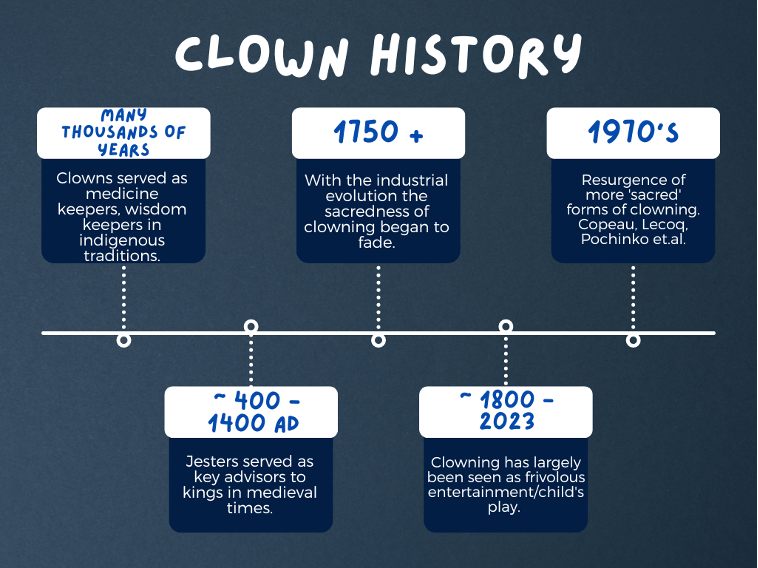
- Ritual roots of clowning -
Before Stephen King and McDonalds captured the popculture image of a clown, clowns were always around. This role of questioning authority to the absurd is often named in the context of an archetypal role in myths and ancient societies; the one of the trickster. This concept came up frequently when I was researching system change. It relates to the ‘chaos’ phase, which I touched on in my last post. According to antropologist Jitske Kramer we are living in a time of change, a liminal space in which we left the known but have no idea yet where we will land (read Tricky Tijden by Jitske Kramer). The tricksters are the ones walking liminal space. They are the court jesters, the gods that play tricks like loki in norse mythology, hermes in greek. They do not choose sides but subvert both sides. Traditional cultures have trickster or clown like roles at important ceremonies to make mock the ritual. To remind us not to take ourselves so serious; to mirror the behavior of elites.
But it seems to me that these figures fulfill a role that I also attributed to science and art namely, to speak truth to power; to question the underlying fabric of what we do. In recent times I have become somewhat disappointed in science and art (more on that later) and with the clown, I see a great promise; bringing playfullness in has a an additional powerful element to fulfill this questioning role, to open up hearts and minds.
-the clown questioning essence-
The clown is not a specific role to play like an actor doing a play by Shakespear. Rather, it is a state of being of the person. As a clown, you embody the 'not knowing'- a clown essence is one of wonder and emptiness. They can question any ordinary thing and turn it around. It displays our worst fears; shame and failures for audience to laugh at. From this state of being situations arise that make the audience see ordinary world differently and laugh about its absurdity about or their own absurd being full of fears, shame and failures.
Cross the line, walk the line
Thursday 9th of april. It is about 26 degrees and I’m running around in a yellow fluerescent jacket, goggles and a red nose with 4 equally silly dressed folks. Holding a rope and red/white no crossing-line, we skippy rope with passers-by; get them to play with our red and white tape. Is this crossing the line? - we ask.


We want to playfully create awareness around the topic of borders and boundaries, the invisible lines we draw in our public space. In just four days, we are a true clown collective, tackling Big Topics with small disruptions in the busy city center of Valencia. Another group is tackling housing problems and gentrification. Their groups mockingly impersonates tourists taking selfies around the square. Pointing at the garbage can: ‘ ow wow! so authentic!’ It is hilarious.

This week I joined the Nomadic rebel clown academy. In five days, 16 people coming from different backgrounds go through a series of games to embody the state of clown and specifically dive into how to use it in doing activism. After the Healthcare clowns, I am desperately searching for more intentional clowning. I find there is a whole world of clown activists, one of the oldest and longstanding groups is CIRCA, the clandestine insurgent rebel clown army, using absurdity to undermine authority, for example showing up as cop clowns in protests.
In five days of rebel clowning I take away some important elements. First of all, to really dare to be silly. Not someone else, but my own silly, childlike self. Whatever the clown version of me is like, it is already there, it just needs permission to get out. There is a tremendous strength that comes out of watching the world with wonder.

Second, awareness of space; space is everything. The physical surroundings of streets or parks, the space between me and fellow clowns or me and audience. The space between silence and talking, between movement and standing still. I learn to slow down.. once more.. Thirdly, that having some structure in a collective is essential to improvise. We learn to flock, sock, peel off and make a tableaux. Are we doing separate actions or telling a story? Knowing our structure provides freedom on the street.
Fourth, failure failure failure. Any action will be imperfect so test iterate. I love the quick-quick-slow approach, which means come up with something, try it out, short evaluation, try again. Then have a longer evaluation.
Most of all, I realise again: I love doing this, and I can do it alone, but it is so much more satisfaying and FUN to do together.
I am happy to have some more tools in my toolbox. There is another version of me behing a red nose. One that marvels and questions without knowing the answers. I hear the clown mantra in my head: I don’t know what I’m doing, and that’s ok. It gives words to a feeling I’ve been harbouring for a while.

Role of art in system change
The experience on the streets reignited my love of play. Clowning for me represents a sincere but not serious way of opening up peoples’ minds; a foot in the door of habitual thinking, a crowbar for thinking in same old stories. It is a role that I have attributed to artists. I gave this a lot of thought and must admit- the ‘art scene’ - i.e. the institutes such as galleries, the subsidy and finances of art and art academy - has left me with a feeling of disappointment in taking up this role in society. Art has its own subculture, being different than ‘mainstream society’ but not necessarily more radical. We as a society seem to have forgotten what the art (and science and education) is really for.
Artists are evaluated based on critic review, succes measured in instagram, gallery exhibits and selling work. In universities, the same feeling creeps up. I have a discussion with a relative who is a university professor. ‘How are your students?’ I ask. He sighs. ‘They are horrible. They are not motivated. At the same time, I have a quotum to not fail them, because then I get a bad evaluation on my record. I am a bad teacher. But sometimes, they know nothing! I have to do marketing now for my classes. Why should I do that? Students should come because they are interested. I hate it, it is a waste of my time’. Students as KPI’s… another effect of treating universities as career factories. I can really get upset over this.
It is not the fault of individuals, there is whole system in place, rooted in patriarchy, colonialism, capitalism and separation that we live in. Art, science, education- these intrinsically valuable roles have been coopted as money making machines; pulling people more and more from the being mode to the having mode. Instead of challenging status quo, voicing dissent, speaking truth to power, raising citizens, all these sectors are institutionalized and monetized, productivized.
The highest leverage point for system change (I highly recommend reading Donnella Meadows thinking in systems if you haven`t) is changing the paradigm.
Last time, I gave a lot of thought on the role of chaos, as an opening. We can start to question the why of art, of science, of politics, of education. Who are we doing these things for? This time, I want to add WHO should do this questioning? Maybe our modern tricksters, the clowns and the rebels, the buffoons and the street performers, can birth these openings in our minds.
So, onwards I go, happily not knowing what I am doing, but that’s ok. Slowing down and continuing to follow my own curiosity. I am looking for any rebel clowns doing actions to refine this practice and learn more.
Next time.. more on the role of spirituality after my stay in Damanhur.
For now, sending playful love
River
