Postcards from Palestine logo

Postcards from Palestine

Archives
Subscribe
September 16, 2026

Banksy's Walled Off Hotel and the West Bank

Dear Friends,

The growing violence in the West Bank has been in the news here in the US. The New York Times ran a story recently about the increase in attacks by Israeli settlers and soldiers against Palestinian civilians. But Palestinians have been living with Israeli cruelty for a long time. Some of the longstanding, everyday violence against Palestinians is documented in the West Bank at the Walled Off Hotel and Museum in Bethlehem, which was created in 2017 by the renowned international artist Bansky.

From The New York Times: “More than 3,200 Palestinians [in the West Bank] have been displaced by settler attacks this year alone — double the rate of last year. As the pace of violence climbs, the U.N. says, the number of Palestinians injured in settler attacks has risen from an average of one every three days in 2020 to more than three per day in 2026." 

A retired Israeli brigadier general is quoted in the article: “This is ethnic cleansing, to put it simply.” 

Why didn’t we have pieces like this before? Was the amount of violence and displacement in 2020 (and before that) ok? We are also left to wonder, where are the individual news stories about more than three attacks happening per day? And why do we need Israeli generals to confirm what Palestinians have been telling us?
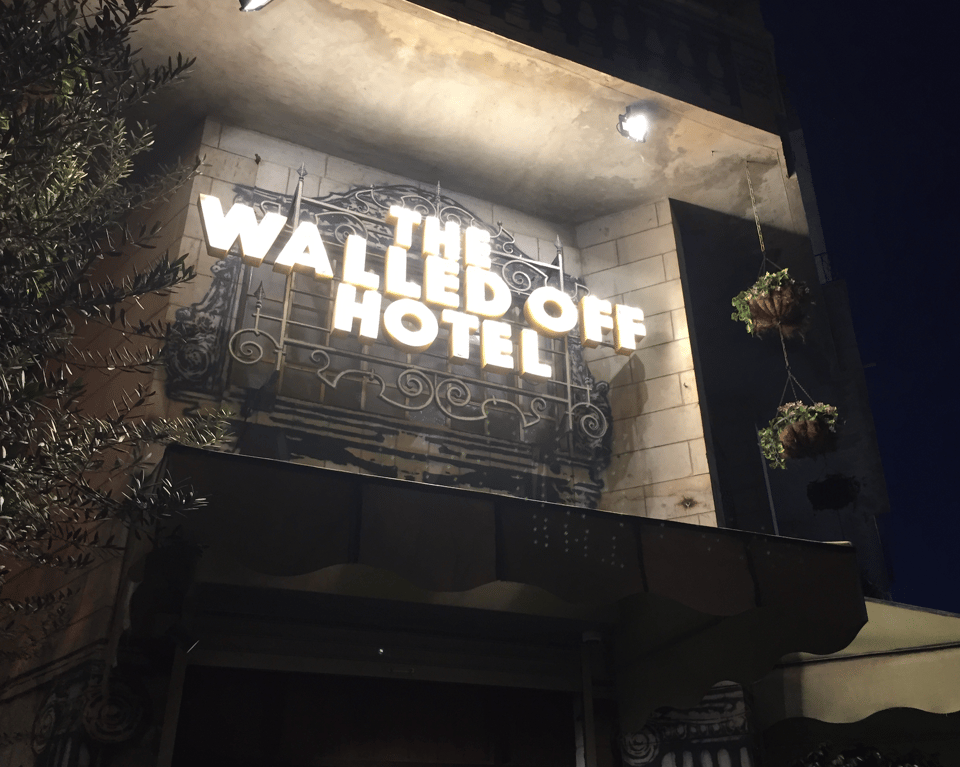
Nighttime photograph showing a hotel entrance with an illuminated  sign that says "THE WALLED OFF HOTEL". Decorative wrought-iron panels, stone columns, exterior lights, hanging plants, and dark awning frame doorway.
The hotel is cleverly named. If you say it quickly, you’ll notice it sounds like the name of a famous luxury hotel, the Waldorf. Elton John joined the opening in 2017 virtually.

I first visited the Walled Off Hotel and its accompanying museum in 2018, and have visited several times since then. In March of 2023, I was able to see some of the guest rooms. Banksy intended the hotel and its museum to bring needed tourist dollars to this West Bank City, and also to bring attention to the injustice of the occupation and the oppressive presence of Israel’s separation wall (also known as the apartheid wall or in Israel as the security fence).

Billed as the hotel with the worst view in the world, the Walled Off Hotel looks out over the wall, which runs throughout the West Bank, including right through the city of Bethlehem. The wall blocks most sunlight into the 10 guest rooms in the hotel, as a reminder of what it is like for Palestinians who live their lives in the wall’s shadow.
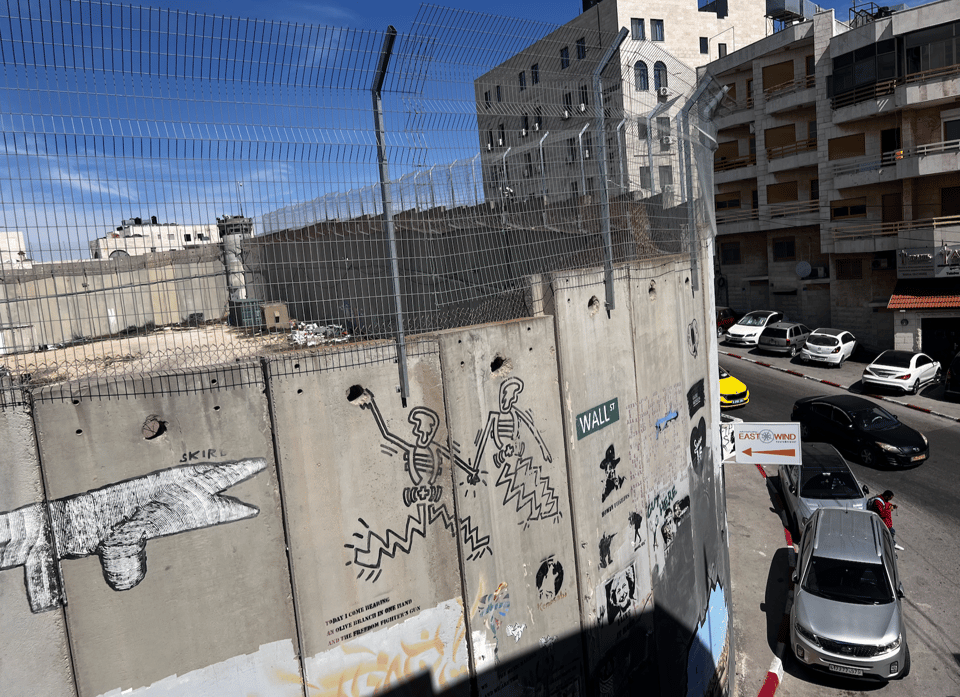
A photograph of a street with a tall concrete wall, composed of separate individual panels. Above the wall is dense wire.  The gray wall is covered with graffiti and small signs (including one that says 'Wall St').  There are parked cars, an apartment building, and a blue sky.
The view from a guest room at the Walled Off Hotel. Israel’s separation wall runs throughout the West Bank. Here, it is 8 meters high and topped with wire, and it encloses many parts of the city of Bethlehem.

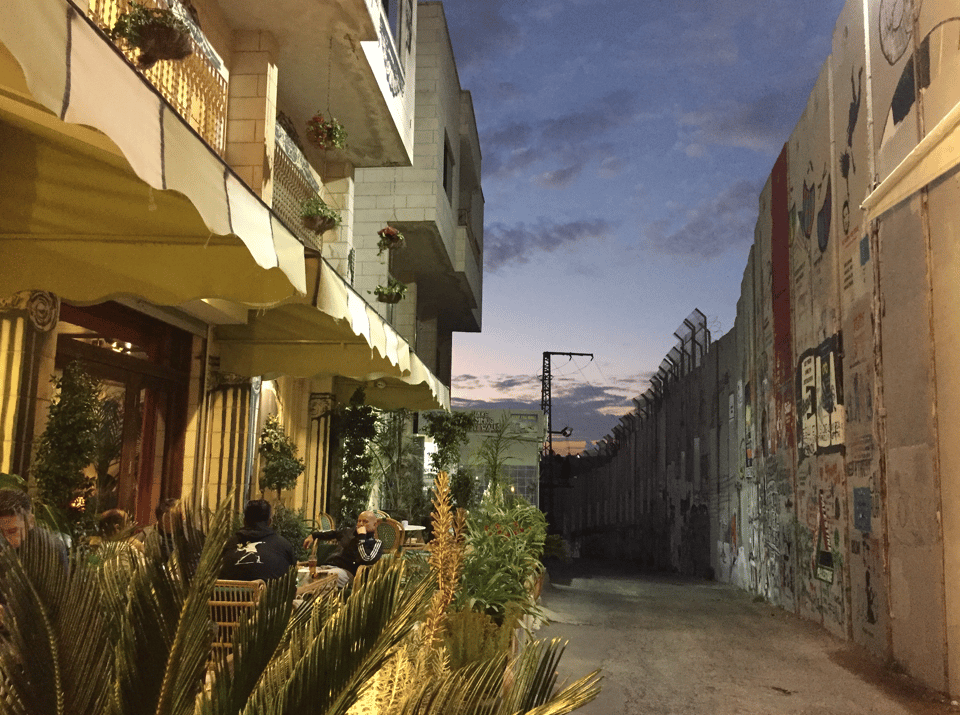
Photograph depicting a narrow alley beside a warmly lit building with balconies, along with outdoor tables and chairs, and many potted plants. On the other side of the alley is a tall concrete wall that appears to be covered with graffiti. The wall is close to the building, and is partly topped with wire fencing. The sky is at dusk.
A side view of Banksy’s Walled Off Hotel. There is a misconception that the wall separates the West Bank from Israel’s 1948 borders. In fact, most of the wall — 85% of it — is inside the West Bank! The wall and its accompanying checkpoints block Palestinians from accessing schools, work, family, hospitals, and their own lands.

The hotel is near a part of the wall that is painted creatively and beautifully, with many original Banksy works.
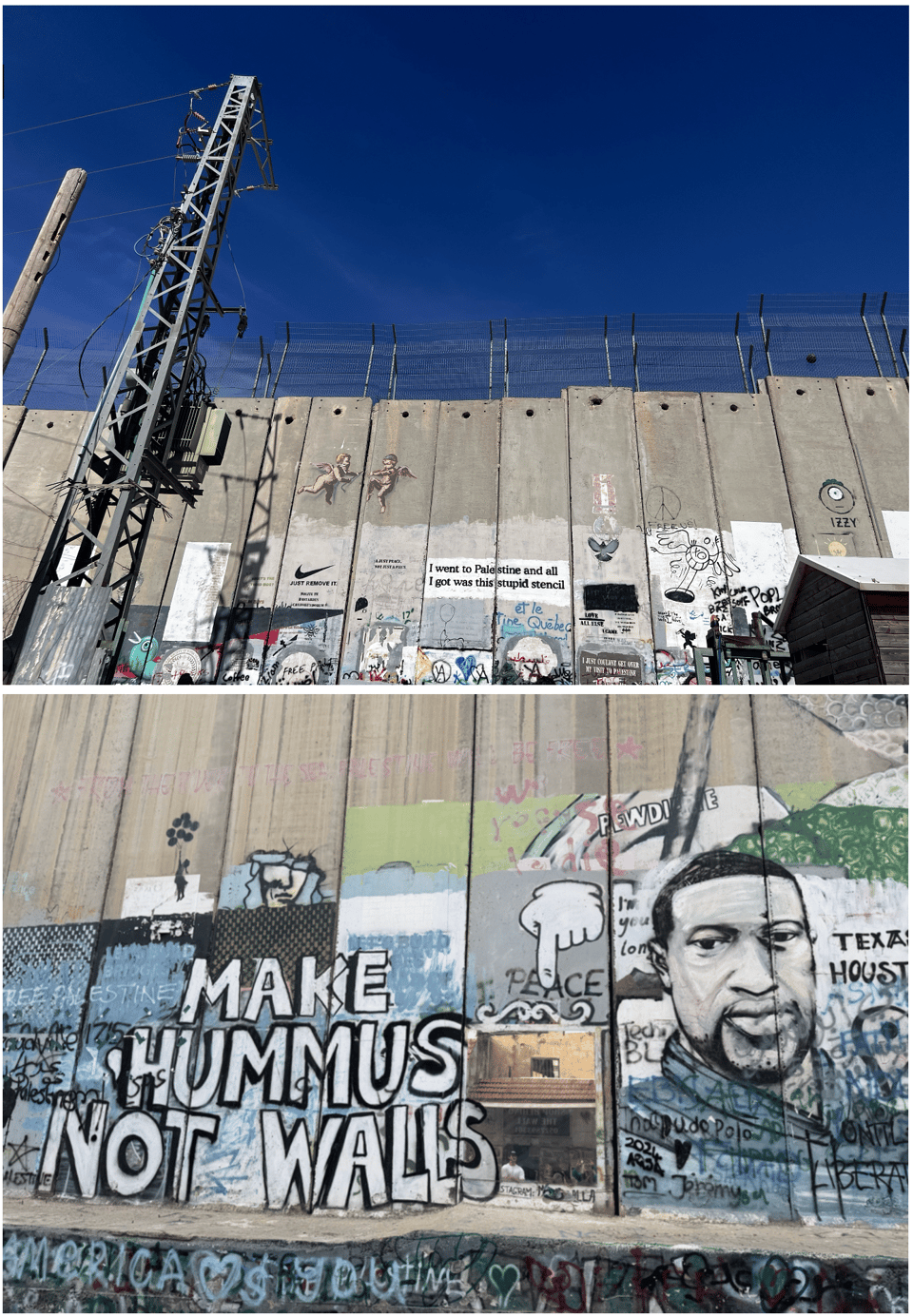
Two images of a tall concrete wall made of towering individual panels. The top image shows a tall metal column, along a bright blue sky. The wall is painted with two angels facing each other, a Nike swoosh with the words 'JUST REMOVE IT' and a whtie rectangle with the words, "I went to Palestine and all I got was this stupid stencil".  The bottom image is the same concrete panels, with faded paint creating many images, including big block letters that say  'MAKE HUMMUS NOT WALLS'. Other words and images include Free Palestine, PEACE, a small black stencil of a young girl being lifted in the air with balloons and a painting of George Floyd.
Two sections of the separation wall in Bethlehem. The top image includes Banksy’s depiction of two angels trying to open the wall with a crowbar. The bottom image includes a painting of George Floyd.

The hotel is filled with many powerful pieces of Banksy’s art:
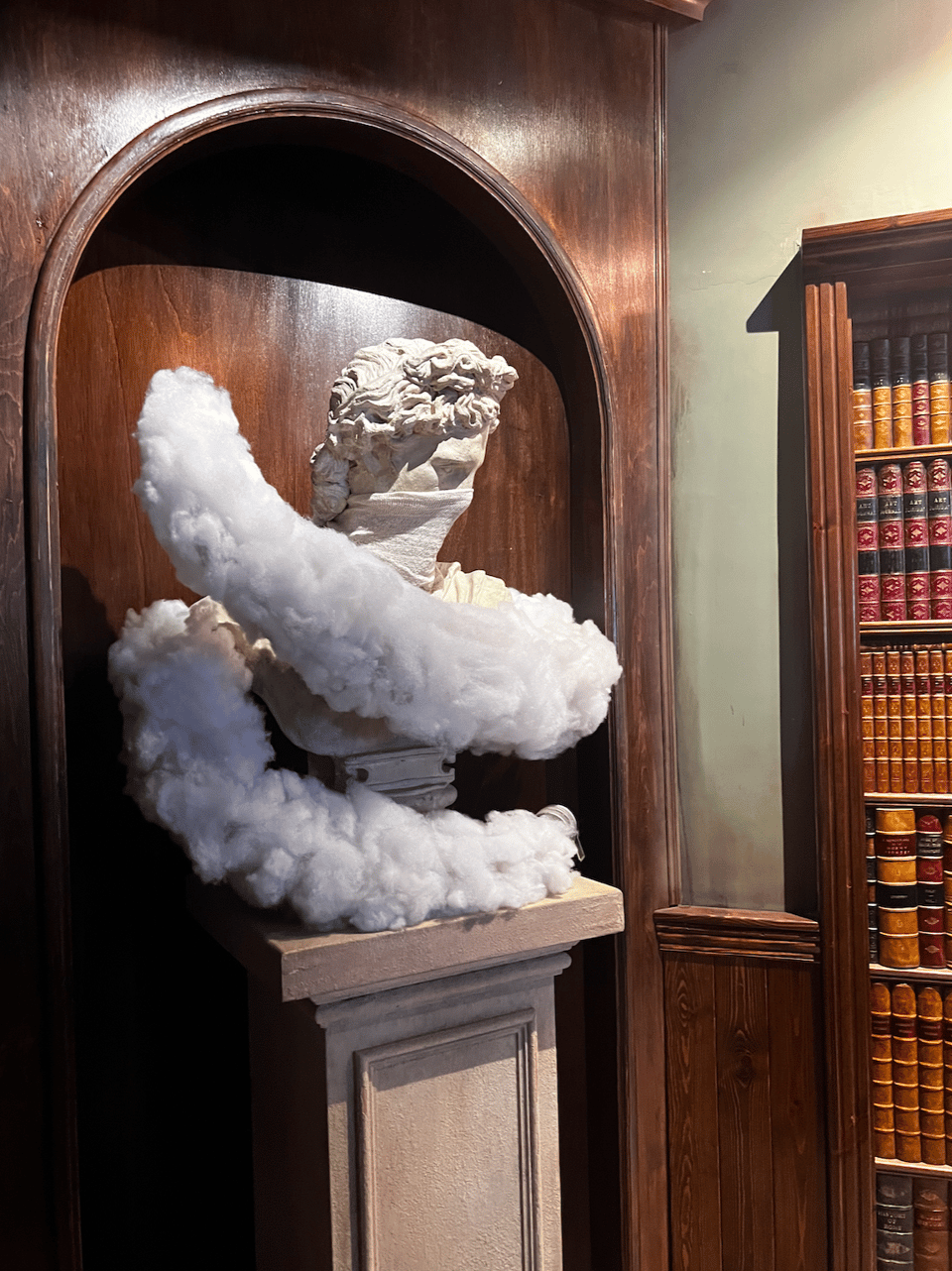
Photograph of a classical marble bust of a man with wavy hair, displayed inside a dark-wood arched niche. Wood paneling and leather-bound books line adjacent shelving. The man is wearing a mask, and a white cloud-like form surrounds the bust.
Artwork in the lobby of the hotel: a classical bust surrounded by tear gas

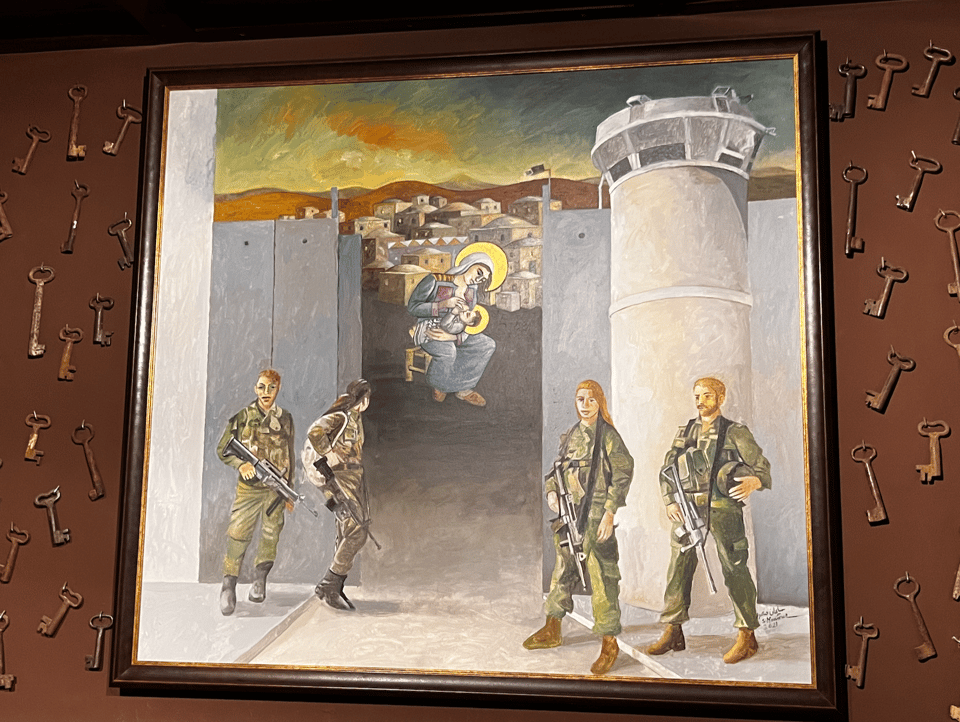
Photograph of a framed painting on a brown background covered with old-fashioned metal keys. The painting shows four soldiers with machine guns in front of a tall concrete wall with a watch tower. Behind an opening in the wall we see a village in the background, along with a seated woman holding a baby. The woman and the baby are painted with yellow halos.
A painting in the lobby: the Baby Jesus and Mary behind Israeli soldiers and the separation wall

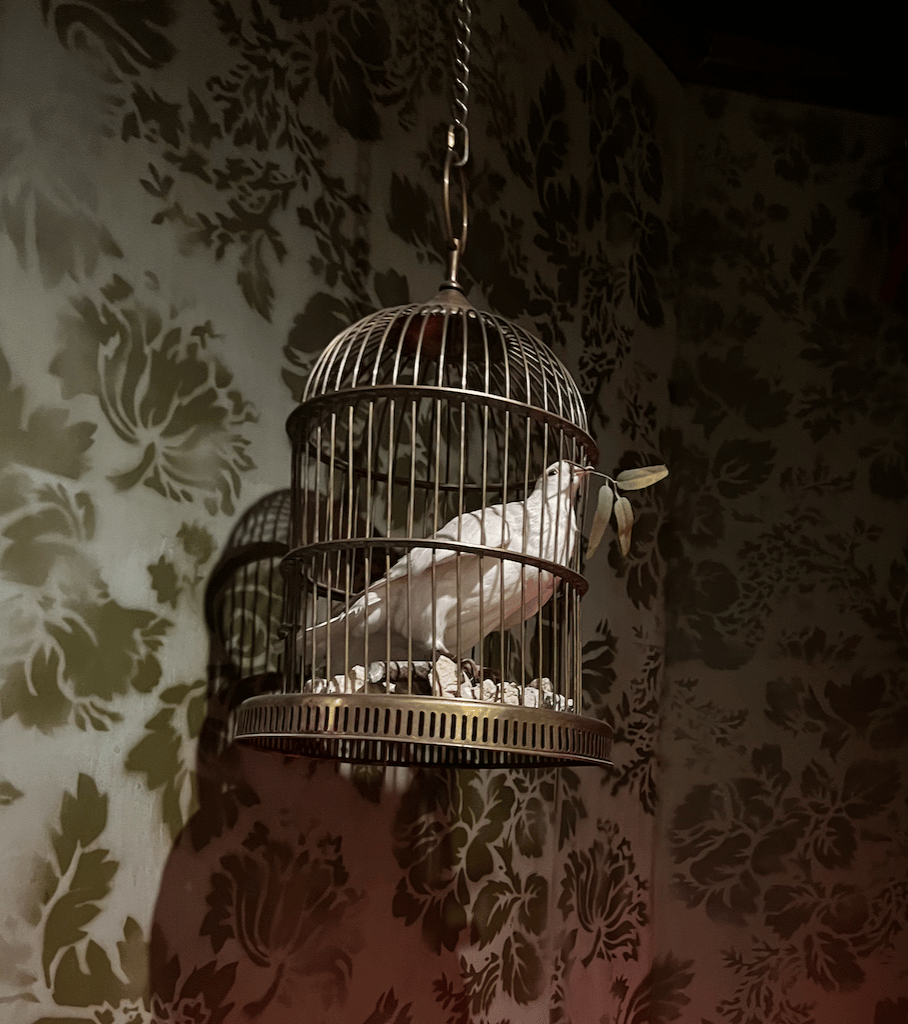
A white dove with an olive branch in its beak, inside a small cage. The cage is in front of flocked wallpaper
More art in the lobby: A caged dove with an olive branch in its beak

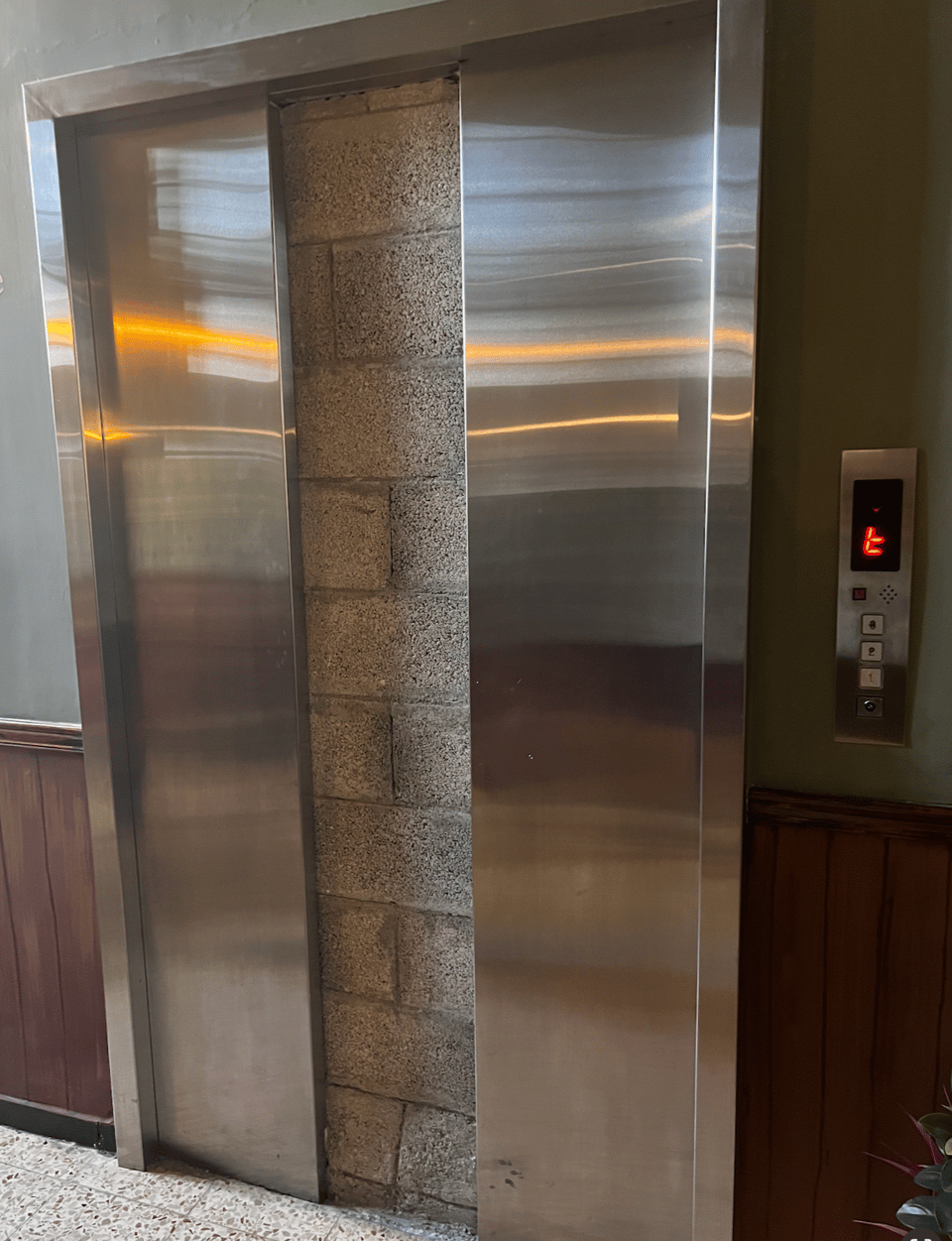
A photograph of an elevator next to a wall with a half-height wood panel.  The stainless steel doors of the elevator are slightly open, exposing a gray cinderblock wall right behind the doors. The elevator control panel to the right displays what looks like an 'E' with a missing top line; or perhaps it's a lowercase 't'.
It took me a moment to realize this isn’t an elevator, but rather, a metaphor for Palestinians’ lack of freedom of movement.

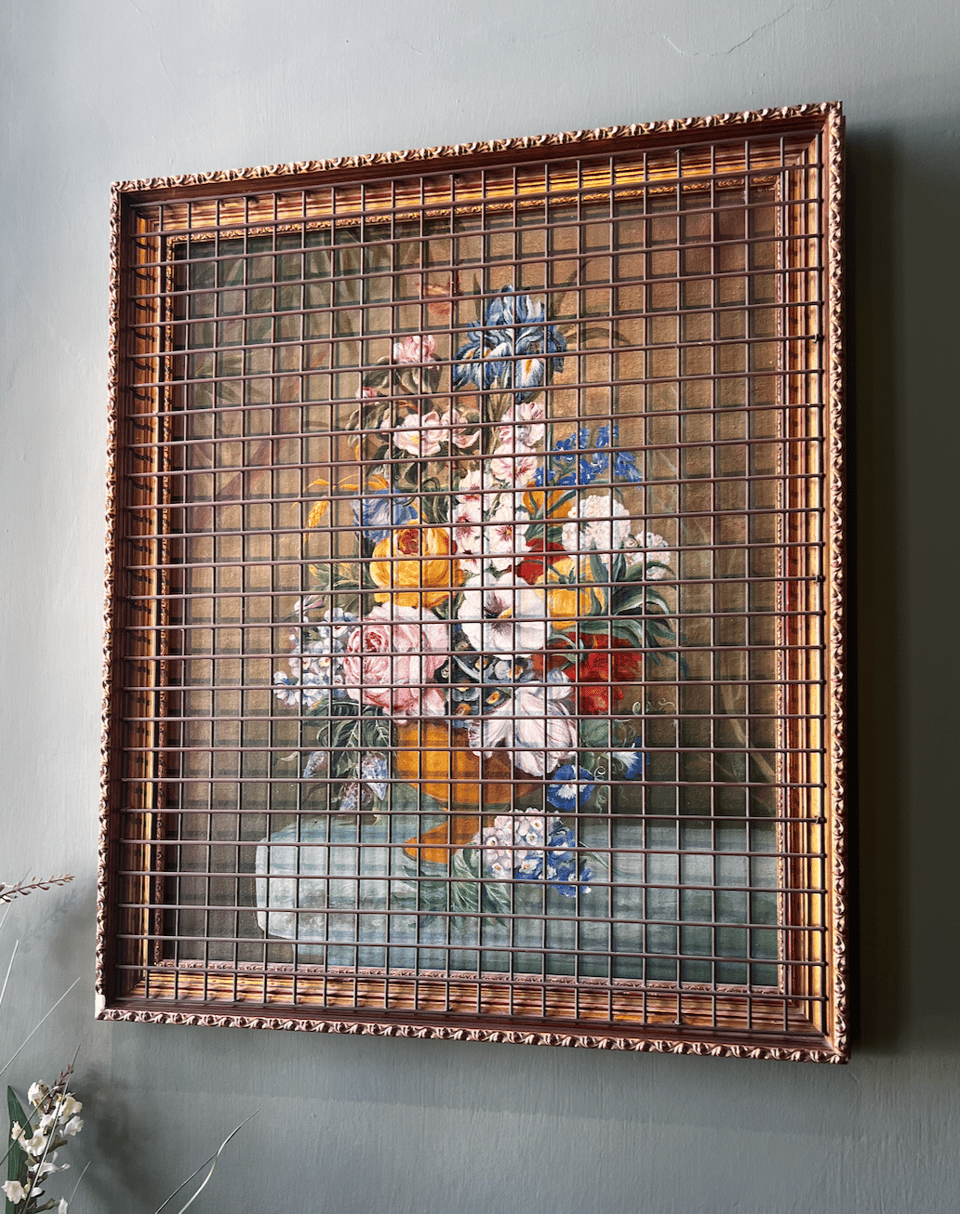
A classical painting of colorful flowers in a vase on a ledge, in a gold frame. The frame and painting are covered by a metal grate.
This piece, Flowers Behind Bars, hangs in the hallway to guest rooms. A heavy steel grill - representing imprisonment and occupation - blocks our view of a painting whose beauty remains.

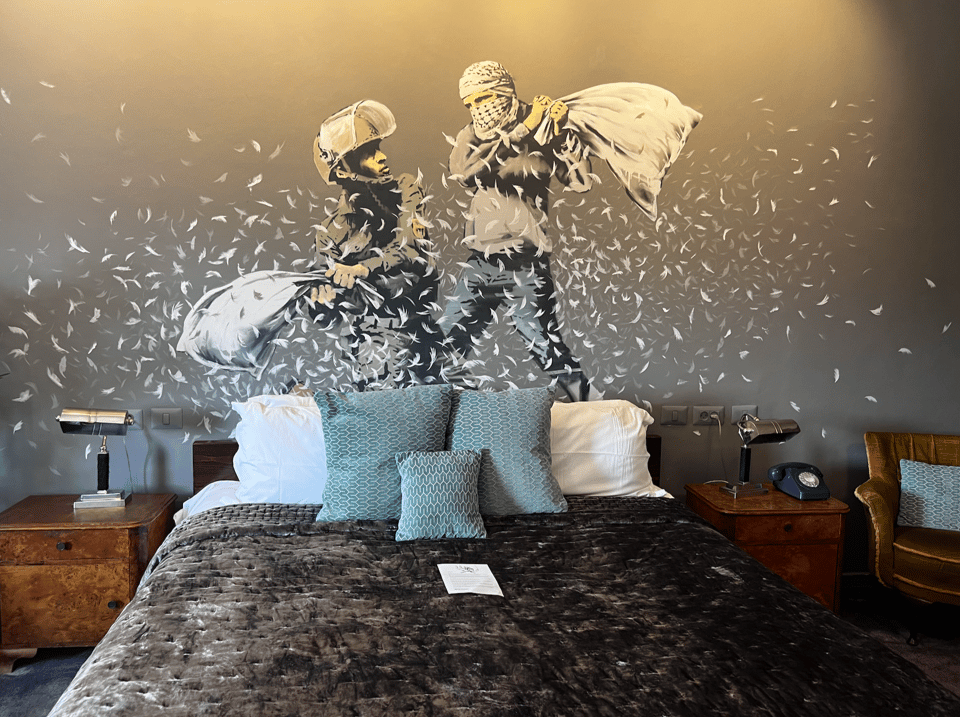
A hotel bed with a brown blanket, two nightstands each with a lamp and one with a phone, and one side chair. There are pillows on the bed. The main feature of the photograph is what is painted on the wall:   two men engaged in a pillow fight, with flying feathers painted all over the wall.  The man on the left is a soldier with a helmet and raised face mask; the man on the right is wearing a keffiyeh that covers his head and his face.
One of the guest rooms in the Walled Off Hotel, with original artwork by Banksy: an Israeli and a Palestinian in combat, having a pillow fight

The museum inside the hotel is filled with poignant information about the wall, and about life in Palestine.
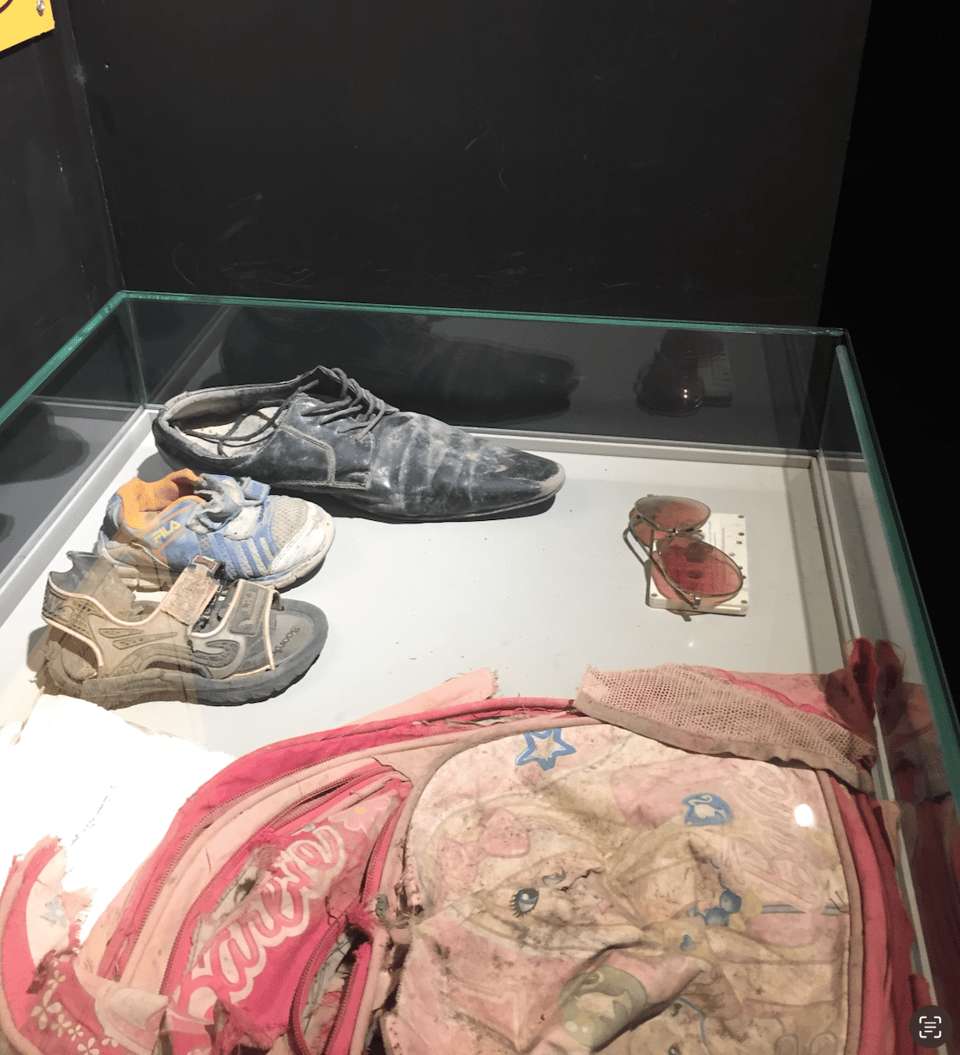
Photograph of a museum display case presenting worn shoes, red sunglasses, and a torn and dirty pink backpack with blue star decorations.
These are objects recovered from bombed buildings in Gaza. I took this photo in March 2023, long before October 7 and the start of the assault that we have seen live-streamed on our phones. A child who was 16 years old at the beginning of 2023 would have already survived five previous Israeli assaults on Gaza: 2008-9, 2012, 2014, 2018-19, 2021, and 2022. (Visualizing Palestine)

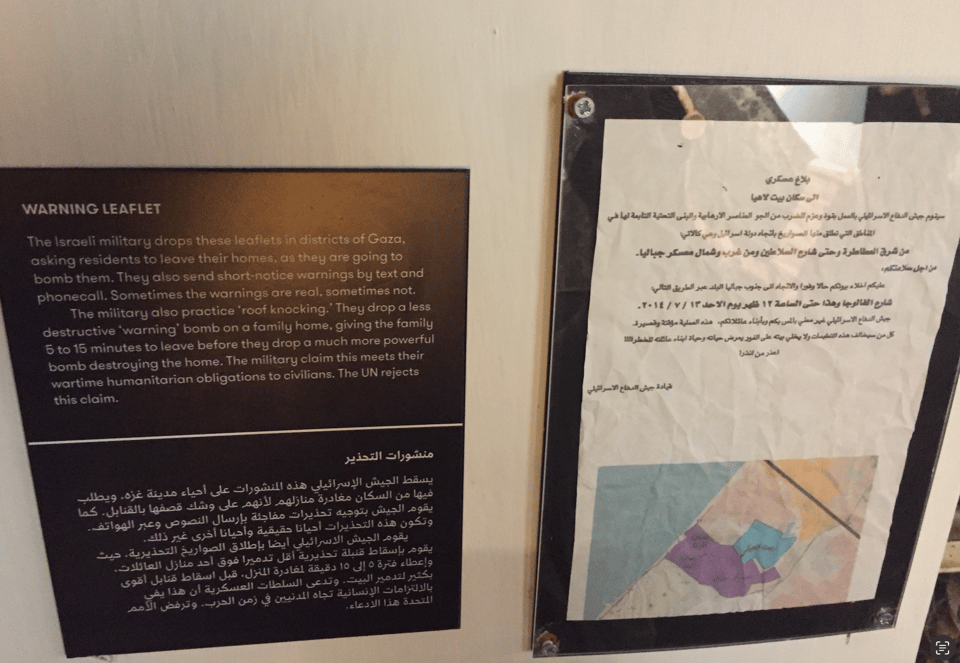
Photograph of an informational sign in English and in Arabic with the heading 'WARNING LEAFLET' next to a framed piece of paper that shows Arabic writing at the top, and a colorful map-like image at the bottom of the page.  (The English version of the text in the informational sign is shown in the caption of this image.)
This is also a photo from March 2023. The placard says, “The Israeli military drops these leaflets in districts of Gaza, asking residents to leave their homes, as they are going to bomb them. They also send short-notice warnings by text and phone call. Sometimes the warnings are real, sometimes not. The military also practice ‘roof knocking.’ They drop a less destructive ‘warning’ bomb on a family home, giving the family 5 to 15 minutes to leave before they drop a much more powerful bomb destroying the home. The military claim this meets their wartime humanitarian obligations to civilians. The UN rejects this claim.”

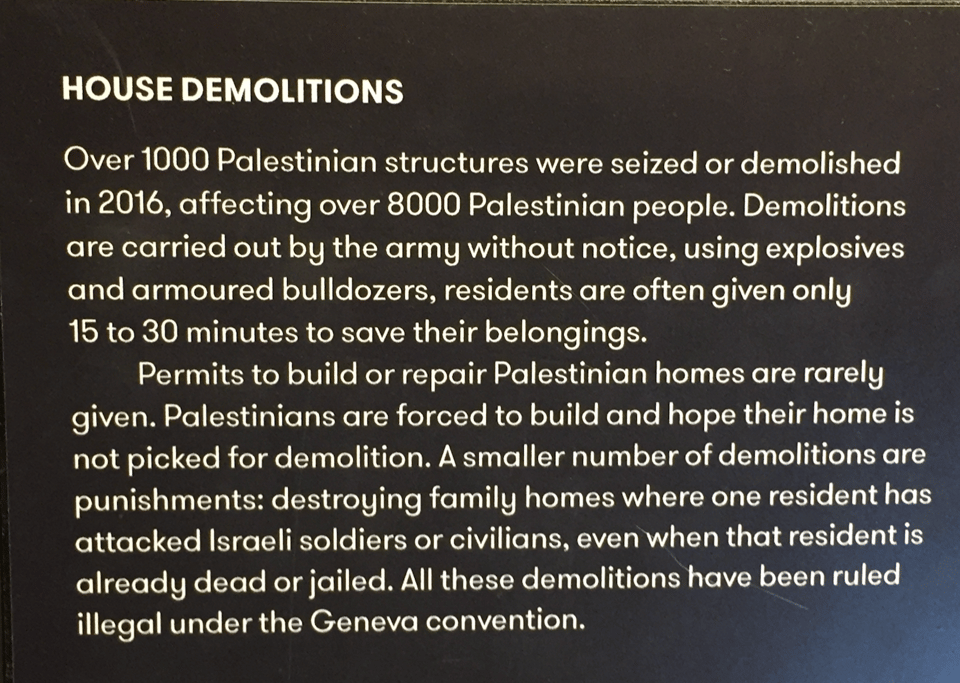
A photo of a sign in the museum that says:  HOME DEMOLITIONS.  Over 1000 Palestinian structures were seized or demolished in 2016, affecting 8000 Palestinian people. Demolitions are carried out by the army without notice, using explosives and armoured bulldozers, residents are often given only 15 to 30 minutes to save their belongings.

Permits to build or repair Palestinian homes are rarely given. Palestinians are forced to build and hope their home is not picked for demolition. A smaller number of demolitions are punishments: destroying family homes where one resident has attacked Israeli soldiers or civilians, even when that resident is already dead or jailed. All these demolitions have been ruled illegal under the Geneva convention.
A sign about home demolitions at the museum

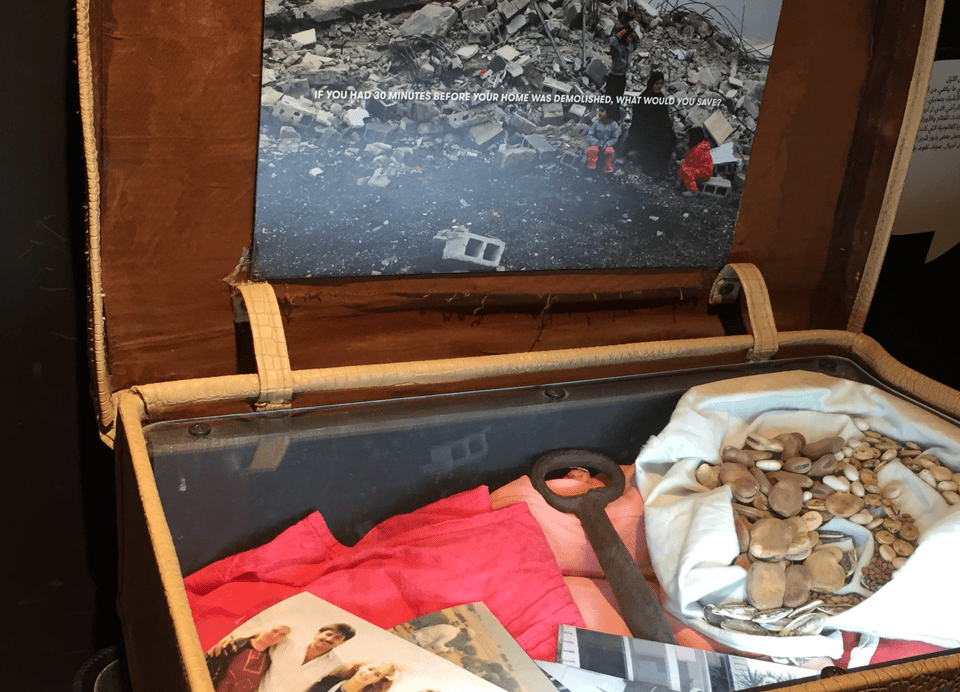
Photograph of an open vintage suitcase containing family photographs, papers, red fabric, a large iron key, and a cloth pouch filled with coins. Lid-mounted screen shows rubble, and a family of 4 sitting in the rubble, and a prompt asking IF YOU HAD 30 MINUTES BEFORE YOUR HOME WAS DEMOLISHED, WHAT WOULD YOU SAVE?
Part of the exhibit on home demolitions. “When the soldiers came in the night to demolish my home, I did not have long to decide what things to take out with me. I chose photos to remember my dead father and my brother… and my children’s birth certificates. I took the house deeds and the door key … My wife took some orange seeds, cultivated by our family on their land for generations. We will replant them. They cannot demolish our memories.” - Enaya, Ramallah

Some people have criticized the hotel and accused it of profiting from Palestinian suffering, and of trying to beautify - and thereby normalize - the wall. They say the wall should not be a tourist attraction, when in reality it is part of an oppressive military occupation that crushes the lives of millions of Palestinians every day.

I asked a Palestinian taxi driver in Bethlehem in 2025 what he thought about that criticism. He said, “I don’t care. I don’t care if tourists want to look at the wall, if it’s beautiful or if it’s ugly. I just want to be able to live, to work, and to be able to take care of my family.”

Israel’s leading human rights organization, B’Tselem, recently released a report about the West Bank called The Elimination Project. In B’Tselem’s words, “Israel is systematically killing, torturing, imprisoning and displacing Palestinians in the West Bank on a vast scale. This is a coordinated assault by the military, police, intelligence services, prison authorities and settler militias, all backed by Israel's legal system.”

If you’d like to know more about what is happening now in the West Bank, this interview (September 2026) with the journalist Jasper Nathaniel is one of the clearest explanations I’ve heard (starting at minute 52). Nathaniel is a Jewish-American who was raised in New York. You can follow him on Substack or at infinitejaz.com for powerful independent eyewitness reporting from the West Bank.

Salaam,

Nancy

If this message was forwarded or if you reached it from a link, you can subscribe to receive future Postcards directly.

Subscribe now
Don't miss what's next. Subscribe to Postcards from Palestine:
Older → Revisiting Kristallnacht and German citizenship
Powered by Buttondown, the easiest way to start and grow your newsletter.