Postcards from Palestine logo

Postcards from Palestine

Archives
Subscribe
July 9, 2026

Right of return and the Aida Refugee Camp

Dear Friends,

Just outside the city of Bethlehem lies the Aida Refugee Camp, whose original residents were forced from their homes in 1947-48. The residents were joined by a new group of refugees in 1967. I visited Aida Camp twice in February of this year (2026). The prominent key at the entrance symbolizes the right of descendants to return to the places from which their families were displaced.
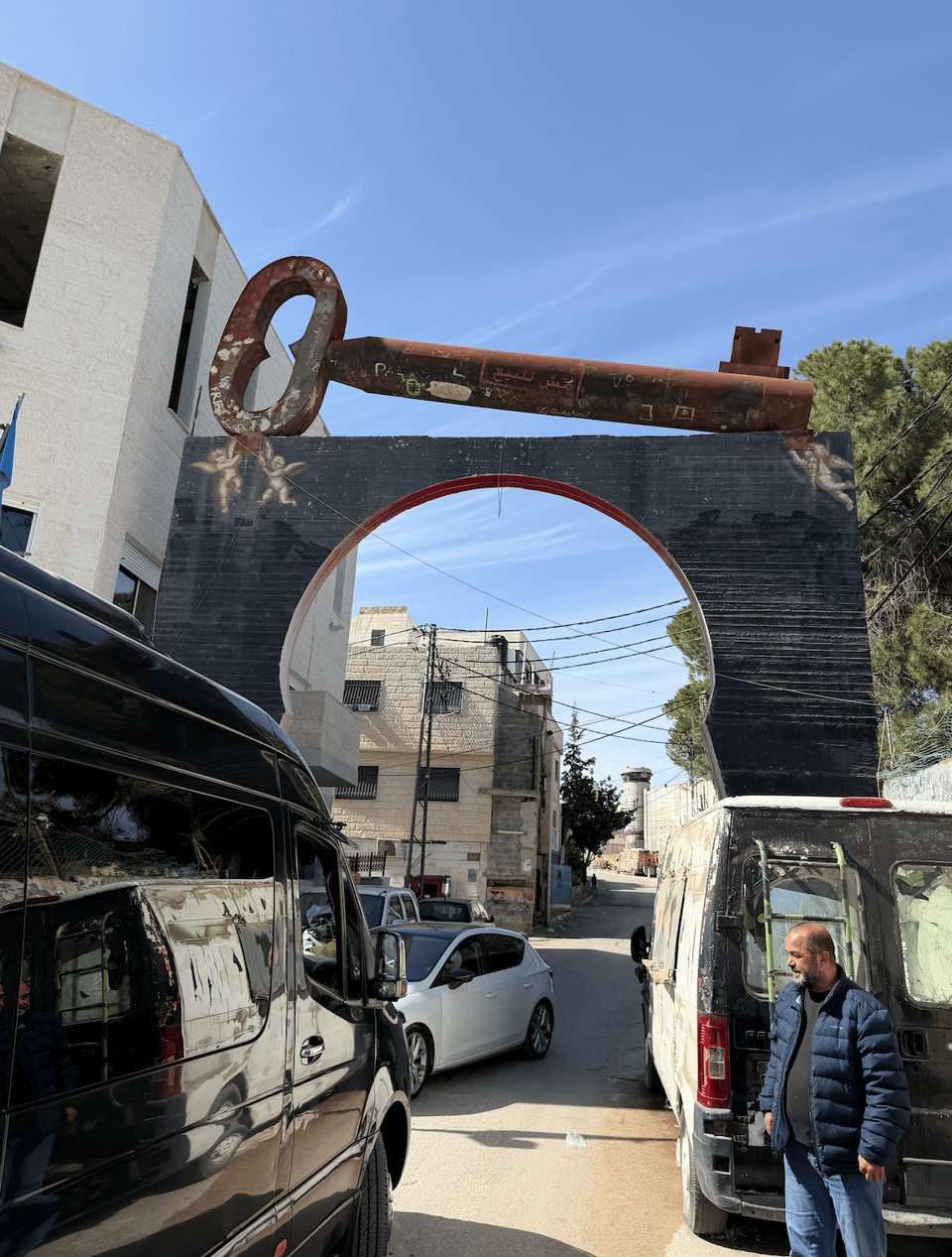
Photograph of a street scene featuring a large black archway with a rusted key sculpture mounted on top. Vehicles and a man in a blue jacket are visible beneath the arch, with buildings and power lines in the background under a clear blue sky.
Palestinians who were forced to flee in 1947-48 took their keys because they expected to return to their homes. The prominent key at the entrance to the camp symbolizes the right of descendants of those refugees to return to their land. (Pictured: Munther Amira)

At its creation in 1950, Aida Refugee Camp housed about 1,100 refugees in 94 fabric tents that were provided by UNRWA (United Nations Relief and Works Agency), the UN agency responsible for serving Palestinian refugees. The man pictured in the photo above, Munther Amira, a current resident, was born in one of those tents. Munther is now the head of the administrative board of the Aida Youth Center, a vibrant hub in the community that was created in 1968 to serve and empower the camp’s children and youth.

In 1956, UNRWA replaced the original tents with cinder block housing units. As the population grew, families expanded their units in the only direction in which space was available - up - so that the camp is now comprised of densely packed multistory buildings. In these overcrowded conditions, residents experience lack of infrastructure including water and electricity shortages, limited access to health services, high unemployment and poverty rates, and lack of access to green spaces and recreational facilities. The camp is surrounded on three sides by Israel’s separation wall.
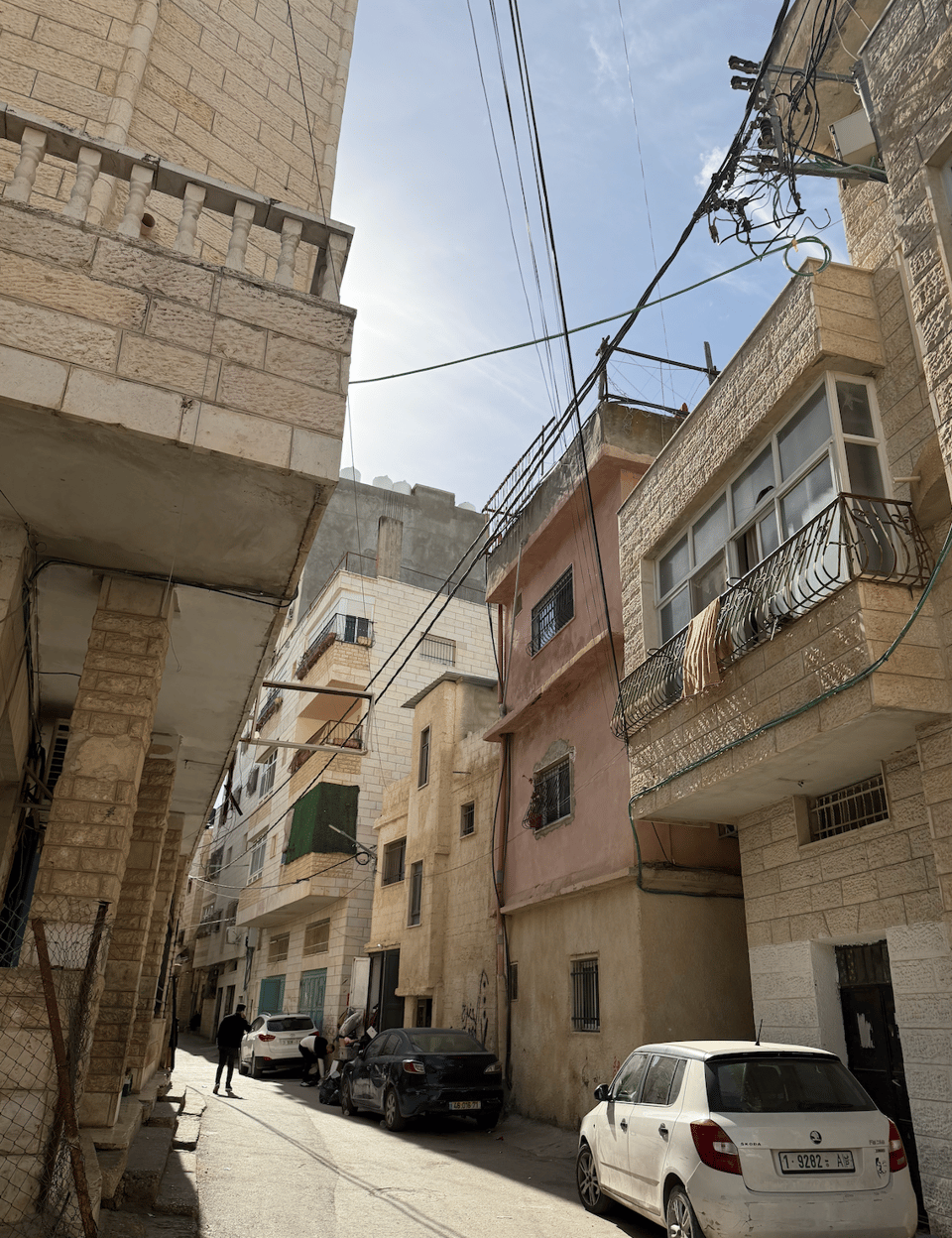
Photograph of a narrow urban street lined with multi-story residential buildings featuring stone and plaster facades in beige and light brown tones. Several parked cars and a few pedestrians are visible, with overhead utility wires crossing above the street under a partly cloudy sky.
As families grow in the Aida Camp, they build upwards, creating crowded streets and limited infrastructure.

ABOUT RETURN

I’m often asked, “why don’t Palestinian refugees accept that they lost the war, and let go of claims to return? Isn’t that what happens in other places?”

Some refugees do make that choice. But that is not the choice of Palestinians living in Aida Camp, elsewhere in the West Bank, or Gaza. And according to international law, all refugees have the right to return to their home country.

Israel has argued that the Palestinian right of return would mean that Israel would no longer maintain a Jewish majority. This is the same reasoning that led to the forcible displacement of the population and the creation of so many refugees in the first place.

But international law is clear. The 1948 UN Universal Declaration of Human Rights, the UN’s Resolution 194 (passed in 1948), and the UN’s Resolution 3236 (adopted in 1974), “Reaffirms the inalienable right of the Palestinians to return to their homes and property from which they have been displaced and uprooted, and calls for their return”. Amnesty International (2001) and Human Rights Watch (2000) also attest to the right of return for Palestinians.

There is another kind of return as well: Israel has had, since 1950, what it calls the Law of Return, which gives every Jew in the world - along with their spouse, children, and grandchildren - the right to Israeli citizenship. Here, the idea of return is based on 2000 year old claims. One has to wonder… if Jews didn’t give up the idea of returning to the Holy Land for 2000 years, why do they think Palestinians will give up their wish - and their legal right - to return to their lands?
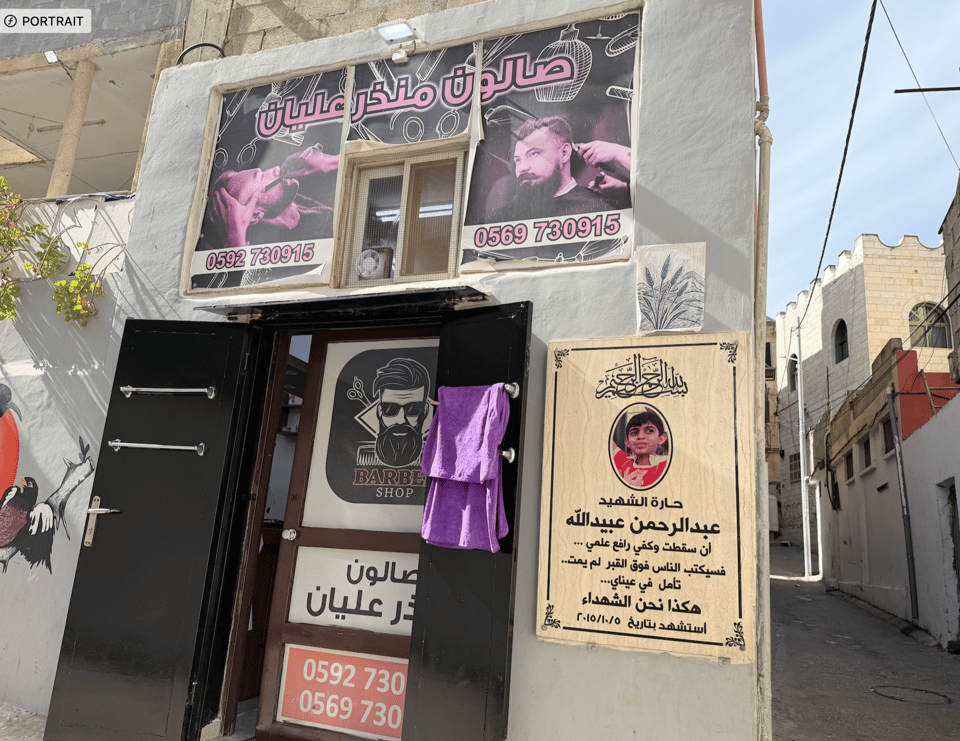
Photograph of a barber shop entrance with open black doors and a purple towel hanging on one door, featuring a sign above with a man getting a haircut and phone numbers with writing in Arabic. Next to the door is a memorial plaque with a photo of a young boy and Arabic text, set against a backdrop of a narrow street with many buildings
A barber shop in the Camp. The image on the right is of Abdallah Rahman Ubaidullah, a child who was shot and killed in the camp by Israeli soldiers (‘by mistake’ according to the Israeli military). The text says, “If I fall, my hand still holding my flag high... People will write above the grave, ‘He did not die’. Look into my eyes. This is how we martyrs are.”

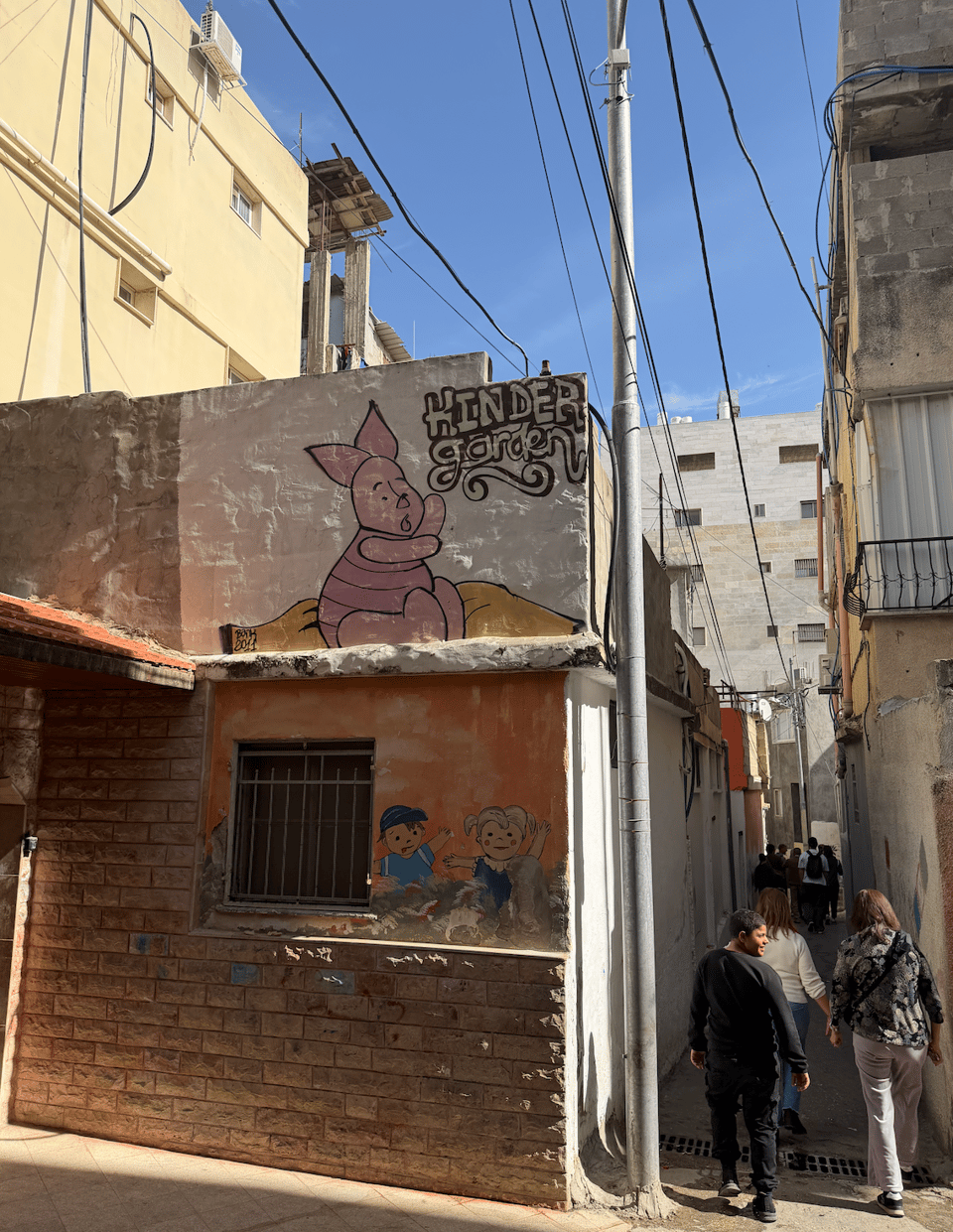
Photograph of a narrow urban alley featuring a mural of Piglet from Winnie the Pooh with the English word ‘KINDER garden’ above it. The mural is painted on a building corner, with additional smaller cartoon characters below a barred window, while several people walk along the alley under a blue sky. Many electrical wires run above the buildings
A kindergarten in the Aida Camp

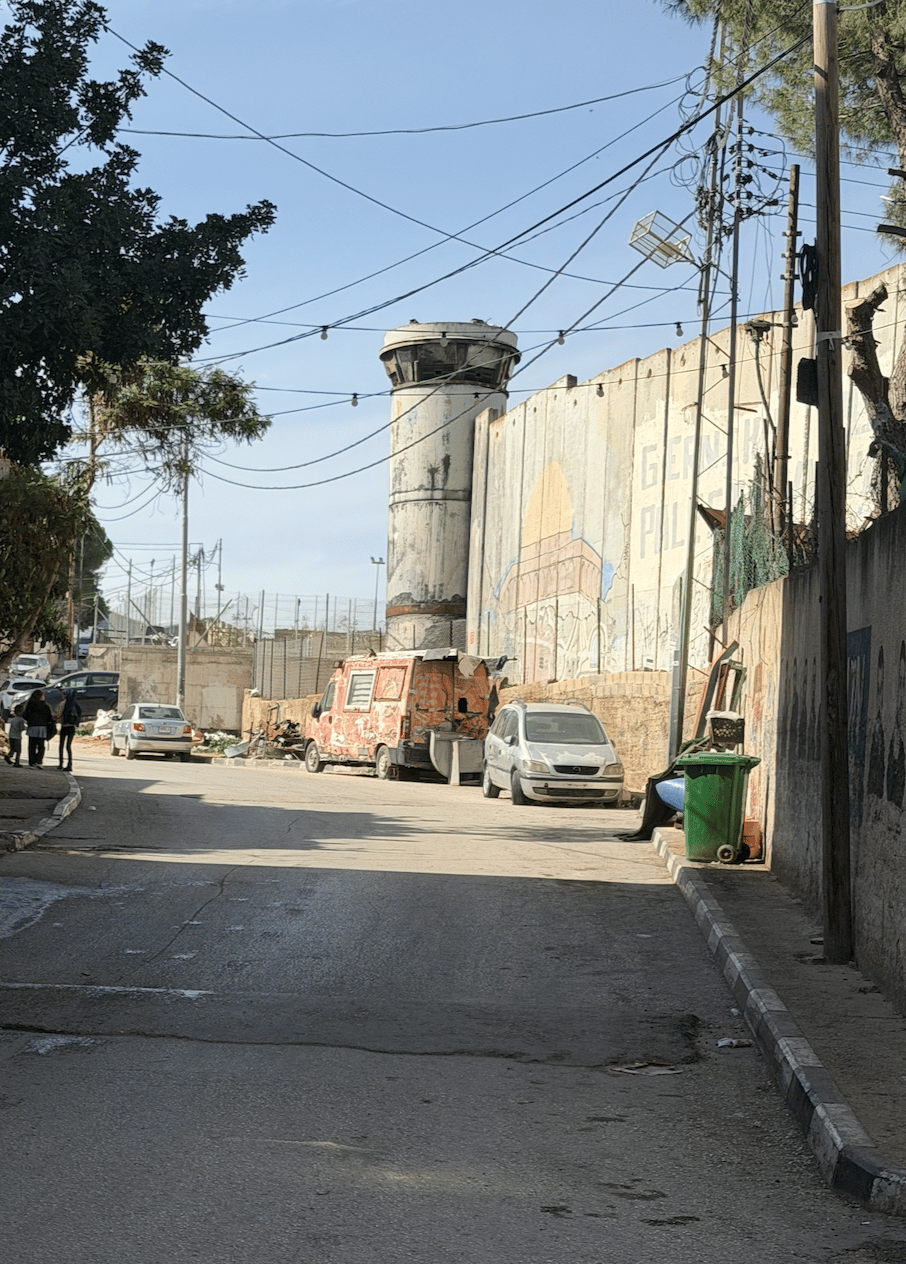
Photograph of a street featuring a tall concrete watchtower and a high concrete wall with faded graffiti. Several parked vehicles, including a rusted van and a small car, line the street, with overhead power lines and sparse trees visible under a clear sky.
The camp is surrounded by the separation wall and seven watch towers. Two Israeli settlements guarded by Israeli soldiers are also close to the camp. Residents of the camp live under intense military surveillance and pressure.

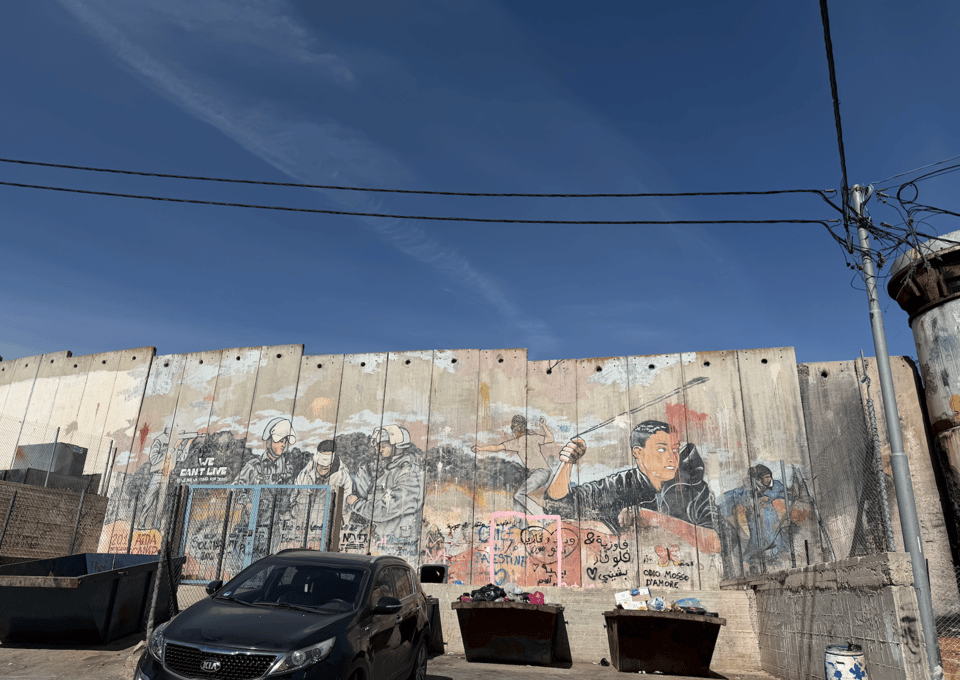
Photograph of a tall concrete barrier wall featuring a large mural depicting a confrontation between a young man and soldiers, with the man holding a sling shot and police in helmets and shields. The mural includes various colors and Arabic text, and the words in English WE CAN’T LIVE. In front of the wall is a black car and trash bins  under a clear blue sky, with electrial wires above the wall. A tall watchtower is seen at the edge of the image
Another view of the separation wall, sometimes referred to in English as the apartheid wall (جدار الفصل العنصري)

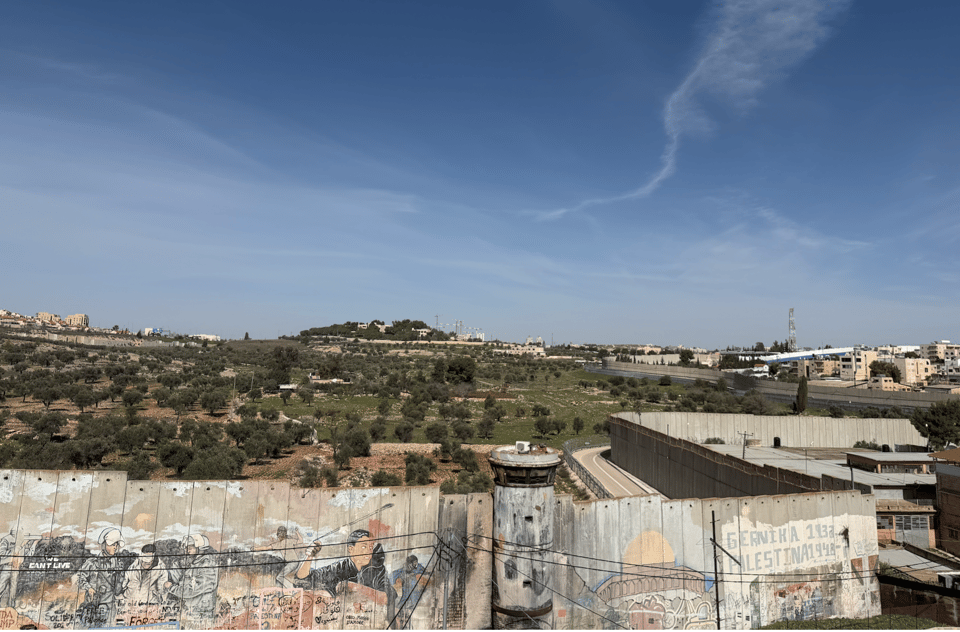
A photograph taken from a high point,  showing, in the foreground, the same concrete separation barrier with graffiti that is shown in the previous photo. On the other side of the wall are green areas and olive trees.  In the distance, what looks like small towns consisting of clusters of buildings
The view from a rooftop inside the Aida Refugee Camp. In the foreground, the Israeli separation wall and a military watch tower; in the distance, two Israeli settlements in the West Bank, that are illegal under international law

Aida Camp is the site of frequent violence from Israeli soldiers. A 2018 study by the Human Rights Center of UC Berkeley found that Aida Camp is the most teargassed community in the world: at the time, 100% of Aida’s residents had been exposed to teargas, over 83% of them inside their own home. (Take a moment to think about that.)
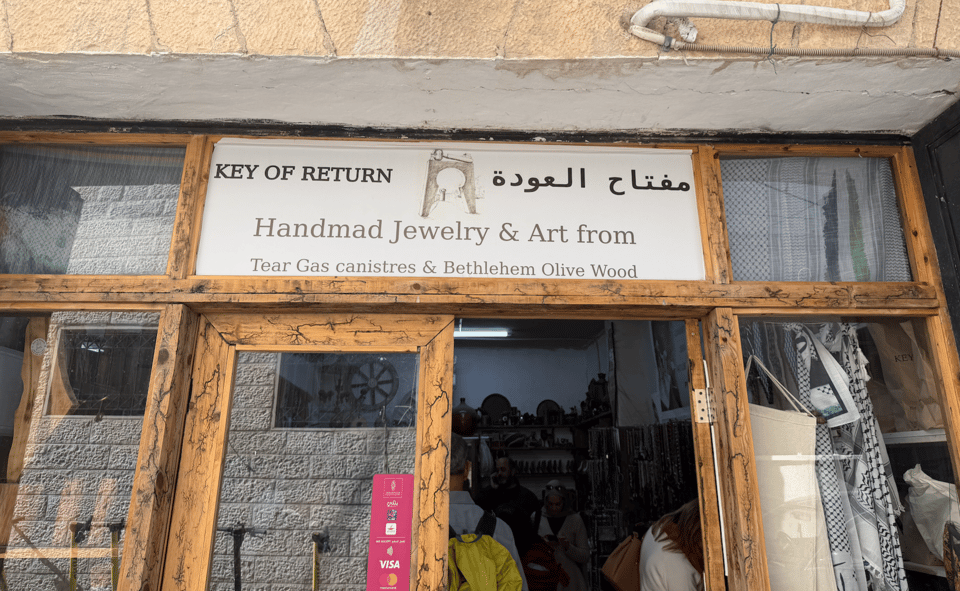
Photograph of a storefront with a sign that says ‘Key of Return’, along with a drawing of the sculpture of the entrance with the sculpture of the key, shown in the first photo above.  The sign has Arabic writing, and says also:  Handmade Jewelry & Art from Tear Gas canistres & Bethlehem Olive Wood. The sign is above wooden-framed glass doors, with interior displaying various art pieces and black and white keffiyehs inside
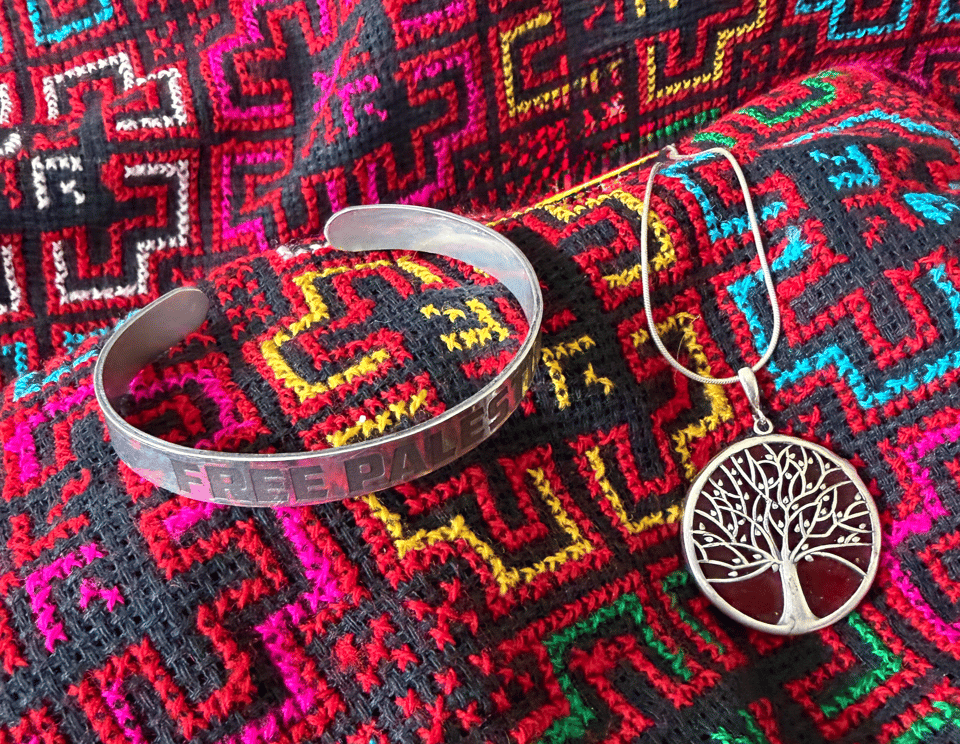
Key of Return: An artist in the Camp began using the metal from used tear gas canisters to create art and jewelry, turning weapons of violence into beauty.

Photograph of a silver cuff bracelet engraved with "FREE PALESTINE" and a silver round pendant necklace featuring a tree design, both placed on a colorful, patterned textile with red, pink, yellow, blue, and black geometric shapes, which is typical of Palestinian embroidery
The bracelet and necklace I have from this shop are very precious to me.

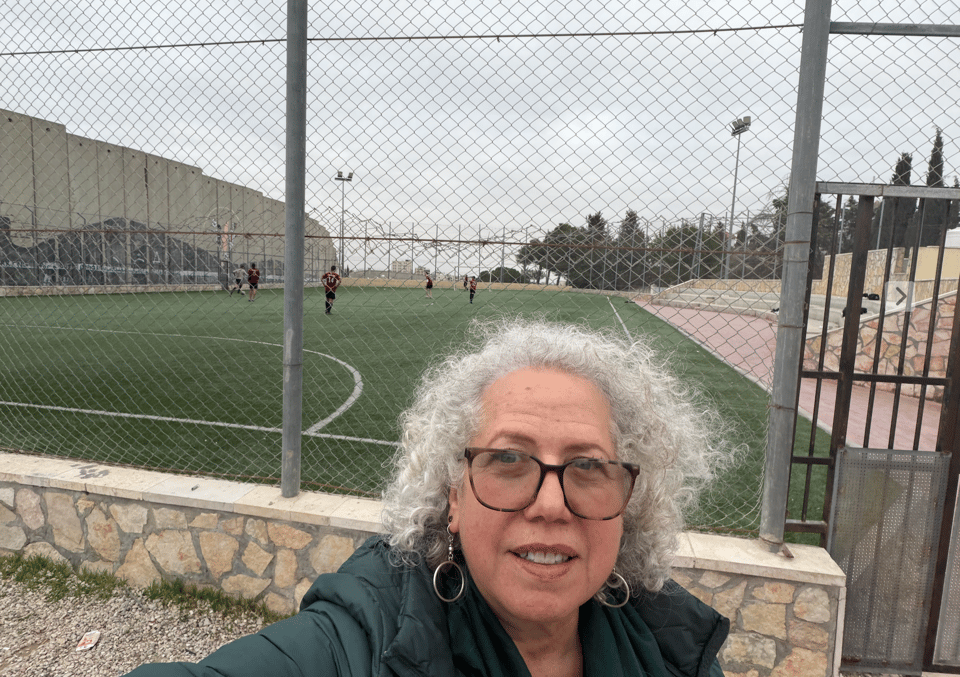
Photograph of a woman with curly gray hair and glasses taking a selfie in front of a fenced soccer field with players in the background, under a gray sky. Next to the field is a large concrete wall.
In November 2025, Israel announced plans to demolish the soccer field at the Aida Camp, because, they said, the field was a security threat as it is so close to the wall. Thanks to international pressure, including advocacy by children’s educator Ms. Rachel and global soccer governing bodies FIFA and UEFA, Israel has halted demolition plans - at least for now.

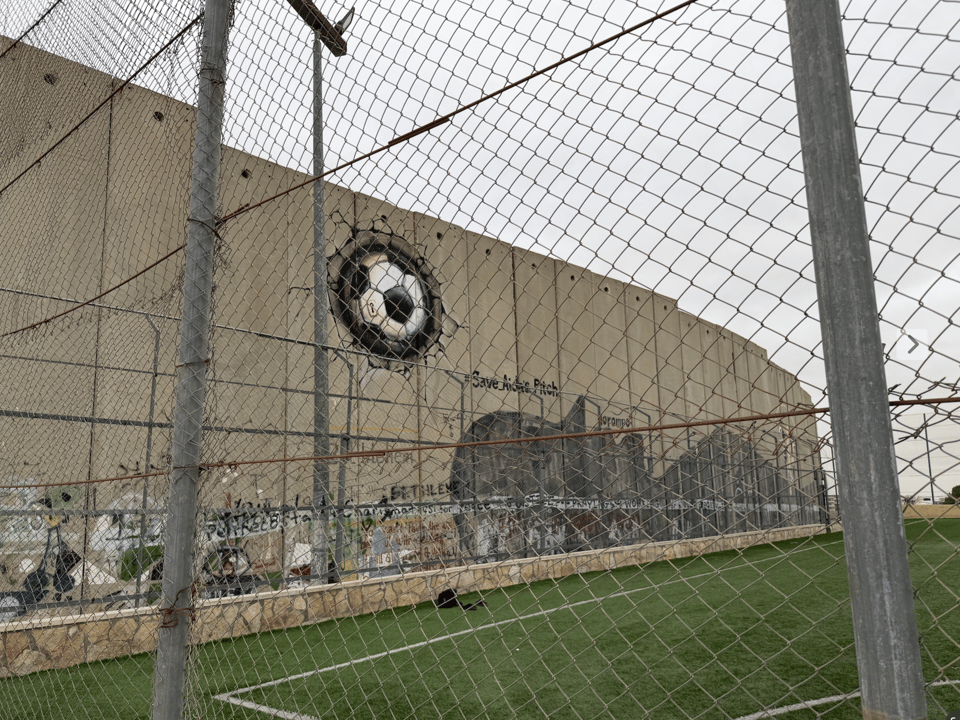
A close-up of the wall seen next to the soccer field in the previous photo. It includes a painting of a person who is lying down, with the words 'Save Aida Pitch'.  It also includes a painting of a soccer ball that looks like it has crashed into the wall and smashed it.
A closer view (from outside the fence surrounding the field) of a painting of what looks like a soccer ball making a hole in the wall. The International Court of Justice (ICJ) ruled in 2004 that the wall is in violation of international law.

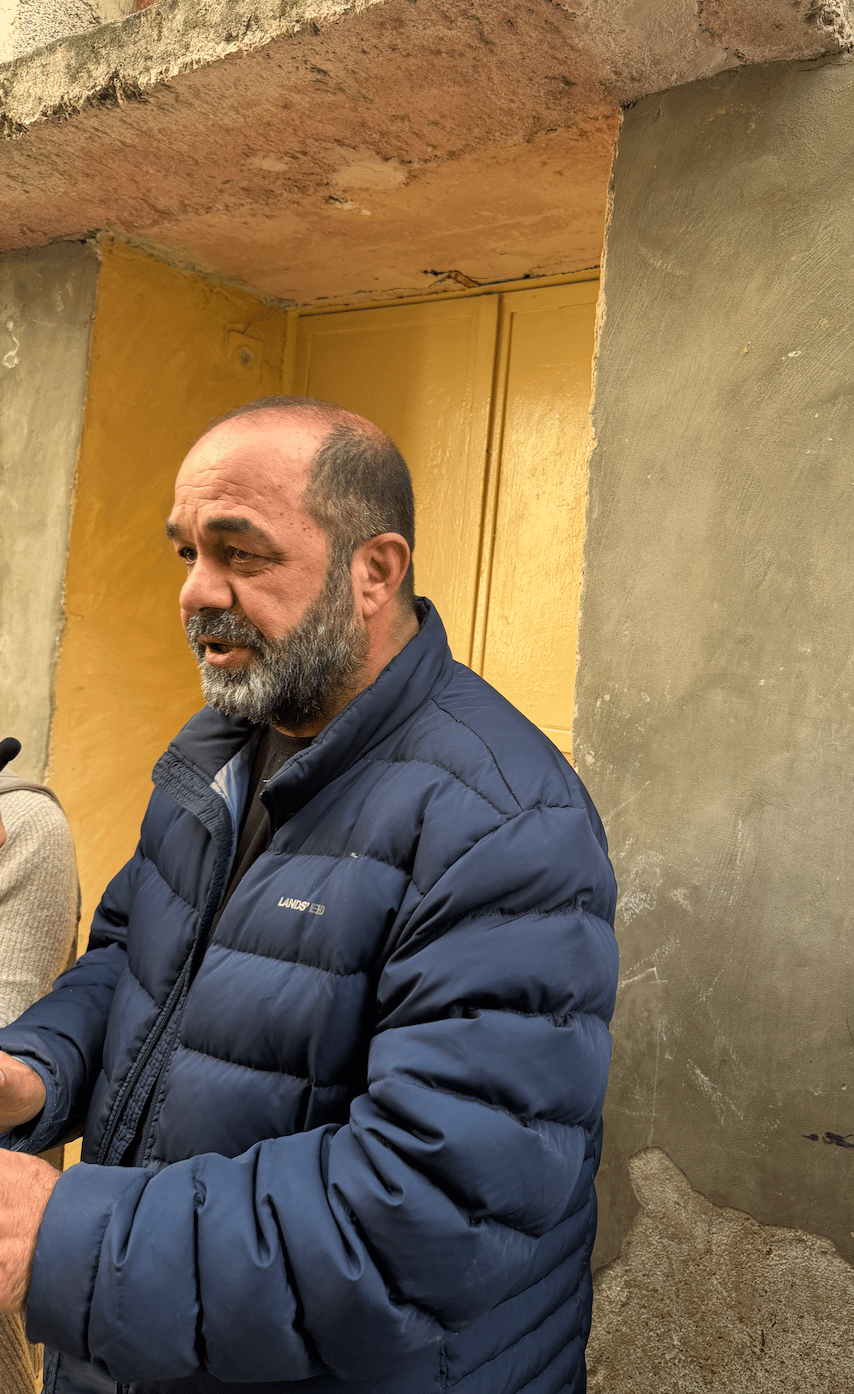
Photograph of the same man in the first photo, wearing a blue puffer jacket standing outside a yellow door next to a gray wall.
Munther Amira, giving our delegation a tour of Aida Camp. As we stood in front of someone’s home, a person inside opened the door. He didn’t ask us to move away - on the contrary, he invited us to come into his living room so we could all sit down.

Munther Amira, the man born in a tent in the early days of the camp, is a calm, thoughtful guy. He described some of the conditions in the camp, and noted that the Israeli occupation controls most everything: water, electricity, signals for cell phones, movement in and out. He said, “The occupation is in every single part of our life. It’s not just the shooting.”

Munther is committed to nonviolence. “Israel has the strongest, most violent military machine in the world, and what happened in Gaza proves that they are waiting for any kind of violence to beat you and to kill you and to throw you from here.”

Following October 7, Munther was arrested, along with more than fifty other people from the camp, including men and women ranging in age from 15 to 55. In the arrests, heavily armed Israeli soldiers stormed the camp before dawn, damaged homes, and threw tear gas. Munther, like the others arrested from the camp and like more than 3,000 other Palestinians currently in Israeli prisons, was held under the Israeli policy of administrative detention, which allows Israel to jail Palestinians indefinitely (in six-month intervals) without charges or trial. Munther was threatened recently that he would be arrested again if he continues his (non-violent) advocacy.

Whispering softly, Munther said he would not tell me about the torture he endured in an Israeli prison: “I will not compare those four months [in Israeli detention] with two centuries in any other prison in the world. Yes, we are paying a hard price just to say, ‘I am a Palestinian. I want this occupation to end.’ The West Bank is a place of suffering. The easiest part of our life is to be killed.”

At the end of our conversation, Munther gazed toward the settlement in the distance and said, “what is happening now in Gaza happened with our families in 1948. But then, there were no media that would cover and document what was happening. And it’s not just in Gaza, but in the West Bank too.”
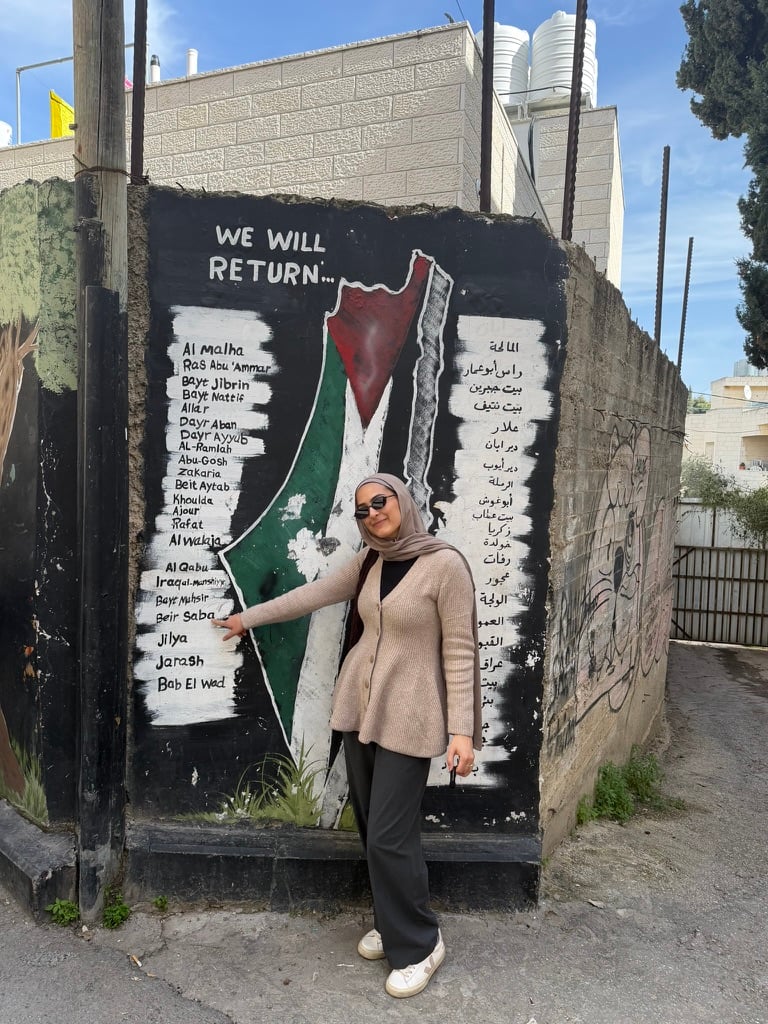
Photograph of a woman standing in front of a mural featuring a map of Palestine colored with the Palestinian flag and the phrase "WE WILL RETURN..." above it. The mural lists names of various locations in Arabic and English on either side of the map. In the background is a cinderblock building with large white tanks atop the roof.
A Palestinian-American pointing to the name of a village that was destroyed in 1948 and from which her grandfather was expelled at that time. Residents of the camp originally came from more than 40 villages and towns across what is now Israel, when they were forcibly displaced in 1947-48 and in 1967. Most Palestinian refugees have never seen the villages that their families were displaced from. In some cases, the villages no longer exist because Israel destroyed them.

Munther ended our conversation with this: “Our strength, it’s our story - the truth, our right to live. The occupation has to be ended, but it will not be easy. We, the Palestinian people, we cannot do it alone. It’s not just our task as Palestinians - it is also your task to end this occupation.”

Salaam,

Nancy

If this message was forwarded or if you reached it from a link, you can subscribe to receive future Postcards directly

Subscribe now

Don't miss what's next. Subscribe to Postcards from Palestine:
← Newer Kristallnacht and the right of return Older → Permission to pray
Powered by Buttondown, the easiest way to start and grow your newsletter.