When an indie film is an unexpected box office hit, does the crew deserve a bonus?
The art director for "Obsession" has stepped into the breach to talk about issues of fair pay.

Be careful what you wish for.
When it comes to the indie horror movie “Obsession,” that’s not only the film’s premise, but also perhaps a larger metaphorical truth.
Made on a budget of just $750,000, the movie has brought in nearly $240 million globally since opening in theaters last month, according to Box Office Mojo.
That kind of success has made it the story du jour in Hollywood: Young filmmaker — Curry Baker, 26 — with a YouTube track record (and following), but notably no big league experience to speak of, is lapping everyone.
For distributor Focus Features, “Obsession” is the company’s highest grossing movie ever. (The company’s No. 2 is the “Downton Abbey” movie from 2019, with nearly $195 million in global box office.)
“Obsession” premiered at the Toronto International Film Festival’s Midnight Madness block, where Focus Feature picked it up for $15 million.
The film’s subsequent financial success is rare for an indie.
And that success has prompted the film’s art director, Sally Choi, to talk about — some might say “complain,” others might say “advocate for” — better systems regarding crew pay when a low-budget productions makes the kind of money that “Obsession” has.
Choi’s concerns, and her decision to go public with them, are a glaring weakness in an otherwise idealized story about the film’s success. Be careful what you wish for; massive box office means people are going to take a closer look at your business practices — as they should.
According to Choi, she was paid $300 a day. This was a non-union shoot. Here’s what she had to say:
I did know the rate beforehand and agreed to it, but at that point I was living paycheck to paycheck. This is the reality of most filmmakers, especially those who work below the line. We become a line in the budget sheet to keep as low as possible.
(“Above the line” refers to actors, directors, producers and writers. “Below the line” jobs on a set refer to the crew.)
So far, neither Curry nor the producers have publicly responded to her post.
Here’s some further context: People are desperate for work in Hollywood right now. Last week, I wrote about this reality, noting that California has lost 51,000 production jobs in the last three years. On the TV side, consider these numbers as compiled by FilmLA: In 2019, 196 scripted series shot in LA. In 2024, that number was 77.
Even seasoned crew are over a barrel at the moment.
Choi described her indie experience further in her post:
As is the case for most low budget productions, everyone has to wear many, many hats. Though my official title is art director, I was also a PA (production assistant), set dresser, graphic designer, background actor, driver, swing, and buyer …
… I say all this to finally have my peace. I know this is bigger than “Obsession” (or Curry and his team, It’s not about that). I know this is even bigger than the film industry. If you feel called to have this discussion with me, please do so. I’m willing to be wrong because I know I’m probably missing information and my perspective is just a drop in the bucket.
OK. Let’s dig in.
First question: Non-union shoots obviously don’t have minimums, but had this been a union shoot, what is the standard pay for an art director? (The union representing most crew members is the International Alliance of Theatrical Stage Employees, or IASTE.)
It can be confusing, so … strap in.
IATSE doesn’t make their rates sheets publicly available, but a member of the union was nice enough to look that up for me. Thank you very much to this person, who will remain anonymous!
Note: IATSE breaks down their rates by job title, but also a projects' overall budget, as well as the type of project it is (feature films, network TV and SVOD, the latter of which is subscription video on demand, aka streaming).
A film with a budget of $750,000 would be considered “ultra low budget” by IATSE’s contract (and requires at least 15 scheduled days of principal photography). There is no flat wage.
However, the contract says that pay can be no less than 125% of minimum wage in the city or state where the production is filming, and “in no event shall this result in an hourly rate of less than $15 an hour.” Also, overtime rules apply — meaning, standard rates for the first eight hours worked; anything over that is paid at time-and-a-half.
OK, so (rolls up sleeves, cracks knuckles), let’s crunch some numbers.
My friendly IATSE member said 12 hour days are standard. Let’s go with that, even though it sounds like Choi worked longer and was doing other unpaid work in service of the film, in addition to her role as art director.
“Obession” was shot in 2024. The minimum wage in Los Angeles at the time was $17.28.
125% of that is $21.60.
That means the first eight hours worked would be $172.80.
The next four hours would be at the overtime rate of $32.40 an hour, which comes to $129.60.
$172.80 + $129.60 = $302.40.
That’s basically Choi’s day rate on “Obsession.”
So even if she had “flipped” the production (meaning, successfully fought for it to be a union shoot), I’m not sure established union rates would have ensured better pay — assuming the budget had remained $750,000 — but there would have been certain workplace protections in place.
Had the film’s budget been a little higher — for a movie between $3.3 million and $6.875 million — the hourly rate as of January 2026 for an art director would be $34.42.
Let’s do the same math.
First eight hours = $275.36
Four hours of overtime (at $51.63/hour) = $206.52
A 12-hour workday is $275.36 + $206.52 = $481.88
So almost $200 more than what Choi got.
But back to the elephant in the room: “Obsession” has made a shitload of money at the box office. Should crew members who worked on the film receive supplemental compensation — a bonus — to make good on being paid so little on the front end?
Before we get to that question — I know, you’re champing at the bit, but hang on just a little bit longer! — let’s look at how the buying and selling of indie films work.
Step 1: Producers raise money from investors (financiers) to make the movie.
Investors can be anyone from your Aunt Gladys to your dentist to angel investors (rich people who do this regularly) to actual film funding companies like Capstone Pictures, which financed “Obsession” and is apparently going to make $45 million to $50 million from the film (which is being shared with the creative team).
Step 2: Spend that money to shoot the film and finish it in post-production. (Money is also spent on getting the movie “out there” to festivals and more, but I’m keeping it simple.)
Step 3: Sell the film to a distributor.
Focus Features picked up “Obsession” for $15 million. Sounds like a windfall for the producers and investors.
But it’s not that simple.
Did Focus Features pay the $15 million up front, or were the film’s producers paid a minimum guarantee (maybe hundreds of thousands of dollars) as an advance against future earnings?
Was there a sales agent who helped broker the deal? Because they get 10% as well.
How much did Focus Features spend on marketing and advertising? That has to be earned back at the box office before there can be profit pinwheels spinning in anyone’s eyes.
What kind of split is there between Focus Features and the exhibitors (movie theaters) showing the film? In some cases, it’s 50-50. Sometimes, a studio like Disney negotiates an 80-20 split for its most anticipated films. That’s rare. In other cases, 60% of the ticket price goes to the theaters, 40% goes to the distributor (which then splits that figure with the film’s producers, who have to then split that among the investors and anyone else who has points, meaning anyone who has profit participation).
Oh, did the film’s investors charge interest? Apparently, that’s not unheard of, either.
All of this information is kept close to the vest. Even though "Obsession" has made $240 million at the box office, we don’t know — and will never know — what it has made in net profit.
In fact, the folks in charge of the balance sheet might determine it’s made no profit at all, despite all appearances. There’s a term of art for that: Hollywood accounting.
Here’s Wikipedia’s definition of the phenomenon:
The opaque or "creative" set of accounting methods used by the film, video, television and music industry to budget and record profits for creative projects. Expenditures can be inflated to reduce or eliminate the reported profit of the project, thereby reducing the amount which the corporation must pay in taxes and royalties or other profit-sharing agreements, as these are based on net profit.
One of the more notorious examples is 1997’s “Men in Black.” According to the movie’s screenwriter Ed Solomon, the movie (which was made on a reported $90 million budget) remains “unprofitable” despite $589 million in box office receipts.
But wait, there’s yet another party that’s making bank off “Obsession.” According to reporting in The Wrap:
Jason Blum’s Blumhouse Atomic is making $17 million in box office bonuses on the movie as an executive producer who helped market the film.
… Blum was brought onto “Obsession” as an executive producer a month and a half after the acquisition of the film to help with the marketing, and negotiated a box office bonus structure of $2 million after the film hit $25 million domestic at the box office, according to an individual with knowledge of the deal. Blumhouse Atomic also receives additional box office bonuses of $500,000 for every $5 million thereafter.
With the bonuses, Blum’s company has earned in the ballpark of $17 million, more than Barker [the writer-director] or producer Haley Nicole Johnson, according to three individuals familiar with the deals.
Wow.
Also, The Wrap says Focus Features stands to make $125 million on the film.
It was “Obsession’s” producers who hired the crew, so they would be the ones to decide if the crew will get any recompense to bump their original pay. If you add in the Blumhouse factor, the producers have an even smaller piece of the pie to divide up amongst themselves and possibly anyone else.
Regardless, there are people involved here making big money.
Does that mean the crew can’t, or shouldn’t, see any kind of bonus in light of the film’s unprecedented financial success?
It’s a worthwhile conversation to have, but Choi’s decision to broach the topic has set off a firestorm on social media.
Some people are in the “Absolutely, pay them” camp.
Others say Choi and her fellow crew members knew their wages were low when they took the job and they can’t complain about it after the fact. This group also believes that having “Obsession” on Choi’s resume will automatically result in more (and better paying) work going forward. This is possible but unlikely.
There’s yet a third group who think Choi is right, but that she shouldn't have posted about it publicly because she risks being labeled “difficult” and blackballed from future gigs. Maybe so; speaking truth to power often comes with real costs.
But I also don’t think we should encourage anyone to crouch in fear when talking about pay and working conditions.
I suspect most crew members understand from the outset that indie films aren’t going to make money. That these films will probably even lose money.
But a movie like “Obsession” is an outlier. Even accounting for all the costs and expenses, surely it shouldn’t only be executives and investors who stand to benefit from the movie’s box office bonanza, while the crew, who made the film possible on shoestring wages, aren’t getting even a few thousand on the back end. How many people are we even talking about? Maybe 50, if that? This is doable!
The idea that financiers are the only people who contribute anything of value — or took any risks — is simply wrong. Sweat equity is as essential to getting a film made as cash money.
The crew are not servants, but people whose time, talent and efforts made the film possible. Film is a group project. You can not one-man-band it.
But that’s also why some people are pushing AI so hard, hoping to convince anyone who will listen that you don’t need actual people to make great TV and film.
My pal from IATSE shared their own perspective:
There's an argument to be made that no below the line film worker expects to be paid out after the fact. But in this case, it isn't "I made a living wage and want more,” it's “I'd like my pay to be brought up to a higher standard because the film meets a higher standard, regardless of budget.”
I think that’s a useful way to think about it.
They added:
I've also worked on some big budget major jobs, and I don't know that that rate was fair either compared to what the people at the top are making. To a certain extent you learn to live with that. It's kind of a thankless industry.
Here are some comments on social media that jumped out to me:
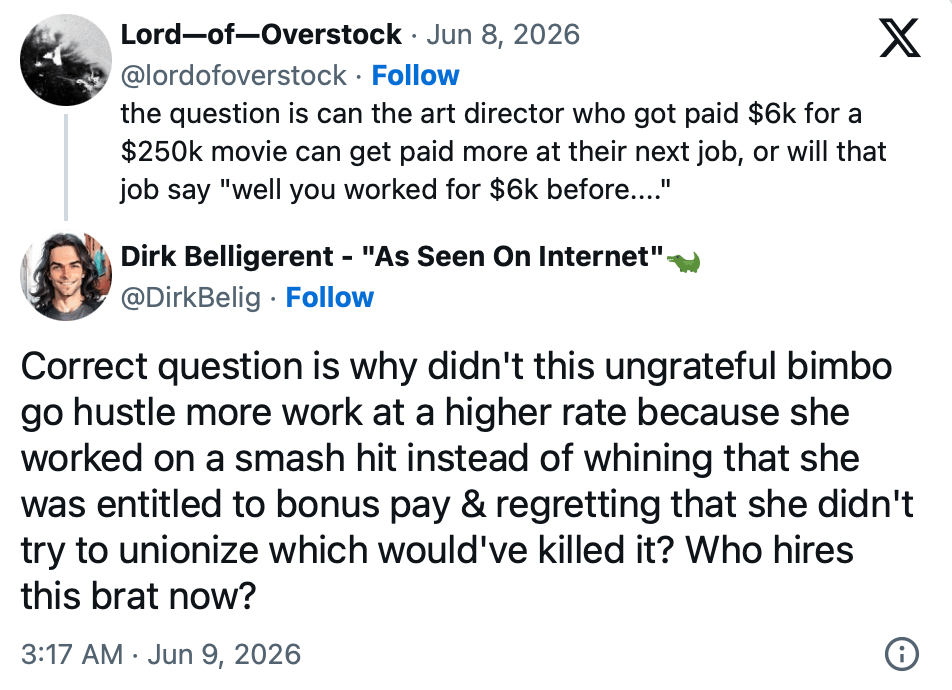
Listen, some people are complete ogres online (this person’s name makes that clear), but I’m just going to point out that in addition to the hilarious hostility and irrational word salad of the post, the reality is that fewer women are hired to work as crew than men, so the “bimbo” and “brat” language is just another way to reinforce the bogus idea that women don’t belong in these jobs.
Plenty of people weighing in have never been on a film set and their opinions are wildly uninformed.
I found it more instructive to hear what actual film workers had to say.
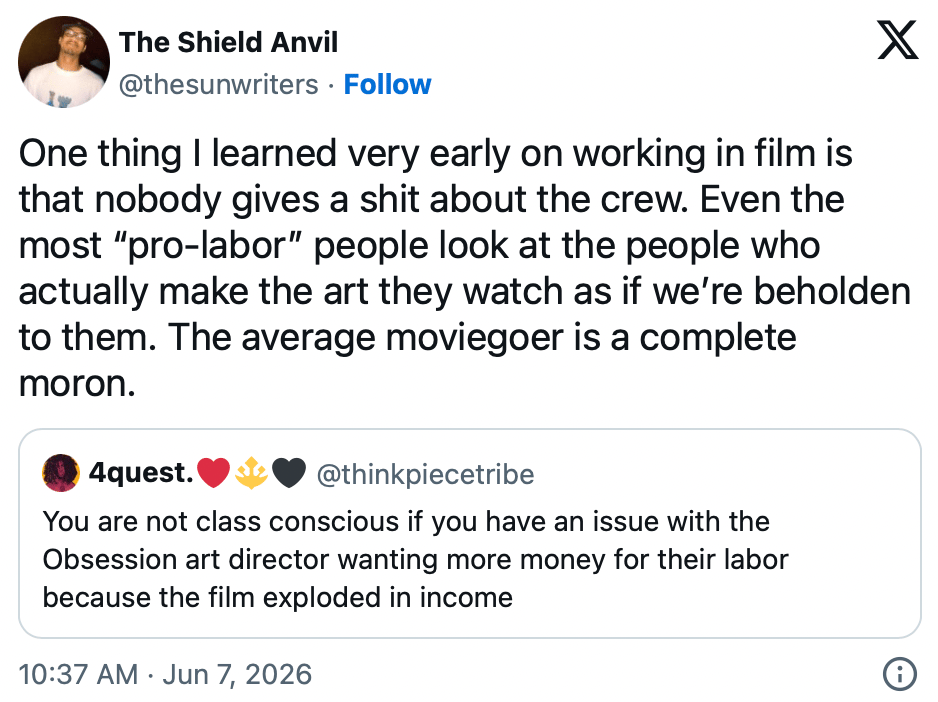
Here’s an exchange about whether or not the crew should have pushed to make “Obsession” a union shoot.
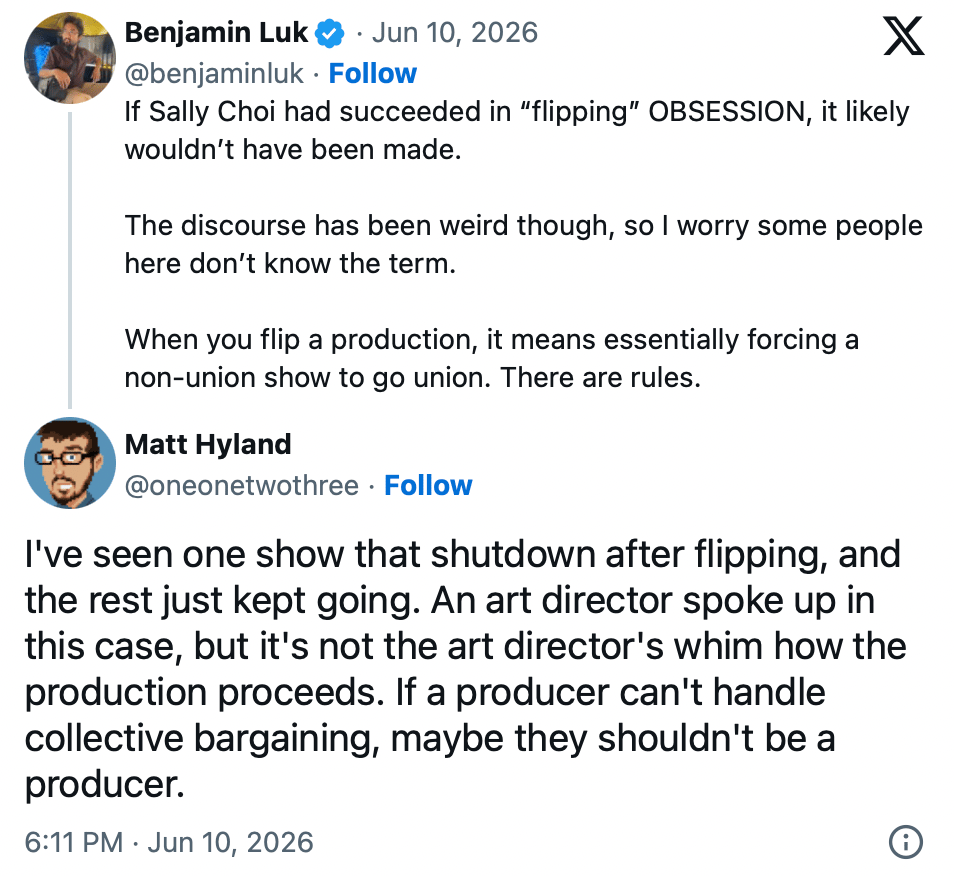
And here’s someone pointing out the fallacy of the whole “this credit on her resume will automatically lead to better paying jobs” fantasy”
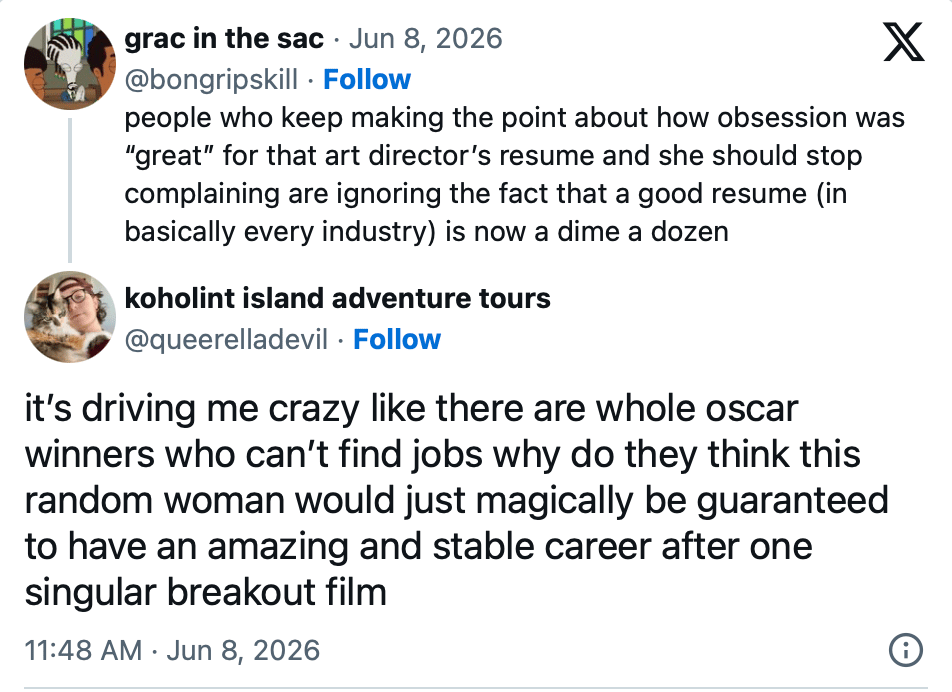
By the way, a backend bonus for the crew isn’t unprecedented!
Some indies put contingency clauses in their workers’ contracts that more or less say: If we get a major windfall, a predetermined portion of that will go to you, as well.
The 2024 Colman Domingo drama “Sing Sing” (distributed by A24) is from filmmakers Clint Bentley and Greg Kwedar. According to The Hollywood Reporter, they are:
… using a model that sees everyone who works on the film, from the PAs to the director to the star at the top of the call sheet, paid the same wage. Additionally, everyone involved in the production above and below the line received equity.
The filmmakers have since launched a company “with the goal of using their model to help other independent filmmakers do the same.”
Here’s what Kwedar said about that:
When I came into the business, one thing I was very aware of was just the lack of transparency and therefore, a growing mistrust on behalf of all the people involved in making the film.
As THR points out, “In an industry full of opaque practices, payment on independent films and the film’s financing can be a particularly black box.”
A model that looks out for the crew was also used on the 2021 relationship drama “Malcolm and Marie,” starring Zendaya and John David Washington and directed by “Euphoria” creator Sam Levinson. Netflix bought it for $30 million.
Here’s how Zendaya explained the set up:
We got to create this financial structure where all of our crew members also got points on it, so when it sold, they made money as well, so hopefully that will be a system that can continue. I think it's important that we take care of our people.
It just felt like the right thing to do. These are the people that are laying all the tracks and were with us through the whole thing — and literally putting their blood, sweat and tears into it.
More recently, the single moniker filmmaker Markiplier’s horror movie “Iron Lung” has made $50 million worldwide since its release in January.
Here’s what he told IndieWire:
We can all win. It’s like, I look at the profit after this and all I can think of is, “I can’t wait to give the crew a bonus.”
I think it’s fair to push for this to be the standard on indie films — and to ask tough questions about why it isn’t.
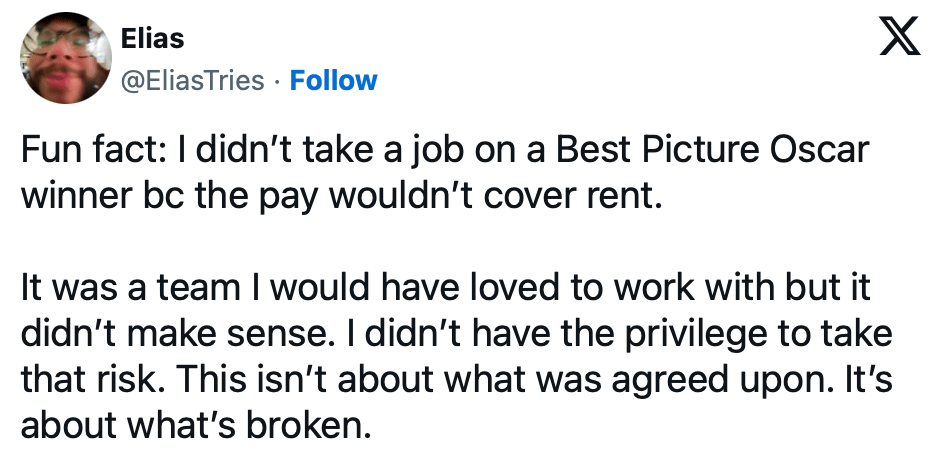
As creative director Elias Tries points out in the post below, the issues Choi brings up aren’t about what was agreed upon. It’s about what’s broken about the system itself.