
In Hollywood, business is not booming
“I went from working nonstop, to now I’ve got to sell my house.”
“I went from working nonstop, to now I’ve got to sell my house.”
Those words were spoken by the actor Kirk Acevedo, who has had a long career with roles in everything from “Oz” to “Band of Brothers” to “Fringe. Appearing on the podcast “An Actor Despairs,” he talked about the brutal financial reality he and many of his peers in Hollywood are currently facing.
Everyone is going through it, he says, except for the biggest stars.
Last week, The Hollywood Reporter published an interview with Jeff Heller. Despite winning an Emmy in 2025 for his role in “Somebody Somewhere,” he echoes this concern:
While Hiller has been seemingly everywhere on TV lately, appearances in this industry can be deceiving. “I haven’t worked in 2026 at all, and that’s scary, like, ‘But I have an Emmy; I don’t get to work now?’” Hiller says with a knowing laugh, adding that he’s at least had some voiceover opportunities. “It’s a rough time. It’s not like business be booming. It’s disheartening.”
Which is why some actors are making other choices. According to Variety: “Jaime Pressly is the latest Hollywood star to make the jump to OnlyFans.”
Pressly’s career includes supporting roles on two long-running network sitcoms — “My Name is Earl” and “Mom” — back when that kind of gig still paid well.
But her pivot to OnlyFans is likely a sign of the times. Nobody’s working. Nobody’s flush.
In the last three years, California has lost 51,000 production jobs.
There are several factors at play, which I discussed recently with Miranda Banks and Kate Fortmueller, the authors of the new book “Boom to Bust: How Streaming Broke Hollywood Workers.”
Doesn’t it seem like nobody currently in charge at the studios understands — or even appreciates — the art of storytelling?
But in our conversation, I had an epiphany. My half of the conversation is in bold:
The thing that the old studio bosses understood was storytelling and mythmaking. And today’s generation of studio bosses seems to lack that talent. But maybe I’m wrong, because as we noted earlier, they do understand storytelling when it comes to the story and mythmaking they’re selling to Wall Street.
Fortmueller: The old studio heads were not good people, we’re not trying to romanticize them, but they were human in all their flaws. And I think the main difference is that telling a story that enchants millions of people is different from telling a story that enchants investors.
Maybe this is the root of so many ills in Hollywood at the moment. Executives no longer give a shit about audiences. Their only “audience” are shareholders.
You can read the full interview in the Chicago Tribune here.
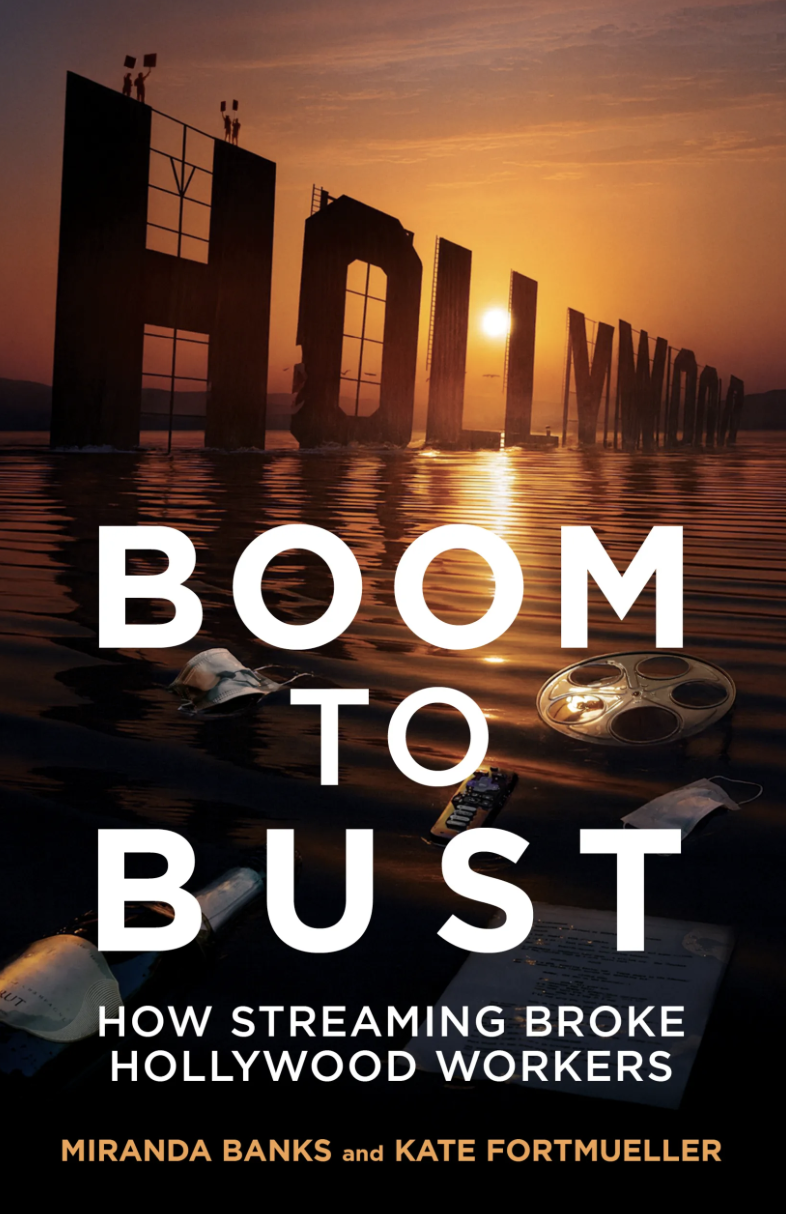
Something else we discussed is the expectation that most shows will be be cancelled after a season or two.
The authors had some thoughts about that, as well:
Banks: What streaming did was they changed the meaning of success, and it doesn’t make any sense to us anymore. In an industry that has always felt like a gamble, it made that even more unclear. Paying upfront huge sums of money for an A-lister to do a show or movie at a streamer, that looks like success regardless of whether anybody showed up to actually watch it, but that doesn’t make sense in terms of how success has traditionally been understood. It gives an aura of success, whether or not audiences resonated with it.
So whether any individual TV show or movie is popular doesn’t really matter. Popular only matters if it ensures that somebody is going to keep subscribing to the service.
Fortmueller: It’s popularity of service, and that’s the shift. If the story used to be “Our movies are great and lots of people go to see them, therefore we are successful,” now, for a company like Netflix, the story is customization and how much closer are we getting to being the perfect thing that you want? That’s how they’re capturing your subscription.
The perfect thing, but catering to millions of people with varying tastes. So it’s not broadcasting in the old model, it’s endless niche-casting instead.
Banks: That’s why, for so many people working in Hollywood, there was a lot of excitement about streaming initially. Because you might be working on a show that only needed to capture a niche audience, but a desirable niche audience for that streamer. So a lot of shows were picked up that were a little edgier, or had a different style or outlook. Shows for Black audiences, or queer audiences, or Black queer audiences, suddenly were getting made. And they generated interest and excitement and buzz, and they didn’t necessarily have to be popular with everyone.
That didn’t last, though. There’s been such a pullback.
Banks: The streamer got that audience to subscribe to watch that show. And once they had them, the streamer didn’t necessarily need that show to go on, right? They already got that audience.
Fortmueller: The biggest thing is that there’s a pulling back of spending. Nobody’s spending as much, that’s just the reality.
Banks: There are also diminishing returns for a lot of shows. There might be people who are dedicated viewers. But the number of people who make it all the way through Season 2 of any particular show is exceedingly small. So what the streamers really care about is people first finding that show and making it through a few episodes.
Netflix has a reputation of (seemingly) canceling nearly everything outside of its biggest hits.
Turns out that’s not exactly true, according to reporting on the digital site What’s On Netflix:
Netflix has a reputation for pulling the plug too quickly — but the numbers tell a more nuanced story. An analysis of every US scripted series the streamer has released since 2016 reveals a platform that has quietly stabilized its cancellation rate over the past three years, even as the absolute number of axed shows doubled in 2025. The real risk, it turns out, isn’t surviving Season 1 — it’s making it to Season 3.
According to the post, Netflix released 23 new scripted U.S. shows last year. Eight were limited series, so theoretically those wouldn’t be renewed anyway. Of the remaining 15 , nine got another season and six were canceled.
Also: The (U.S.) Netflix series that were canceled in 2025 did not have the lowest viewership.
That seems countintuitive! It’s not. Because this information is incomplete. Let me explain.
I don’t follow this aspect of the business as closely as someone like the entertainment journalist Rick Ellis (his Too Much TV newsletter is here) but I do know that, just generally, we — audiences, but also most journalists covering the current state of Hollywood — are still trapped in the old way of thinking, where viewing numbers are telling us something important.
That used to be true for broadcast TV and box office receipts for movies. But streaming? No.
That’s because streamers are looking at other data — things like completion rate and percentage of subscribers who watched — to assess the value of any given show or film. And streamers do not make that data public. None of it is transparent.
In other words, we don’t actually know anything meaningful about the success or failure of what we’re watching.
Nielsen, which has traditionally been the third party firm that measures linear TV viewing, expanded into covering streaming as well in recent years. But again, they don’t have the data that is most relevant internally at streamers. Which is why their recently released a “multiplatform” report on the 100 “most-watched” TV series (whatever “most watched” even means anymore) of the 2025-2026 “season” is nonsensical. It encompasses shows across streaming, broadcast and cable, effectively collapsing all context entirely. The fall-spring TV season is relevant for broadcast shows, yes, but an entirely arbitrary block of time if we’re looking at streaming. And again, it’s likely different factors are involved in how these shows are viewed internally in terms of measures of success.
Nevertheless, Variety dutifully reported the results.
Old habits die hard. And since some convoluted form of “viewing” info is periodically released, we squint and try to make sense of a streamer’s decisions.
It’s a suckers game.