
Streamers aren't tied to the deadlines of a primetime network schedule. Maybe that's not a good thing.
TV writer-producer Javier Grillo-Marxuach says one of the main problems resulting from streaming is a lack of economic and logistical pressure to make shows on a regular schedule.

Last fall, I wrote about the regularity — the comforting regularity — that’s baked into broadcast television’s primetime schedule.
Streaming platforms have dispensed with that altogether. Shows premiere whenever, a chaotic alternative to network TV’s more reliable fall-spring schedule.
I think a lot about what this means for us as viewers, as we scramble to stay on top of what’s new and what’s coming back … and how much (or little) we’re able to become invested in these shows.
Delays between seasons are not only frustrating but seemingly counterproductive, impeding whatever momentum a show might have generated.
Why are delays standard in streaming?
For some context, Seth Rogen recently talked about delays plaguing the movie business these days.
When he made “Superbad” 20 years ago, “We cast the movie, we found a director for the movie, we made it according to [the studio’s] schedule and we released it on the date they chose,” he told the New York Times. “That would never happen today in a hundred million years. No studio would just buy a script, give it a release date, cast it and then make it.”
Now, he says, “everything has to be in place before they’ll decide whether or not they’re making it:
Who’s the director? Who are the actors? Are they famous enough? Do they have big enough names? If not, then we’ve got to get different ones, or else we won’t make it. And I know we want it to start shooting in April and release it next summer, but if we don’t have the right actors, we’re not going to do that, because we think these actors will get us more money than these actors, even though they might not be the funniest actors for the role.”
I’d wager something similar is happening with streaming.
Recently, the TV writer and executive producer Javier Grillo-Marxuach posted some thoughts on BlueSky that explored this phenomenon further.
A major factor, he wrote, is the lack of “economic or logistical pressure to actually make shows.”
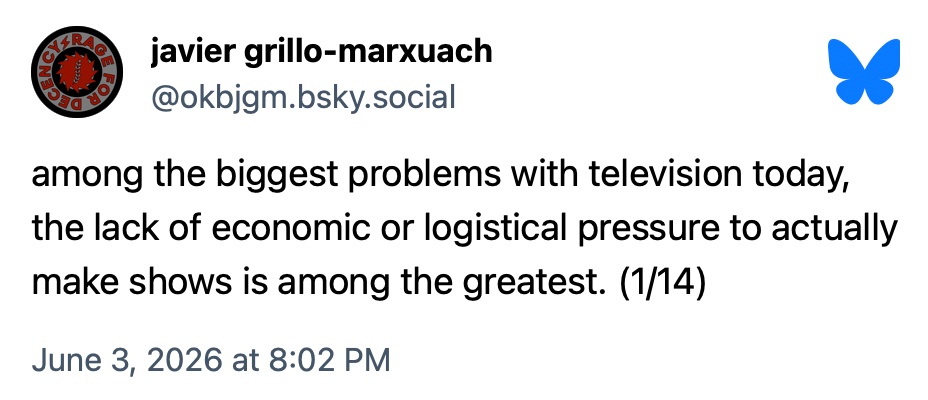
Here’s more from his thread:
During the network/cable era, there were seasons and advertisers: shows HAD to be made for the fall season and episodes HAD to come on a schedule because the company’s revenue depended on having real estate to be filled with advertising.
Let’s dig further
The networks have 3 hours of primetime to fill each night (21 hours to fill every week) no matter what.
So the parameters are clear: Greenlight shows and program a lineup — otherwise you have dead air, no viewers and no money coming in from advertisers.
That’s a good kind of pressure, because it means decisions have to be made. Shows have to be made. Things are happening on a schedule because they have to happen, otherwise everyone is fucked.
With the streaming model, there is no prime-time block that needs to be urgently filled. Delays just aren’t catastrophic.
Which is why the current system is so disempowering to people who create shows: “Streamers can basically wait anyone and anything out, replace entire staffs and pull the plug at any minute,” is how Grillo-Marxuach put it.
I wanted to hear more, so I gave him a call. His TV credits are extensive and include everything from “Charmed” to “Medium” to “Lost” to “The Witcher.”
He frequently writes and talks about the in’s and out’s of the television business in an effort to demystify it, including his podcast Children of Tendu, co-hosted by fellow TV writer Jose Molina.
Here’s our conversation:
I’m interested in the idea that, for most of television’s history, the business was structured in a way that prevented one of the things we all hate about streaming: Long and unpredictable delays between seasons.
What precipitated me writing the thread was a writer who called me for advice about how to manage their situation in a writers room.
The amount of notes and interference they were getting from the many parties involved has resulted in them basically rewriting the same two scripts five times each. And now they’re close to the end of their writing period. They have outlines for the next episodes, but they’ve been mired in the pilot script and the next two scripts for almost the entirety of the six months they have to write the show.
In other words, with streaming, the process can get drawn out because that show doesn’t have to be ready to air Tuesdays at 8 p.m. two months from now.
That’s right.
Do you want to know why American television had such a worldwide cultural impact for so many years? It was because there was a steady pipeline. TV was being made consistently and constantly.
I was an executive at NBC the first two years of my career from 1993 to 1995. And I was there the year that “ER” and “Friends” were developed. But there were other pilots that went on the air that year. They weren’t perfect, but they went on the air because they had to. You picked the shows that were the most promising and you had to take a risk. Maybe you didn’t have a perfect prototype, but then over the course of the first few episodes, the kinks could be worked out in real time.
The other element were the commercials, because that meant TV writers were always writing for a cliffhanger [before each commercial break].
So those two economic factors created a very narratively propulsive, forward-moving mode of making television. And there was a reliability to it.
What’s different with streaming?
What I’ve seen happen many times is that a show will go into pre-production and they’ll have writers rooms and six or eight scripts will get written — and then the show won’t get made at all.
At the networks, by the end of January — whether the pilot scripts that come in were great or not — you have to greenlight enough to fill the gaps in your schedule for the shows you’re going to cancel.
And people will say: Yeah, and when network TV was all we had, that resulted in a lot of mediocre television.
My counter is: Yes, but that also resulted in a lot of great television.
Activity creates fertility. So, if you limit that – if you are limited to making a smaller number of shows — the amount of practice the writers are getting shrinks, the amount of episodes a showrunner gets to make shrinks, so their experience shrinks.
When you have less work and less material, you’re not going to get as good at this job and that means there’s a lesser possibility for greatness.
I’m not saying the streamers don’t have deadlines or quotas they have to meet. It’s that their schedules are so elongated that pilots can drop off, go away or be redeveloped countless times.
And it’s very opaque to me what their quotas are. How many shows do they have to make? And what’s their definition of an executive who has succeeded in delivering for them, other than someone who has delivered three or four name-brand hits?
The intention is different, right? The goal in network TV is to create shows that run for as long as possible; let’s make enough episodes so that we can hit syndication and license it to other networks as reruns and make additional money that way.
Streaming’s definition of a hit is not a long-running show. We may not even know what they consider a hit because they have internal metrics they very intentionally do not make public. But they’re not looking for a show that’s built with the components that make viewers want to watch for seven seasons. Their shows are built to get you to watch the first season, and then stick around to watch the next series the algorithm feeds you.
I wonder if that affects how streaming executives think about what a TV show should be? And maybe why they nitpick over it so much?
Maybe!
One of the great benefits of the way television used to be made was that the characters on a show would solve a problem each week — or deal with a thorny moral issue that was usually resolved within the hour — and you [the viewer] could just go back to living your life, having been entertained and maybe enlightened a little bit.
Every week there was this place you could go to hang out with your TV buddies on screen.
Which is why the death of regularity has been no fun for us as viewers! Relatedly, you called “The Pitt” the best show of 1998.
I say that with love, admiration and respect.
Here’s how I interpret that comment: What audiences wanted — and liked — in 1998 is maybe not all that different in 2026?
There was a saying at NBC — which some people will misinterpret as a rallying cry for mediocrity — but the saying was: Tried and true does not mean dead and buried.
Let me read one of the replies to your thread from Christina Strain.
She’s a colleague of mine and a dear friend.
Here’s what she says about the lack of urgency at the streamers:
It’s because buying the IP is what gives the exec who bought it power. They “won” in purchasing it. Actually making the show is a risk, because if it turns out poorly, they “lose.“ So better to do nothing at all and never actually make it.
Executives start out wanting to make a great show. But the system has developed in such a way that what Christina says is absolutely true. You can labor over something for so long, it creates a weird kind of perfectionism.
It can be easy for writers and creators to psychoanalyze the process of executives and ascribe motivations that may not necessarily be what’s going on. I don’t think executives are sitting around thinking, “Haha, if I don’t make a decision, I’ll never be fired.” Or, “This is how we wreck television!”
I just think that with deadlines and economic pressure, you had to make the show and put it out, whether it was great or not. And the system we have now does not encourage propulsive, forward motion. And that kind of stagnation can replicate into a pattern.
So if you don’t make a lot of episodes, you don’t get that many chances at greatness. And we’re just not getting a steady stream of novelty.
I didn’t sign up for the circus so I could wait for the lion tamer to make sure his chair was completely perfect. I signed up for the circus because the guy grabs his chair and does his job that’s dangerous and difficult and ongoing, and it’s thrilling!
I just want to be clear, I’m not anti-streaming and I don’t think executives are bad people.
But as I said in the thread, if you want to disrupt a system — or fix it, or create a new one — first you need to understand how it worked before.
You can hear more from Grillo-Marxuach and his podcast partner Jose Molina in a new episode of their show titled “They are back and they are pissed — Part One!” The link is here.