
I'm not mad. Please don't put in the newspaper that I got mad.
Hollywood's rich and famous are complaining about critics again.
Here’s a depressing reality: Many outlets that cover pop culture are increasingly uninterested in publishing individual reviews or really any kind of cultural criticism writ large.
Meanwhile, as The Guardian recently pointed out, Hollywood press tours have become gimmicky. Interviews are now party games. No one is having a real conversation.
This erosion first began in the 2010s with layoffs at regional newspapers across the country (waves hello from the Chicago Tribune) before reaching digital outlets that once offered regular coverage, but no more. In the last year or so, even legacy outlets like the New York Times, Vanity Fair and Rolling Stone have elbowed out some of their critics.
There are writers to whom you probably gravitate. Their sensibility matches your own. Or challenges your preconceptions. Either way, their work leaves you feeling smarter about what you just watched. Maybe they just know how to craft a good turn of phrase!
There are also writers you probably don’t respect, or don’t jibe with.
All of it is fine!
But our pop cultural lives are diminished when the pool of working critics becomes smaller and smaller, and fewer ideas are being exchanged.
This is a long pre-amble to the latest edition of The Rich and Famous Are Complaining About Critics Again.
Are people who make TV and film aware that the job of critic barely exists anymore?
Probably not! Perhaps the fact that anyone is still employed as a critic is the actual sticking point.
Taylor Sheridan recently appeared on a podcast and no one was safe from his barbs.
The “Yellowstone” super-producer churns out shows at an admirable or, depending on your point of view, alarming rate, and he took aim at his fellow screenwriters (who he says don’t understand the fundamentals of storytelling) as well as studio executives (who also don’t understand the fundamentals of storytelling). In some cases, he’s not wrong!
(One might argue that Sheridan’s own grasp on storytelling fundamentals can be tenuous at times, but I digress …)
Surprise, he also had some choice words for TV critics.
“Landman” is his series about oil prospectors starring Billy Bob Thornton. Here are his thoughts about the show’s critical reception:
The critics and me — I don’t care what they think, and it annoys the shit out of them that I don’t care. I’ll be the first to tell you that there are things that I do that rage-bait them a bit, and this is one of them. Fuck ’em, honestly.
This is hilarious and very “I’m not mad. Please don’t put in the newspaper that I got mad.” I would actually respect it if this were some kind of elaborate performance art! Maybe it is!
But writing with the intention of “rage-bating” critics is silly and counterproductive. It’s the equivalent of looking in the mirror and telling your reflection to stuff it.
Seth Rogen has a less pugilistic energy in his dislike of critics, but the subtext is the same. In a recent podcast interview (of course, another podcast — everything is a podcast!) this is what he had to say:
I’m at the point in my career where not a lot of people are in a position to yell at me in my job. But the New York Times will publish an entire article saying I suck at my job.
That’s the tradeoff: I worked my way up to not having to deal with that much personal conflict — face-to-face conflict — but I will have a cultural institution tell everyone that I suck.
There’s more, but let’s pause for a moment.
He’s reached a point in his career where he’s surrounded by people who say “Yes, great!” — but doesn’t stop to consider whether this is creatively fruitful or healthy. Or would even be considered “normal” in any other profession.
Part of maturing as an artist is learning to parse the difference between analysis of the work and an attack on you as a person. Perhaps Rogen still struggles with the distinction, which is why he refers to feedback as “yelling” and “conflict.” Maybe those word choices tell us something about his insecurities and how he processes any assessment of his efforts.
Here’s what he says specifically about critics:
If most critics knew how much it hurt the people that made the things they are writing about, they would second guess the way they write these things. It’s devastating.
He really needs to grow up!
As one person commented: “A film is not above reproach simply because you worked on it.”
Another comment: “Really? I feel like most TV/film criticism in mainstream culture outlets today is way too gentle!” (Agreed.)
Or as this person points out:
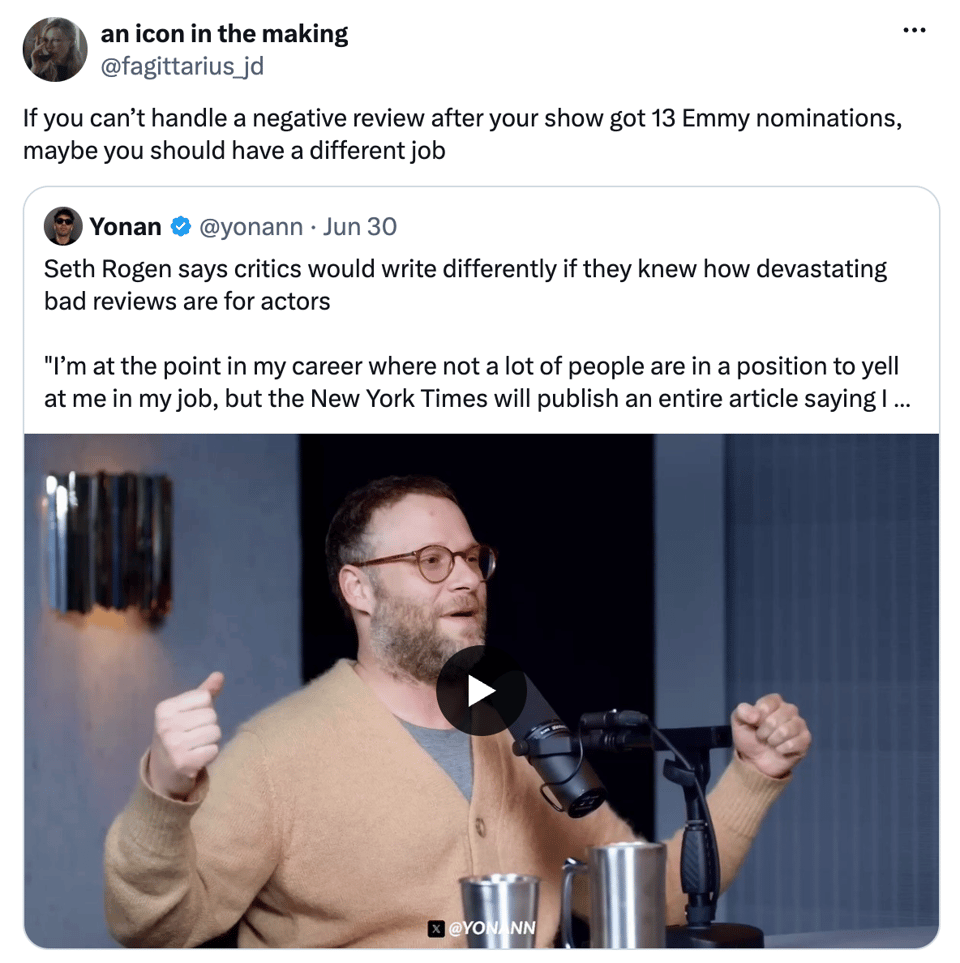
That’s in reference to his Apple TV series “The Studio,” which satirizes the movie business.
I had critiques about the show’s first season, which avoids the existential threats of streaming and AI. That’s a weird choice. A squirmy choice. Regardless, most critics liked the show.
I obviously did not, and took issue with something he said in the run-up to its premiere. It’s worth mentioning that he not only stars, he’s one of the show’s co-creators:

I end the review with this observation:

I have no idea if Rogen read my review, but it doesn’t matter either way. There’s nothing wrong with him being exposed to a viewpoint that challenges the show’s premise. I don’t think “The Studio” is being honest and it’s my job to say as much.
Critics are supposed to take the work seriously — to engage with it seriously — and provide additional context and analysis. It’s then up to the reader to decide how much (or little) of that deepens their understanding and appreciation of the show or film in question.
Sometimes I’ll read reviews and disagree with their conclusions, but they invite me consider other questions or to think about things in a different way.
I’d like to think artists with enough self-confidence in their work understand this and aren’t threatened by it.
But I don’t want to dismiss Rogen entirely. Celebrity has a way of dehumanizing people even as it elevates them, and he’s reminding us that, fame and money aside, creative endeavors demand emotional vulnerability and risk, and it can sting when those efforts are critiqued.
This week, Variety published this piece: ‘The Odyssey’: Ranking Every Performance in Christopher Nolan’s Film From Worst to Best.
Ranking every performance? Come on. A listicle isn’t a thoughtful way to do criticism and I wouldn’t disagree with any actor who had a problem with this kind of approach because I also have a problem with it.
I’m cynical enough to assume that most actors aren’t making a distinction between this kind of piece and a straight review. To be clear, they are two different things. Maybe that feels like splitting hairs.
Some critics are lousy at their jobs and take cheap shots in print. Rogen is right to be sour about that.
But people in other professions experience this kind of feedback — blowback — too. Even the most knowledgeable and diligent of journalists (including critics) get plenty of it. Sometimes in the form of death threats. That’s not hyperbole.
Once upon a time, this transpired via snail mail. Thanks to the internet and social media, a lot of that now happens in public. Most weather this while living paycheck to paycheck, dreading the next round of layoffs.
Everyone has anxieties, no matter what they do for a living. But Hollywood stars with considerable economic cushions might want to consider how easily a focus on their bruised feelings can tip over into churlishness when teeing up their complaints.
Kristen Stewart (on yet another podcast) had some thoughts about “the moments that I fell on my face in public”:
A nice, healthy amount of humiliation is really humbling. And it also makes you realize — that first scratch, who cares? After that first scratch you just go, OK, so crash the car. You know what I mean? We can fix it.
“We can fix it” will ultimately lead all of us down a far more interesting and liberating path.