
Corporate biopics are tycoon-aganda
Are these movies — or glorified commercials? Hollywood is hoping you don't bother asking.
This week, Angel Studios released a trailer for a film it is releasing Thanksgiving Eve called “Hershey.”
This is corporate mythmaking masquerading as a movie. But then again, Hollywood itself is built on corporate mythmaking. So, yes. Of course studios are drawn to these stories. And they’re banking audiences will be as well.
If response to the trailer is any indication, that might be a tough sell. One comment that made me laugh: “Every joke trailer from ‘30 Rock’ is just real now.”
It’s been a couple of years since we’ve seen one of these, but in 2023, corporate origin stories dominated our screens to a truly weird degree. There was “Air” (about Nike’s line of basketball shoes), “Tetris” (about the eponymous video game), “BlackBerry” (about the smartphone brand) “Flamin’ Hot” (about processed snack food) and “The Beanie Bubble” (about Beanie Babies, the collectible toy plushies).
Half of those were released by companies (Amazon and Apple) that exist to sell you stuff other than TV and film, so I supposed one might argue this was a logical inevitability.
Here are some thoughts from my review of “The Beanie Bubble”:
If nothing else, Hollywood would like you to worship at the altar of captains of industry. Enjoy these movies all you want, but let us note this abundance amid the remarkable absence of stories about unions and labor actions.
Do studio executives have an aversion to narratives about the frequently underpaid and under-appreciated collective workforce that make all these corporate endeavors possible? If you think this lineup of films is mere coincidence, I have a sneaker/video game/smartphone/snack food/stuffed animal to sell you. Or rather, Hollywood does.
But more to the point, rarely do these subjects make good films. Complicated films.
These are, for lack of a better term, business biopics.
Five years ago, a very different kind of film — 2020’s “Nomadland,” which depicted, in part, the onerous work of those employed at Amazon fulfillment centers — won the Best Picture Oscar. It’s not a title that tends to resurface in conversations at the moment, what whatever you think of the movie itself, it is a notable outlier in terms of its point-of-view framing and whose story it centers. And it’s conspicuous that, in the six years since, we haven’t seen more movies with an interest in the everyday worker.
What are movies selling, anyway?
I’m not going to pretend that movies have to be pure expressions of art. Commerce has always been part of the equation. Movies sell ideas — about who we are and whose stories matter — but movies also sell overpriced popcorn!
But when movies are selling audiences on a brand — when it’s no longer a movie, but an elaborate form of marketing — that’s when I think audiences should revolt. I’m in the minority on this; “F1: The Movie” made more than half a billion worldwide.
The recent Michael Jackson biopic “Michael” was also a big moneymaker at the box office, and though it is ostensibly about an artist, it is more explicitly a corporate biopic — and not just because it was produced by the late singer’s estate. It exists for one reason only: To generate interest in Jackson’s music by putting it back in the public consciousness. Which is why the story stops shorts of any mention of the concerning allegations that were made against him.

Let’s go back to “Hershey.”
The studio behind it is known for its focus on "values-based" entertainment. Here’s how that is explained on its website: “At Angel, we believe in the power of storytelling to amplify light. This guiding principle is our North Star — it sheds light in the darkness and keeps our focus on what is good, beautiful, and worth sharing.”
OK.
But Hershey, like many chocolate makers, relies on an ingredient — the cocoa bean — that is often harvested by exploited workers outside of the U.S.
According to a report published by the Daniels Fund Ethics Initiative and the University of New Mexico, titled “The Hershey Company and West African Cocoa Communities”:
Although the Hershey Company strives to engage in ethical and responsible behavior, the realities of the cocoa industry present several ethical challenges related to the fair and safe treatment of workers, especially children.
The report has an entire section titled “Criticism of Hershey’s Efforts.”
The 2015 non-fiction book “The Chocolate Trust: Deception, Indenture and Secrets at the $12 Billion Milton Hershey School” is by longtime business reporter Bob Fernandez. According to this Philadelphia Inquirer story about the book:
Pulling no punches, Fernandez's tome looks not just at corruption but allegations of sexual abuse, poor student care and low academic achievement, as well as the child-slavery allegations in Africa that had aroused his interest in the first place. That a trust established to educate orphans would be linked to child-labor abuses halfway around the world is one of many ironies in a book that is chock full of them.
Separately, in 2018, the think tank Capital Research Center published a report titled “Milton’s Bittersweet Legacy: Unsavory Scandals,” which you can read here.
These are far less gauzy stories than the one presented in the movie’s trailer. I mean, of course.
I’ve written a lot about copaganda and wealthaganda. Let’s call this genre what is it: Tycoon-agenda.
The website for Hershey, PA — the destination tied to the chocolate company — is promoting the film on its website and notes that it was made in partnership with the “Hershey Entities.”
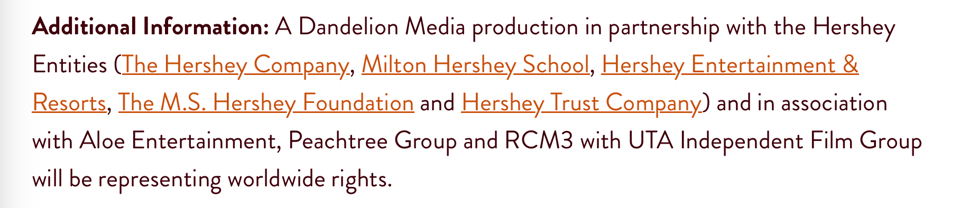
This should bother audiences just from a philosophical standpoint: You want to charge the price of a movie ticket … for some company’s glorified commercial? It’s supposed to work the other way around.
But we live in upside down times, so here we are.
Remember Walley World, the theme park in 1983’s “National Lampoon’s Vacation,” and McDowell’s, the fast food franchise in 1988’s “Coming to America”?
My Fourth of July thought that I’ll leave you with: I’m always going to prefer movies that put time and energy into creating fictitious brands for the explicit purpose of skewering America’s fetishization of corporate behemoths.