
Adaptation vs. interpretation vs. they shoulda just made an original story from the get-go
From "The Odyssey" to "The Thomas Crown Affair"
Emily Wilson is a classicist and a translator whose work includes “The Odyssey.” This week, the London Review of Books published her thoughts on Christopher Nolan’s cinematic version of the epic Greek poem, and her assessment was mostly critical. In turn, a whole bunch of people lost their minds.
“She’s not a film critic!” some said.
Nope, she’s not.
That’s not why she was asked to write about the movie — and that’s not why anyone should be curious to read it. It’s a review that answers the question: What does someone deeply well-versed in the study of Homer’s “The Odyssey” think of Nolan’s “The Odyssey”?
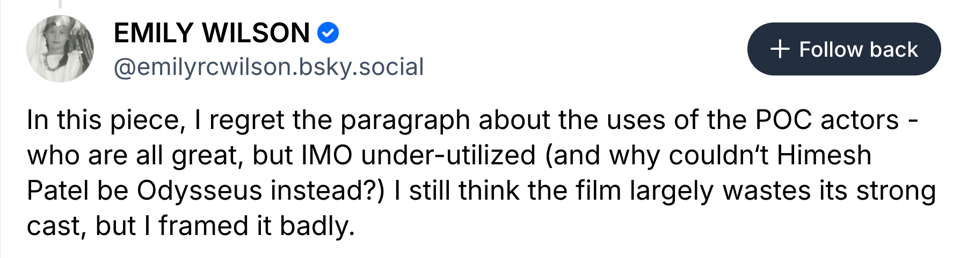
I wouldn’t have written a review quite the way she did. There can be defter ways to criticize something than going straight for the jugular. But she’s not a film critic and I don’t expect her to necessarily have that muscle. I think she would have benefitted from a stronger editor pushing her to refine some of her assertions. There’s one — about how characters who are played by people of color are treated by the screenplay — that is badly reasoned and articulated. Even Wilson agrees:
Her piece also makes arguments that have a clear point of view (essential in criticism!) and just the kind of snap and pop of a good film review:
It lacks psychological, emotional, political and ethical depth. Its narrative structure is gimmicky. The writing is abysmal. None of the characters has convincing motivation for their actions or words. There are no sex scenes, and all the food looks horrible.
As my friend Chanda Prescod-Weinstein pointed out, Daniel Mendelsohn has also published a translation of “The Odyssey” and he, too, wrote a review of the movie (for the New York Review) and no one lost their shit the way they did over Wilson’s piece.
Both Wilson and Mendelsohn have knowledge and a perspective that most film critics do not, which is why I think they’re worth reading. But just because they are experts in Homer and Ancient Greece doesn’t mean they are off limits. You can critique their critiques! It’s all fair game.
(I do think it’s absurd to say Wilson is looking a gift horse in the mouth and should be grateful that the movie has increased sales of her translation. A) That’s not actually a criticism of her analysis. B) She doesn’t owe Nolan or the film industry her silence. They’re not her employers. I’m sorry, I have to laugh! And C) She’s entitled to her point of view and to talk about that publicly, whether the film personally benefits her or not.)
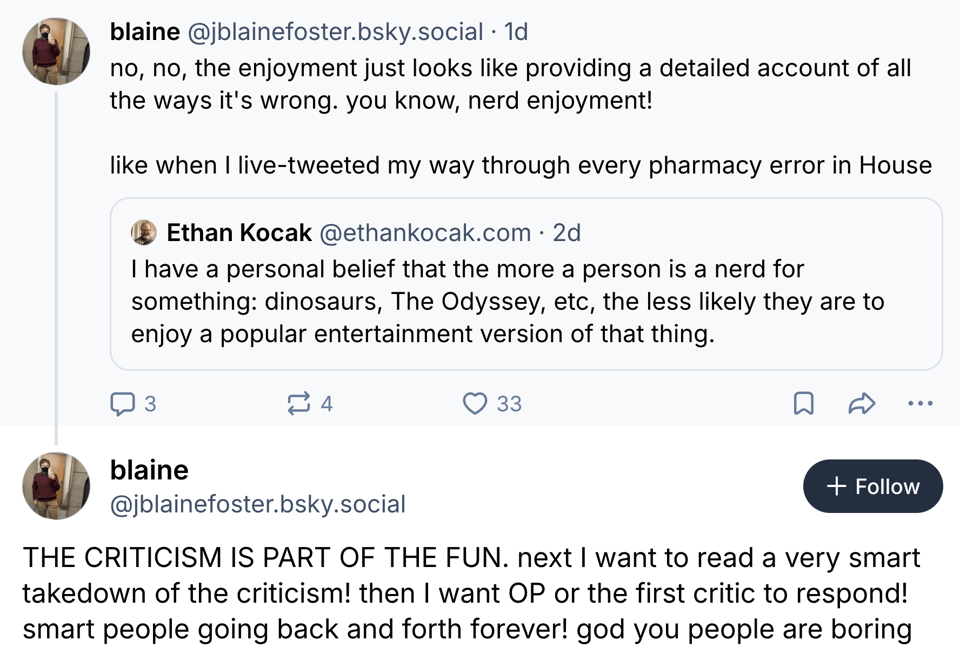
Whatever your thoughts on “The Odyssey” as a cinematic phenomenon, it’s been exciting to see all kinds of conversations unspool. Not the bigoted reactionary stuff about casting, but people genuinely grappling with the source material and the movie and comparing the two. I agree with this person: The criticism is part of the fun, because it means we as audiences are thinking through ideas and choices and themes. We’re debating them! That’s a rich way to engage with entertainment.
Nolan’s film diverges from Homer in notable ways. The gods don’t take physical form. Unlike the poem, his Odysseus is more of a self-flaggelating downer. Nolan has shaped the story to fit his metaphorical needs, which is what you’d hope and expect any storyteller to do: This shouldn’t feel like transcription, but a movie that has a point of view.
Does that make it an adaptation or interpretation? Does the distinction matter?
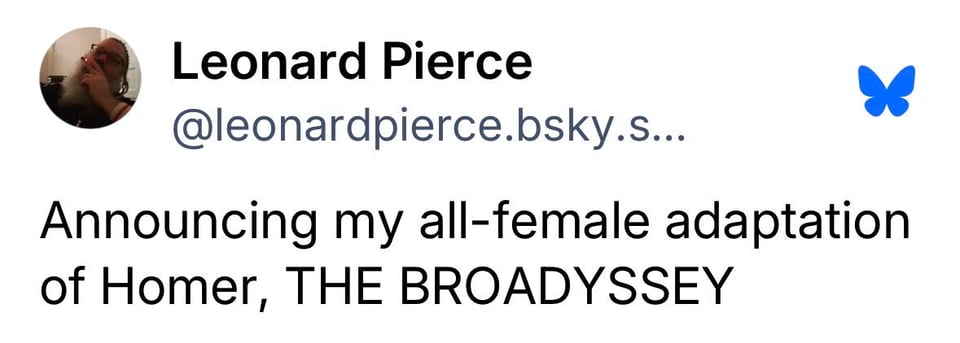
OK, this is funny because back in 2012, a theater company in Chicago staged an adaptation of “Moby-Dick” with an all-female cast. It was an interesting experiment! I wasn’t a fan of the production, but I found the idea behind it intriguing: What happens (if anything) to this story, about a bunch of dudes losing their minds on a whaling ship, when every role is played by a woman? How do we feel about the characters and their choices and their interpersonal dynamics? What preconceptions are we bringing to the experience?
As Wilson points out, Homer’s version of “The Odyssey” was an adaptation itself:
The poem used a relatively new technology – the written alphabet – to rework existing mythical traditions, reshaping the story of a veteran’s homecoming to resonate with the complex concerns of Greek-speakers in the archaic period, an era of migration, colonisation and urbanisation.
Nolan wants his version of “The Odyssey” to be less an exploration of how ancient Greeks might have engaged with the story and more a vehicle for ideas about our problems in society today. Whether you think he succeeded, or not, is part of the conversation.
Sometimes you watch an adaptation and think: Does this filmmaker understand the original at all? (Coughs, Emerald Fennell’s “Wuthering Heights.”)
And sometimes reworking a story — telling it from a different point of view, or pulling minor themes from the edges and pushing them to the forefront — opens up another way of experiencing the story. What if up were down? What if dark were light?
Wilson isn’t opposed to that!
Adaptations needn’t and shouldn’t follow the original with anything like the exactitude of a translation. Some of the best radically transform or resist the source material … The most memorable creative responses to “The Odyssey” … reconsider the poem’s structure, narrative and values.
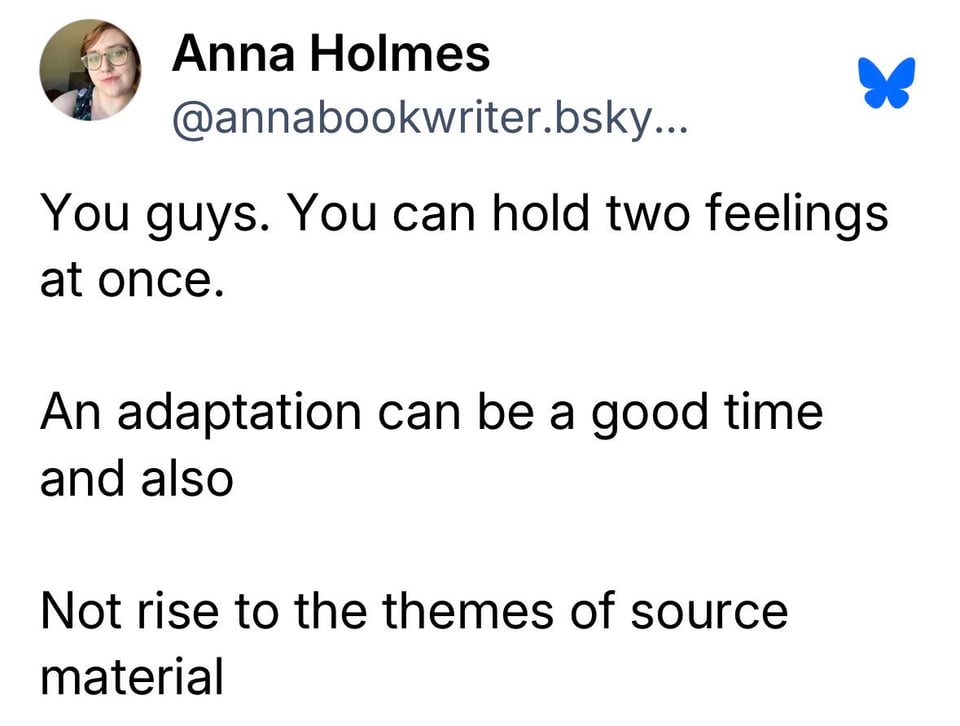
I think Anna Holmes offers a good distillation of this debate: An adaptation can be a good time and also not really in meaningful conversation with the source material.
OK, so let’s look at another upcoming movie that had me wondering: Adaptation or interpretation?
This week a trailer for Michael B. Jordan’s “The Thomas Crown Affair” was released.
It’s a remake of the 1968 heist film starring Steve McQueen as a wealthy businessman with a proclivity for robbing banks, and Faye Dunaway as the insurance investigator who sets out to nab him. There is palpable sexual tension between them, despite their conflicting agendas. It’s a sly, delicious game of cat-and-mouse and outsmarting one another.
The film was remade in 1999 starring Pierce Bronson and Rene Russo and it’s one of the few remakes that, in my opinion, improves upon the original. Instead of a bank robber, this incarnation of Thomas Crown is an art thief. He’s so rich, this is the only way he can stave off boredom; that’s the subtext, anyway. Bronson plays him as courtly, cheeky, debonair and stubbornly opaque.
But the movie is really Russo’s, because we experience the story from her point of view. She’s sexy, perceptive and wonderfully put-together. And then she encounters this man who has her rocked her back on her heels. Initially, she’s intrigued — the game is afoot! — and then it kind of fucks with her head. She’s fallen for a guy who is either her intellectual equal and a worthy adversary, or someone who’s treating her like a fool.
In both movies, everyone is stylish as hell. That’s so rarely the case these days.
So, here we are with version No. 3, set to open in theaters in March.
Jordan is the director as well as the star, and judging by the trailer, it’s a very different approach tonally.
Romance? Not a whiff. I’m not sure it even remains a two-hander, because his co-star, Adria Arjona, barely shows up at all. Where is the heat?? (You could ask the same of Nolan’s “Odyssey.”) Flirtatious trickery has been replaced by action scenes and a story that comes across as self-serious rather than playful — so much so that it seems to bear no meaningful resemblance to its predecessors.
Why not just make a new film with a new title? Because IP has a chokehold on executives right now who decide what gets greenlit. Also, maybe Hollywood has lost faith in audiences, for whom it’s assumed banter and great chemistry — the interplay between two very smart, very hot, very warped people — are unpersuasive reasons to buy a ticket. Better to downplay or eliminate all that and give your star the James Bond treatment, where he gets to throw a few punches and play the macho man in formalwear instead.
Is this version an adaptation or interpretation? Does Jordan have something to say that the other two films didn’t? We won’t know until the movie comes out.
But I’m struck by how resistant I am to remakes compared to my reaction when going to the theater. There are numerous plays I’ve seen revived and they always have a different quality to them because the people involved are different. A different cast and a different director means a different point of view, different physicalities, different energies. Even a different budget.
I’m always curious and excited to see what they do with the source material. I don’t want fidelity necessarily — and by that I mean fidelity to my first experience and memory of the play. I want that tricky combination of familiar but new.
I’m a lot more resistant to that when it comes to filmed entertainment, and I think it’s because theater is ephemeral. What you saw that night will never be repeated in the exact way again, in those exact circumstances. Whereas once a performance is delivered to a camera, it becomes “fixed,” and I resent efforts to fiddle around with that, or update it for modern sensibilities, or simply redo it because it’s easier than marketing something original. This is a silly response on my part. I’d much rather go in with the same openness that I do when seeing a play revived. And yet …
Michael B. Jordan is allowed to bring a different sensibility to his version of the movie. I may not be enthusiastic about it. But, creatively, his choice is valid if the movie works.
We’ll just have to wait and see.