How to talk about on-screen villains
Actors often say they can't judge their characters, no matter how reprehensible. Is that a dodge?
A few years ago, the British actor Eddie Marsan was asked about playing reviled characters:
Actors can’t act in pejorative terms. They can only act in descriptive terms. So I can’t play someone evil – they can do evil things and others can judge them as evil, but when you’re playing them, they don’t think they’re evil. And you have to understand that justification and play it for real.
This is a pretty standard response. You hear a version of it whenever actors talk about playing a villain.
I was thinking about this as I read a GQ profile of Jeremy Strong promoting his upcoming role as Mark Zuckerberg in the movie “The Social Reckoning,” from writer-director Aaron Sorkin, opening in October. It’s a follow-up to Sorkin’s 2010 screenplay for “The Social Network.”
The headline is … something:
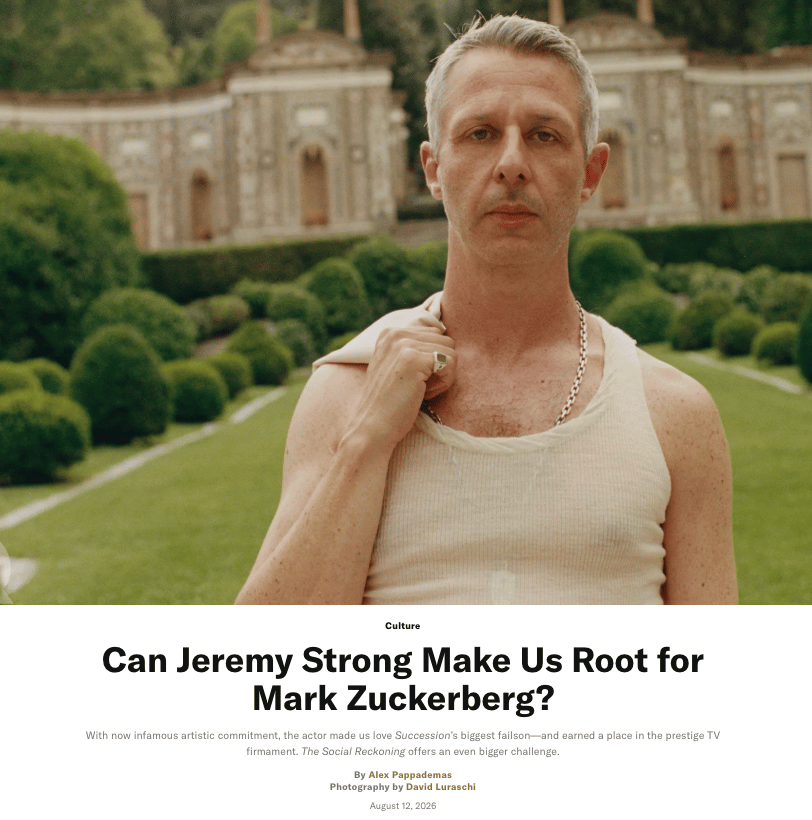
The piece isn’t even about this (weird!) question except to note that despite playing a fictional billionaire on “Succession“ — one whose history included actions that led directly to someone’s death! — audiences “loved and rooted for him anyway.”
But Strong doesn’t talk about wanting audiences to root for his version of Zuckerberg — or even contemplating that this is a possible outcome. GQ resorting to a clickbait headline is perhaps just a reflection of how inconsequential cultural reporting has become.
In the piece, Strong is asked about playing the Facebook founder:
Strong remembers bumping into Sorkin at a party a few Oscar seasons ago, hearing what Sorkin was working on, and telling him, If Jesse Eisenberg doesn’t do it, call me. “Because it’s the kind of role that fascinates me,” Strong says, especially now that Zuckerberg is one of the most recognizable public figures of his generation.
He was attracted to, and excited by, the personal challenge presented by the role. That’s a legitimate reason to take it on.
Eisenberg, however, tells GQ that, in his experience, being “historically linked with Zuckerberg” hasn’t been great in hindsight:
[It’s] not like I played a great golfer and now people think I’m a great golfer … It’s this guy that’s doing things that are problematic.
Right. This seems like a reasonable response. I wish we heard more actors discuss this.
Here’s Strong again, talking about his approach to the role:
Listen, I know that [Zuckerberg] is a reviled person and not a popular person in our culture, but I do not think you should have an actor playing him who wants to set out to condemn him.”
It’s interesting that Strong is speaking as if he’s above the fray — as if Zuckerberg and Meta have no effect on him, the people in his orbit or the world he inhabits. He seemingly has no opinion on Zuckerberg being “reviled” and “not a popular person” — these sentiments simply exist and he has no need to consider why.
Surely that’s not what he actually thinks (I hope), but that’s how it comes across in the interview.
The piece’s author Alex Pappademas characterizes the actor’s words this way:
Strong clearly doesn’t want to screw the project over by saying anything on the record that would tip that scale in either direction.
I get that. To an extent.
But also, why tiptoe around any of this?
The movie is about a Facebook employee-turned-whistleblower named Frances Haugen — a real person — who would go on to write the 2023 non-fiction book “The Power of One: How I Found the Strength to Tell the Truth and Why I Blew the Whistle on Facebook.”
Among the revelations were Facebook’s dissemination of vaccine disinformation, as well as weaknesses in the company’s response to human trafficking.
There’s a reason the company changed its corporate branding to Meta in 2021, and I’d wager some (if not all) of that was because “Facebook” had become toxic.
As recently as last week, “A US judge in New Mexico has ordered Meta to pay another $567 million for its failure to warn the public about dangers its platforms posed to children, marking the largest fine against the company over child safety.”
Also last week, in a meeting with Indian government officials, “Mark Zuckerberg apologized for child sexual abuse material and AI-generated deepfake content that had appeared on Meta’s platforms in the country, according to local media outlets.”
And another lawsuit began this week: Meta Faces Up to $1.4 Trillion Reckoning as Youth-Addiction Trial Opens in Oakland.
And Meta is Zuckerberg’s company. He’s the founder and the face of it and remains integral to how it functions as a corporate entity. He’s no figurehead.
In his personal life, he is the owner of a $100 million Hawaiian estate (where he has or is supposedly building a doomsday bunker) and shortly after acquiring it, this happened:
Zuckerberg’s lawyers filed lawsuits against hundreds of Hawaiians who may own an interest in small parcels within the boundaries of Zuckerberg’s estate. The “quiet title” suits, first reported by the Honolulu Star-Advertiser, are used to clarify the often complicated history of land ownership in Hawaii and can result in owners being forced to sell their land at auction. In some cases, defendants are even required to pay the legal fees of the plaintiff – in this case, the world’s fifth richest man.
A law professor called him the “face of neocolonialism.”
Objectively bad stuff!
I’m not saying Strong has to condemn Zuckerberg. He can feel however he wants about him.
I’m saying that, after portraying the guy and thinking about him deeply, having no opinion about who he is and the choices he’s made is odd.
Maybe he’s telling us in an indirect way.
According to the piece:
… he thinks artists, in this historical moment, “should tell us what is irreducibly human and worth fighting for.” He sends me a picture of a quote he kept taped to his dressing room mirror when he did Henrik Ibsen’s “An Enemy of the People” on Broadway; it’s the line about “forc[ing] our brothers to see themselves as they are, to cease fleeing from reality and begin to change it.”
Or maybe this is an actor trying to navigate a studio’s dictums to promote the movie in neutral terms and say nothing of substance, lest there actually be an interesting conversation ahead of the film’s opening.
Or maybe Strong has nothing to say at all.

Why does it feel fraught? I’m genuinely asking!
And is it his job to “defend his point of view” and “fight his fight” after filming has wrapped?
Let’s give him the benefit of the doubt. Maybe he’s concerned that if he says anything negative about Zuckerberg, he’s opening himself up to threats from the Facebook faithful.
But it can also read as squirrely. Why do the film if you have no desire to talk about the issues it raises and the role your character has played in all of it to enormous personal financial benefit?
When actors play villains and say “I have to embrace this person’s point of view,” I get it. But once they’ve completed the performance, they can judge their character. They no longer need to engage in the mental gymnastics of justifying the behavior and viewpoint of a loathsome character, be they a virulent racist or violent child abuser or … the CEO of a company that has wrought destruction on millions of people.
I’m always curious to learn: What are an actor’s thoughts now in hindsight? About putting themselves in that mindset? That would be interesting to hear!
I’d like to see journalists ask — and actors willing to engage with — questions about the psychological experience of playing a real person with enormous power whose choices have led to, or created, real harm.
I was poking around the internet to see what other actors have said about this topic and found a blog called Reflections in a Cracked Glass that hit on some good food for thought.
(I’d cite the author, but unfortunately, nowhere on their site do they provide their name.)
They begin with the standard “don’t judge the character” thought process:
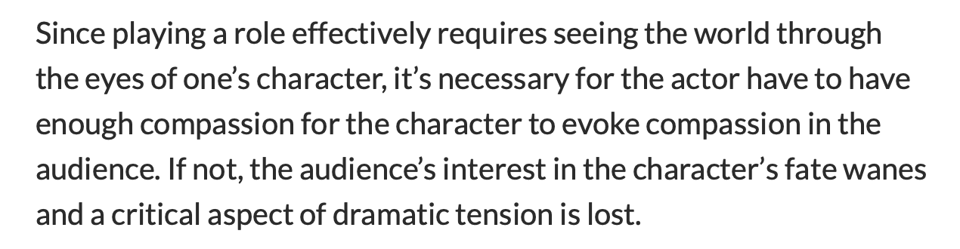
But also, there are limits to this:
The actor must not make the antagonist more decent or misunderstood than the character deserves to be. In so doing the actor can make a negative character so sympathetic to the audience that it turns the tables on the [writer’s] intent.
OK, now we’re getting somewhere!
(This, by the way, was always my criticism with “Succession.”)
Back to the blog post, because this is a good point:
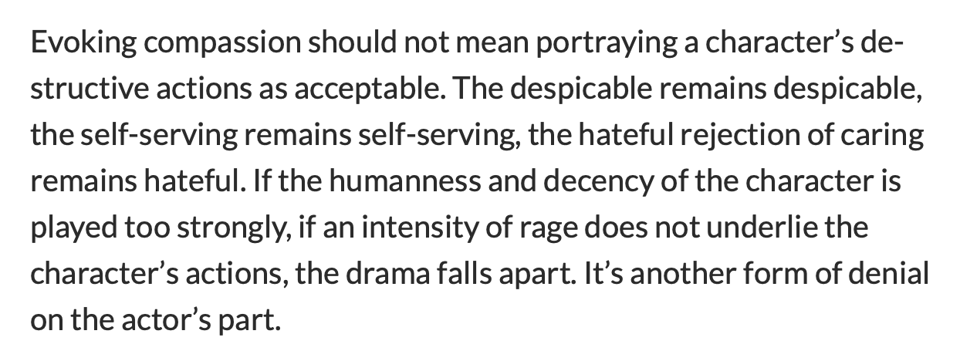
A lot of that is dictated by the script and the director’s choices. But this is also what I think is missing when actors are asked about their characters.
The despicable remains despicable. We’re not talking about Cruella de Vil. Zuckerberg is a real person who continues to exert influence. Everyone else will be talking about who he is when the movie comes out. Should Strong?
I say yes, but that’s only because I’m curious what it’s like to embrace and embody someone whose viewpoints, actions or decisions you find reprehensible and scary? (I'm aware this may not be a foregone conclusion for Srong.)
Surely that creates a dilemma.
Or maybe it doesn’t. Is acting just a form of dissociating?
If so, it’s that a good thing?