
The true crime glut on TV
It’s a genre Hollywood has relied on from the beginning, but I increasingly have no stomach for it.
Have you been following the trial of Lindsay Clancy, the Massachusetts mother accused of the strangulation deaths of three young children? Her defense is that she was in the grip of a severe bout of postpartum psychosis.
It’s such a deeply sad story on multiple levels.
But it is not one I need to see dramatized by actors in a limited streaming series. Chances are, it will be anyway.
I was thinking about this when I saw some news this week. In 2025, Hulu released a limited series called “Good American Family,” about the case of Natalia Grace, a Ukrainian girl who was adopted by a couple in the U.S. (played by Ellen Pompeo and Mark Duplass) who later abandoned her, claiming she was an adult masquerading as a child. It’s a gruesome story. I’m not surprised a TV executive said “make it.”
But now “Good American Family” is being reformulated into an anthology series — following in the footsteps of Ryan Murphy’s “Monster” and “American Crime Story” anthologies — with another season from the same show creator (and with Pompeo producing once again).
This time, the Hulu series will focus on a notorious story from the early 90s: That of John and Lorena Bobbit. After years of alleged abuse at the hands of her husband, Lorena severed her husband’s penis while he was asleep, using a kitchen knife. She then discarded his penis in a field, called the police and confessed her crime. His penis was located and ultimately reattached.
Lorena will be a consultant on the upcoming season.
Perhaps for anyone too young to remember this story, perhaps it sounds salaciously gruesome enough to pique some interest.
But I have a lot of skepticism around these projects. I always wonder if the creator has something to say beyond recounting the events in a scripted context. Usually the answer is no. I never feel smarter about the human condition. These recreations tend to feel depressing and exploitative.
I’m not saying true crime can’t be a legitimate genre of storytelling. It didn’t really get going in Hollywood until the mid-20th Century, but one of the earliest examples is a 1911 silent film called “The Colleen Bawn,” which was adapted from a 1860 play based on an 1829 novel called “The Collegians,” which itself was based on the true story of a 14-year-old named Ellen Scanlan, who was murdered in Ireland in 1819. Here’s the summary from Wikipedia:
She was recently married to John Scanlan, but when he saw that she would not be accepted into his family, he persuaded his servant, Stephen Sullivan, to kill her.
Despite its popularity, rarely is true crime done well. Certainly right now.
Maybe social media has changed the context in important ways. We’re exposed to so much tragedy on a daily basis — the lives of so many are harmed, one way or another — that I have no stomach for it when I go looking for a TV show to watch.
I know many viewers feel otherwise; that they find some comfort, or distraction, in the genre. I just don’t.
Every once in a while, there’s a report that someone is going to adapt “The Devil in the White City,” Erik Larson’s non-fiction book about the late 19th Century Chicago serial killer H.H. Holmes. He is notorious, in part for the murder hotel he had built (sometimes called a “murder castle”), which supposedly had all kinds of dastardly trap doors and secret passageways and were instrumental to his crimes. The era is also notable, as the hotel hosted visitors to the 1893 World's Columbian Exposition.
I understand why there’s interest in telling this story. I just don’t share that interest. Every time another attempt at making “The Devil in the White City” falls through, I give a silent cheer.
About 10 years ago, I reviewed a play that tried an interesting gambit. It was called “Holmes vs. Holmes” and it was a mashup of fact (H.H. Holmes) and fiction (Sherlock Holmes) wherein the latter arrives in Chicago to investigate the former.
Imagine those two, going toe-to-toe. And they have the same last name. It’s not a bad premise, except that Sherlock’s stories are fun and … H.H. Holmes carving up anyone who crosses is path is decidedly not. The overall idea never quite gelled.
Crime is lurid and of course we have a fascination with that. I’m just frustrated that we get so many of these stories, when there are plenty of real people and events that aren’t necessarily grim, but would be just as interesting.
Here’s one example: I’d love to see a “Mad Men”-esque show set in 1970s Chicago at Johnson Publishing, which was the home of Ebony and Jet magazines.
I mention “Mad Men” because that show did such a good job of juggling work stories with those of the characters’ personal lives. Plus, it captured a moment in history.
Imagine if we got a show that allowed us to watch the writers, editors and photographers of Ebony and Jet debate and riff on the pop cultural issues of the day — and, pointedly, without that being filtered through the sensibilities (or fears or biases) of white people.
Also, Eunice Johnson (John H, Johnson’s wife) was on the masthead and played a prominent role in the company at a time when that was uncommon for women. This is all potentially rich stuff to play with in a narrative.
Consider the aesthetics of era! Specifically the stylistic backdrop afforded by the Johnson Publishing offices, which were featured in a nearly 40-page spread in Ebony.
The offices are gorgeous, including the groovy, swirling orange and reds of the test kitchen, which has since been dismantled and reassembled for an exhibit currently on display at the Africa Center in Harlem, New York.
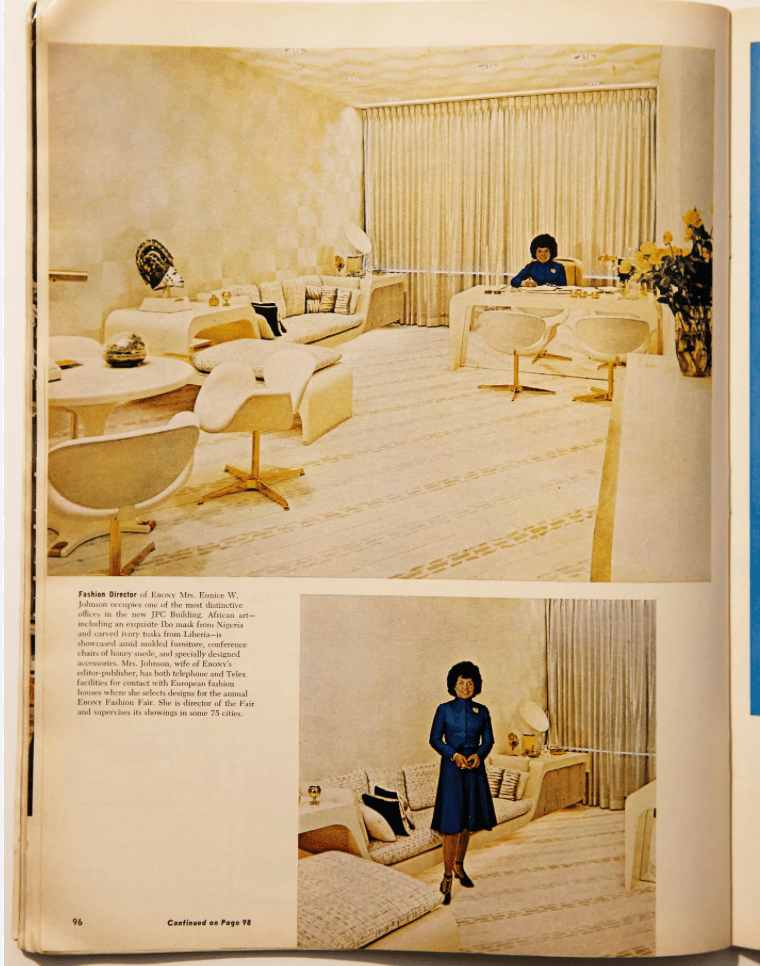
That edition features Muhammad Ali, his then-wife Khalilah and their newborn Muhammad Ali, Jr. on the cover.
And inside, there’s an opinion piece about the racism of movie star John Wayne. How was that story pitched and discussed — and perhaps even debated internally — before its publication? We don’t necessarily know, but that’s the stuff of compelling drama.
Someone make a smart, funny, high-end series in this kind of real life setting and I’ll watch as many episodes as you make.